

With buying cycles now 40% longer than they were pre-pandemic according to Richardson Sales Performance, your old script isn’t just tired; it’s likely costing you business. It’s completely normal to feel that knot in your stomach before a call, fearing you’ll sound like a robotic cliché or lose a prospect’s interest in under 30 seconds. You likely feel that a traditional sales pitch strategy is too aggressive for your personality, and you’re right to be cautious. Most entrepreneurs want to build genuine connections but feel trapped by high-pressure tactics that don’t fit who they are.
You’re about to learn how to build a personality-driven framework that eliminates sales anxiety and lets you sell with absolute confidence. I’ll show you how to stop being pushy and start being a trusted partner, even in a market where 90% of consumers have already researched your solution before they pick up the phone (Zendesk, Jan 2026). We’ll walk through a repeatable, "out of the box" system for handling objections naturally and structuring conversations that prioritise the prospect’s problems over your product’s features.
Key Takeaways
- Discover why a successful sales pitch strategy must move from broadcasting features to a consultative conversation that’s focused on solving specific problems.
- Learn the “USP” five-part framework to structure your meetings, starting with a powerful hook that validates the prospect’s situation within the first 30 seconds.
- Explore how personality-based selling removes the need for rigid scripts, so you don’t feel robotic and can build genuine professional relationships.
- Find out how to localise your core message for a worldwide audience by adjusting your tone and directness to match different regional business cultures.
- Move beyond theory and begin practising “out of the box” techniques that turn every conversation into an opportunity for authentic connection and higher conversion.
Table of Contents
-
What is a Sales Pitch Strategy and Why Does it Matter in 2026?
-
Localising Your Global Pitch: Strategies for Worldwide Success
What is a Sales Pitch Strategy and Why Does it Matter in 2026?
A sales pitch strategy is the deliberate organisation of your value proposition to solve a specific problem for your prospect. It isn’t a rehearsed monologue or a rigid set of slides designed to badger someone into submission. Instead, it’s a tactical map that guides a conversation toward a mutually beneficial outcome. Whilst many beginners view a pitch as a performance, professionals understand it’s a consultative process. Citing a foundational look at What is a Sales Pitch helps us see that while the core elements of presenting value remain constant, the execution must evolve to meet modern buyer expectations.
In 2026, the "broadcasting" model of selling is effectively dead. With 90% of consumers conducting deep online research before ever speaking to a human (Zendesk, Jan 2026), your prospects don’t need you to tell them what your product does. They need you to explain why it matters to their specific situation. This shift from broadcaster to consultant requires a robust strategy that prioritises the buyer’s experience over your own internal metrics. When you have a clear plan, you stop "winging it", which is the single greatest cause of sales anxiety. A strategy provides the structural foundation that allows your true personality to shine through without the fear of forgetting a key point or losing control of the room.
At the heart of any successful approach is self-belief. You cannot convince a prospect to invest in your solution if you haven’t first invested in the belief that you are providing genuine value. This isn’t about arrogance; it’s about the quiet confidence that comes from knowing your process is designed to help, not just to take. By mastering a repeatable framework like the Ultimate Sales Professional programme, you replace nervous energy with clinical precision.
The Evolution of Pitching: From Scripts to Solutions
Traditional, high-pressure scripts feel clinical and cold. They fail amongst modern buyers because they ignore the human element of the transaction. Personality-based selling is your greatest competitive advantage in a market saturated by AI-generated outreach. It requires you to have empathy for the prospect’s "entry state"—the specific emotional and professional place they’re in when they first engage with you. If you can validate their current struggle within the first 30 seconds, you earn the right to propose a solution.
The Financial Impact of a Structured Approach
A clear strategy does more than just boost your confidence; it directly impacts your bottom line. Salesforce reported in February 2026 that representatives spend roughly 60% of their time on tasks other than selling. A structured pitch reduces this friction by shortening the sales cycle, which has grown 30-40% longer since the pandemic. For entrepreneurs, mastering this is the only way to move from "founder-led" sales to a scalable, predictable revenue engine. When your pitch is consistent, your growth becomes predictable.
The 5-Part Framework for a High-Conversion Sales Pitch
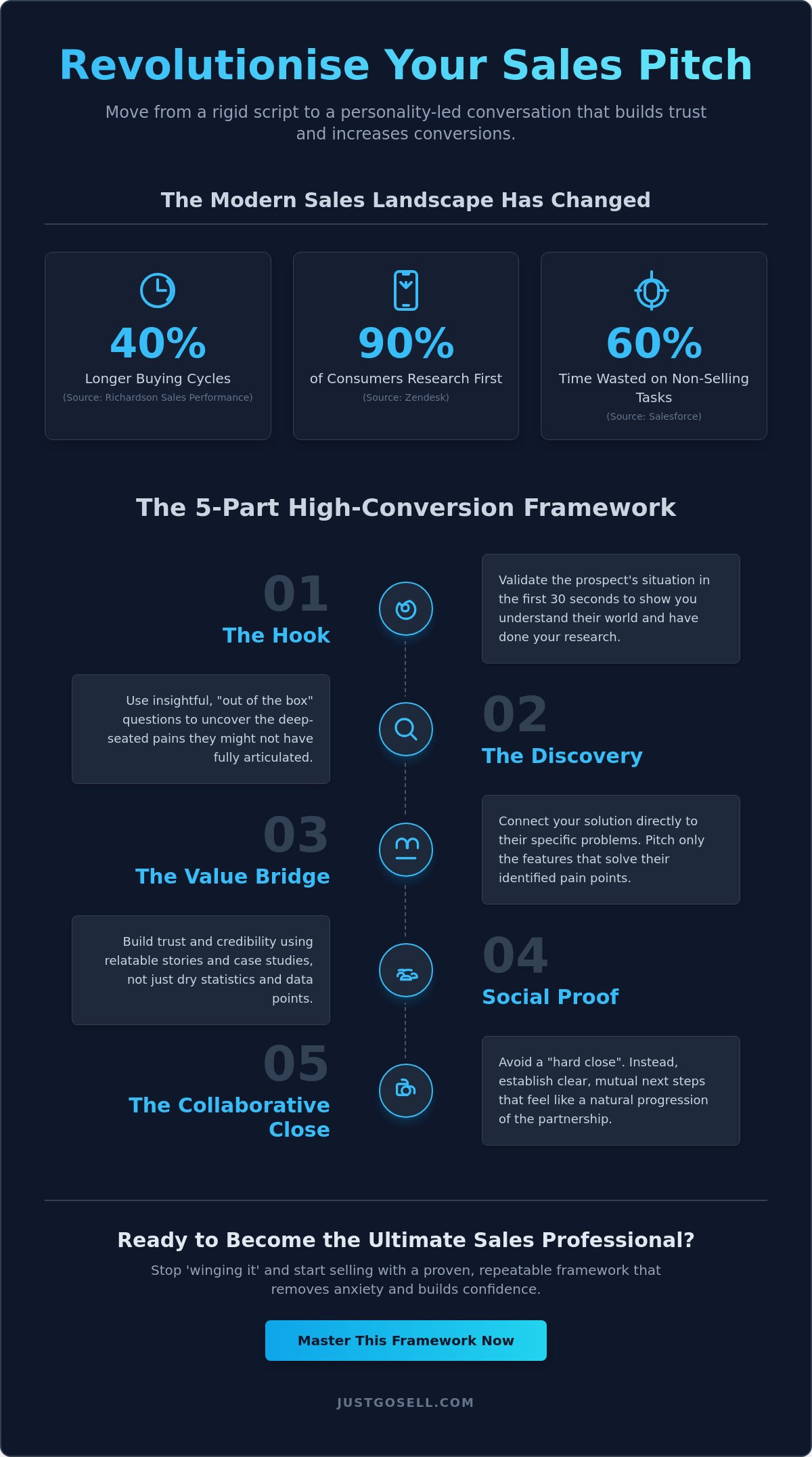
Building a successful sales pitch strategy isn’t about memorising a monologue; it’s about mastering a flexible framework that adapts to the human across from you. At Just Go Sell, we teach the "USP" (Ultimate Sales Professional) approach. This system moves you away from high-pressure tactics and toward a conversation that feels natural and supportive. By following these five steps, you can eliminate the "winging it" habit that leads to rejection and anxiety.
-
Step 1: The Hook – You must validate their current situation immediately. This shows you’ve done your homework and understand their specific world.
-
Step 2: The Discovery – Use "out of the box" questions to uncover the pains they haven’t even admitted to themselves yet.
-
Step 3: The Value Bridge – This is where you link your solution specifically to the problems they just identified. Don’t pitch every feature; only pitch the ones that solve their pain.
-
Step 4: Social Proof – People buy from people. Use relatable stories rather than just dry statistics to build trust and credibility.
-
Step 5: The Collaborative Close – Instead of a "hard close", set clear next steps whilst maintaining the relationship. It should feel like a natural progression, not a trap.
If you’re finding it difficult to move from a scripted approach to a personality-led one, you might benefit from speaking with a mentor who can help you find your voice.
Crafting Your Hook: The First 30 Seconds
The first 30 seconds of your conversation determine whether the prospect leans in or checks their email. Avoid the robotic introduction where you list your company’s history. Instead, use a template that challenges their current state. Try something like: "I noticed your team is currently navigating the new FCC ‘one-to-one consent’ rules that went live in January 2026. Many leaders I speak with are worried about how this affects their lead flow. Is that a priority for you right now?" This establishes immediate authority and shows you’re a specialist, not a solicitor.
Discovery: The Art of Listening Over Talking
The best "pitching" happens when you aren’t talking. Salesforce data from February 2026 shows that the most successful sales professionals spend significantly more time listening than their lower-performing peers. Your goal is to uncover the "pain behind the pain". Try these tactical questions:
-
"What happens to your department’s productivity if this friction isn’t resolved by next quarter?"
-
"How is this specific challenge affecting your team’s morale on a daily basis?"
-
"If you could change just one thing about your current process, what would it be and why?"
Use active listening to tailor your value proposition in real-time. If they mention morale, your pitch should focus on ease of use. If they mention productivity, focus on time-saving automation. This level of tailoring is what makes your sales pitch strategy truly "out of the box" and highly effective. To go even deeper on this skill, explore these proven sales discovery call tips that transform awkward interrogations into high-value diagnostic conversations.
Personality-Led Selling vs. The Rigid Sales Script
The clinical approach to selling assumes that if you say the right words in the right order, the prospect will buy. It’s a robotic, one-size-fits-all model that treats humans like algorithms. At Just Go Sell, we believe your sales pitch strategy should be a reflection of your personality, not a mask that hides it. When entrepreneurs try to force themselves into a rigid script, it triggers intense sales anxiety. You’re so worried about getting the next word right that you stop listening to the human being in front of you. This disconnect is exactly why 57% of sales professionals reported in February 2026 that the sales cycle is getting longer (Salesforce).
The "out of the box" method is about adapting the core strategy to suit your natural communication style. If you’re naturally analytical, lead with data; if you’re energetic, let that enthusiasm drive the conversation. Authenticity isn’t just a buzzword; it’s the most effective tool you have for overcoming the "skeptical buyer" objection. In a world where 90% of consumers conduct online research before buying, they don’t need a walking brochure. They need a human they can trust. When you show up as yourself, you build that trust instantly.
Why Scripts Fail (And What to Use Instead)
Prospects can smell a script from a mile away. It creates an "uncanny valley" effect where you sound almost human, but not quite. This immediately puts people on the defensive. Instead of full sentences, use bulleted talking points to maintain a natural rhythm. You shouldn’t memorise a speech; you should internalise your strategy until it feels like telling your favourite story. This gives you the freedom to be present whilst staying on track. It allows you to react to the prospect’s behaviour in real-time, which is essential when 45.5% of businesses now prioritise customer experience over pricing (Zendesk, Jan 2026).
Handling Objections Without Losing Your Cool
Many beginners see an objection as a personal rejection. It isn’t. It’s actually a request for more information. If a prospect says "it’s too expensive", they’re often saying "I don’t see the value yet". The "Feel-Felt-Found" technique is particularly effective because it’s empathetic rather than aggressive. You might say, "I understand how you feel; many of our clients felt the same way initially, but what they found was that the productivity gains far outweighed the investment." Objection handling is a collaborative problem-solving exercise.
Localising Your Global Pitch: Strategies for Worldwide Success
Your sales pitch strategy needs to be as adaptable as the markets you serve. In 2026, digital borders are practically non-existent, yet cultural boundaries remain very real. Gartner predicts that 80% of B2B sales interactions will happen through digital channels this year, meaning your pitch will likely reach prospects across multiple continents from a single home office. Success depends on your ability to balance "Universal Value", the core problem your product solves, with "Local Context", the specific way that problem manifests in different regions.
Whilst your primary value proposition might remain the same, the delivery must shift. A pitch that works in London might feel too indirect in New York, or too aggressive in Tokyo. You aren’t just selling a product; you’re navigating a social contract. Mastering this nuance is what separates a generic salesperson from a trusted partner who understands the global landscape. When you tailor your approach, you show the prospect that you respect their time and their culture.
Navigating Business Culture and Communication
Understanding the difference between high-context and low-context cultures is vital for international success. In low-context cultures like the US or Germany, prospects often value directness and efficiency. They want you to get to the point quickly. Conversely, high-context cultures in parts of Asia and the Middle East prioritise building the relationship before discussing business details. If you rush the pitch, you risk appearing untrustworthy or even rude.
There is also a delicate balance between traditional British English politeness and the need for global efficiency. Whilst a polite "soften" can build rapport, being too indirect can lead to confusion in a fast-paced digital environment. If you’re struggling to adapt your voice for different territories, personalised sales coaching can provide the "out of the box" feedback you need to refine your international delivery and boost your confidence.
Virtual Pitching: Mastering the Digital Stage
The distance barrier is a psychological hurdle that can trigger sales anxiety. When you’re pitching through a screen, you lose many of the non-verbal cues found in face-to-face meetings. To overcome this, you must be more intentional with your energy. Use digital whiteboarding or collaborative templates to keep prospects engaged. This turns a passive presentation into an active, shared experience. It’s about moving from "presenting at" them to "problem-solving with" them.
Clinical productivity is your best friend when managing global accounts across time zones. Since sales professionals still spend approximately 60% of their time on tasks other than selling (Salesforce, Feb 2026), you can’t afford to let follow-ups slip. Proactive, structured communication ensures that the momentum of your pitch isn’t lost in the digital void. If you want to ensure your global strategy is converting at its highest potential, contact us today to discuss a tailored approach for your team.

Becoming the Ultimate Sales Professional
Mastering your sales pitch strategy is a transformative milestone, but it is only one pillar of your journey toward commercial mastery. True success in 2026 requires more than a single great conversation; it demands a comprehensive foundation of self-belief and tactical skill. This is why we created the Ultimate Sales Professional course. It’s designed to take the "out of the box" techniques you’ve learned here and weave them into a repeatable system that produces predictable revenue whilst protecting your mental well-being.
The Just Go Sell philosophy is simple: sales isn’t about being the loudest person in the room or memorising the most clever rebuttals. It’s about loyalty to your prospects, a commitment to hard work, and the courage to find your own voice. When you stop trying to be a "salesperson" and start being yourself, you eliminate the friction that causes sales anxiety. If you have a solid foundation and a genuine desire to help others, then financial success becomes an inevitable byproduct of your daily actions.
The Mentor-Led Path to Mastery
Fragmented internet advice often leads to more confusion than clarity. You might find a tip on LinkedIn today that contradicts a video you watched yesterday, leaving you more anxious than when you started. This "information overload" is why having a Trusted Partner like myself (Colin Knowles) is so vital. Through 1-to-1 sales coaching, you receive clinical, personalised feedback that addresses your specific hurdles. We’ve seen this tailored approach fix a broken pitch strategy in just a few weeks, saving entrepreneurs from years of trial-and-error frustration.
Your Next Steps: From Anxiety to Action
The transition from learning to doing is where most people stall. Don’t let this be another article you read and forget. If you want to see a change in your conversion rates, you must take immediate, imperfect action. Confidence isn’t something you wait for; it’s something you build through consistent practice. Start with this simple checklist today to refine your approach:
-
Review your current pitch: Record yourself or read your notes aloud to identify any phrases that feel forced or "salesy".
-
Remove the script: Pick one area where you usually follow a rigid script and delete it. Replace those lines with a few bulleted talking points instead.
-
Add a discovery question: Insert a specific "out of the box" question into your next call that asks about the prospect’s emotional pain, not just their technical requirements.
You have the potential to be a game-changing force in your industry. By prioritising the human connection and refining your tactical process, you’ll move from a state of uncertainty to a state of absolute confidence. If you’re ready to stop winging it and start winning, join the Ultimate Sales Professional program today and let’s build your future together.
Ready to Own Your Sales Future?
You now have the framework to move from a state of "winging it" to a state of absolute clinical precision. By ditching rigid scripts for a personality-driven sales pitch strategy, you’ve learned how to validate prospects within 30 seconds and handle objections as collaborative partners. We’ve seen that in 2026, whilst 45.5% of businesses prioritise customer experience over price (Zendesk, Jan 2026), your ability to be human is your greatest tactical advantage.
Success isn’t about being pushy; it’s about having the right foundation. This includes having your core strategy documented; using a platform like GrowthGrid allows you to generate the strategic business plans and essential documents needed to support a scaling operation. Founded by myself, (Colin Knowles), Just Go Sell specialises in helping you overcome sales anxiety through tailored, "out of the box" coaching methods that actually work in the real world. You don’t have to navigate this alone or settle for fragmented internet advice that only adds to your confusion. It’s time to find your voice and turn every conversation into a predictable revenue opportunity.
Take the next step toward financial success and professional mastery. Master your pitch with The Ultimate Sales Professional today. It’s time to stop letting fear hold you back and start selling with the confidence you deserve.
Frequently Asked Questions
How do I create a sales pitch strategy if I hate selling?
You create a strategy by reframing the interaction as a consultative problem-solving session rather than a transaction. Focus on your natural strengths and your genuine desire to help the prospect resolve their specific challenges. When you prioritise helping over pitching, the anxiety of "selling" disappears. This approach allows you to stay authentic whilst following a structured path that leads to a natural, pressure-free conclusion for both parties.
What is the ideal length for a sales pitch in 2026?
The initial hook should take no more than 30 seconds to earn the prospect’s attention in a crowded digital landscape. Whilst the entire meeting might last 30 minutes, your actual "pitch" or value bridge should be delivered in under 5 minutes. This ensures you leave ample time for the discovery phase and collaborative problem-solving, which are the elements that actually drive conversions in the current market.
Can I use a sales pitch strategy for cold calling and emails?
Yes, a robust sales pitch strategy is essential across all outreach channels, including cold calls and digital messaging. The core framework remains the same: you must lead with a relevant hook that validates their current struggle and follow with a clear value proposition. For emails, this means a punchy subject line and a first sentence that proves you’ve done your homework, rather than using a generic template that prospects will ignore.
How do I handle the "your price is too high" objection during a pitch?
You handle this by immediately shifting the focus from the cost of your service to the cost of inaction. Ask the prospect what it will cost their business in lost productivity or missed revenue if the problem remains unsolved for another six months. By quantifying the pain they identified during the discovery phase, you bridge the value gap and show that your solution is a necessary investment rather than a luxury expense.
Is it better to use a slide deck or just have a conversation?
A conversation is almost always superior for building genuine trust and rapport with modern buyers. Whilst a slide deck can provide a visual aid, it often acts as a barrier that forces you into a rigid, robotic rhythm. By ditching the deck, you can maintain eye contact and react to the prospect’s behaviour in real-time. This "out of the box" approach keeps the focus on the human connection rather than a screen.
What happens if I forget my pitch strategy halfway through a meeting?
If you lose your place, simply stop talking and ask a thoughtful sales discovery call question. Returning to the listening phase gives you a moment to breathe whilst keeping the prospect engaged. You might say, "Before we go further, I want to make sure I’ve fully understood how this specific challenge is impacting your daily operations." This allows you to reset your thoughts whilst gathering more valuable information to tailor your final proposal.
How often should I update my sales pitch strategy?
You should review your strategy at least once per quarter to ensure it aligns with shifting market regulations and buyer behaviours. For example, the FCC "one-to-one consent" rules that became effective in January 2026 required many businesses to completely overhaul their outreach messaging. Staying current ensures your hooks remain relevant and your solutions address the most pressing challenges your prospects face today.
Does a sales pitch strategy work for B2B and B2C sales?
The framework is highly effective for both B2B and B2C environments because the underlying psychology of decision-making is identical. Whether you’re selling enterprise software to a CEO or a premium garden wellness solution from Simply Saunas to a homeowner, the prospect needs to feel understood and confident in your solution. A personality-based sales pitch strategy ensures you build that trust regardless of the industry or the complexity of the product you’re offering.


Article by
Colin Knowles
Sales Growth Consultant | Sales Director | Author | Founder: JustGoSell. With an extensive background in corporate sales training and team leadership, my role as Sales Trainer and Director at Just Go S.L. revolves around empowering sales professionals to excel. My approach has consistently fostered environments where sales teams surpass targets, thanks in part to my focus on effective sales processes and direct sales techniques. At the core of my professional ethos lies the commitment to continual development and adaptation of sales strategies to stay ahead in a dynamic market. Through one-to-one coaching, group webinars, and the authorship of "JustGoSell," I have solidified my reputation as a catalyst for transformative sales results and an advocate for sustained sales skill advancement.