

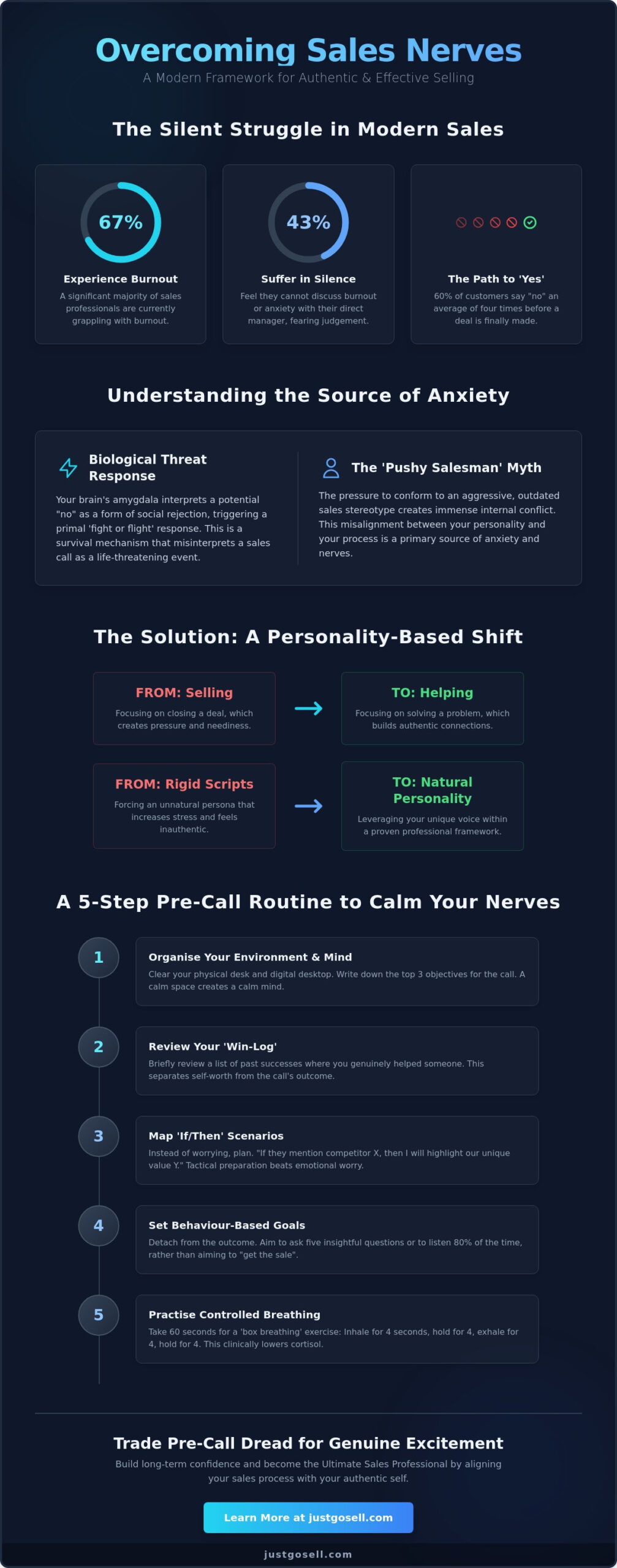
Did you know that 67% of sales professionals are currently experiencing burnout, yet 43% of them feel they can’t even mention it to their manager? If you find yourself dealing with a racing heart, sweaty palms, or a sudden mental fog before a call, you’re part of a silent majority. Overcoming sales nerves isn’t about forcing yourself to be an aggressive, high-pressure extrovert. It’s about realising that your anxiety often stems from a misalignment between your natural personality and a rigid, outdated sales process.
We understand that the fear of being seen as pushy is real, especially whilst 60% of buyers say no four times before a deal is finally done. You want to be a Trusted Partner, not a nuisance. This guide promises to help you trade that pre-call dread for genuine excitement by using out of the box, personality-based strategies that help you become the Ultimate Sales Professional in 2026. We will walk through clinical techniques to calm your nervous system, tactical ways to handle rejection, and a framework for closing deals that feels entirely authentic to who you are.
Key Takeaways
- Understand why your brain treats a “no” as a survival threat and learn how to reframe this biological response to remain calm under pressure.
- Discover the “out of the box” secret to overcoming sales nerves by tailoring your approach to your natural personality instead of a rigid script.
- Learn to lower your cortisol levels instantly with a clinical five-step pre-presentation routine designed to organise your mind and environment.
- Shift your focus from “selling” to “helping” to neutralise anxiety and build authentic connections through active listening.
- Build long-term confidence as a dynamic muscle by using tactical repetition and professional feedback to refine your sales process.
The Psychology of Sales Anxiety: Why Your Brain Fears the ‘No’
Your brain is remarkably efficient at keeping you safe, but it’s often terrible at distinguishing between a genuine physical threat and a cold prospect on a Zoom call. When you feel that familiar knot in your stomach, it’s actually your amygdala taking the lead. This part of the brain is responsible for the "fight or flight" response; it perceives a potential "no" as a form of social exclusion. For our ancestors, being cast out from the group was a survival crisis, so your biology reacts to a rejected pitch as if it were a life-threatening event.
Feeling these jitters doesn’t mean you aren’t cut out for business. In fact, these nerves are a sign that you actually care about the value you’re providing to your clients. Even the most successful graduates of the Ultimate Sales Professional programme started their journey with these exact same physical symptoms. The secret to overcoming sales nerves isn’t to delete your emotions, but to understand the clinical reality of what’s happening in your head.
Understanding the Fear of Rejection amongst Beginners
For someone just starting out, a lost deal often feels like a personal indictment of their social standing. This biological hurdle is widespread; research indicates that approximately 30% of people experience some form of performance anxiety when speaking or pitching to others. There’s a clear line between "normal" excitement before a call and debilitating sales anxiety that prevents you from picking up the phone. Sales anxiety is a manageable physiological state rather than a permanent personality trait. Once you realise that a "no" is just data rather than a rejection of your character, the physical symptoms begin to fade.
The ‘Pushy Salesman’ Myth and Its Impact on Nerves
Many ethical entrepreneurs struggle with selling because they’re haunted by the "boiler room" stereotype. You don’t want to be the aggressive, fast-talking character from a dated film, so you hesitate. This mental block creates immense tension because you’re trying to wear a mask that doesn’t fit. When you try to sound like a "salesperson," your stress levels spike because you’re acting against your true nature. Overcoming sales nerves becomes much easier when you align your selling style with your actual personality. You’ll find that being a "Trusted Partner" is far more effective than being a high-pressure closer, and it’s much kinder to your nervous system too.
‘Out of the Box’ Mindset Shifts to Neutralise Pre-Call Tension
Forget the common advice to just "make more calls" until you go numb. Whilst some internet forums claim it’s merely a numbers game, this brute force method usually leads to burnout rather than mastery. Real success in overcoming sales nerves comes from an "out of the box" approach where you don’t need to adopt a fake, aggressive persona. Instead, you should embrace personality-based selling. This means your sales process should suit who you are as an individual, allowing you to speak with your unique voice whilst following a proven professional foundation.
Clinical preparation beats emotional worrying every time. When you’re nervous, your mind tends to spiral into "what if" scenarios that focus on failure. You can flip this by using tactical "if/then" logic. If the prospect mentions a competitor, then you have a specific, pre-prepared response ready. If they ask about a feature you don’t have, then you know exactly how to pivot to the value you do provide. By mapping out these paths, you remove the terrifying unknowns that fuel your anxiety.
The Power of Self-Belief in Your Selling Ability
Building confidence starts with a mental "win-log". This is a list of past successes where you solved a problem or helped someone, even if it wasn’t in a sales context. It’s vital to separate your self-worth from the outcome of a single discovery call. A "no" isn’t a rejection of you; it’s often just a sign of bad timing or a poor fit. Many entrepreneurs find that the Ultimate Sales Professional course provides the structured foundation needed to build this belief system from the ground up.
Tactical Detachment: Focusing on Process over Results
The fastest way to trigger intense nerves is to "need" the sale. When you’re desperate for a signature, your prospect senses the pressure, and your anxiety spikes. To counter this, set behaviour-based goals for your day. Instead of aiming for a specific financial target, aim to ask five deep-dive questions or to follow your process perfectly on three calls. This shift allows you to focus on helping, not being liked, which is a far more stable mental position. When you adopt a "Curiosity Mindset," every call becomes a research project rather than a high-stakes pitch. If you’re looking for a partner to help you implement these shifts, speak with us about your sales strategy today.
Reframing the Pitch: Helping vs Selling
Traditional sales models often feel like a battle of wits. You try to push; they try to resist. This adversarial dynamic is a primary trigger for sales anxiety because it places you in direct conflict with your prospect. In 2026, with 57% of sales professionals reporting that sales cycles are becoming longer and more complex, the high-pressure approach is increasingly ineffective. Overcoming sales nerves requires a shift to a "Helpful Consultant" mindset. Instead of worrying about how you are perceived, you focus entirely on the prospect’s challenges. By positioning yourself as a "Trusted Partner," you move from being a vendor to being a mentor. This "out of the box" transition reduces your own anxiety because your brain stops prioritising self-protection and starts prioritising problem-solving.
Adopting a mentor-like approach allows you to lead with value. When you teach your prospect something new about their own industry or challenges, you establish authority without needing to be "salesy." This naturally builds the self-belief required to handle larger buying committees, which now often include 8-13 stakeholders. If you feel your foundation is shaky, the Ultimate Sales Professional programme provides the tactical framework to make this mindset shift permanent.
The Discovery Call as a Service
You should view every discovery call as a diagnostic service rather than a pitch. Your primary goal isn’t to force a solution; it’s to determine if a genuine fit exists. When you start a conversation by openly asking, "Is this a fit for both of us?", the pressure immediately evaporates for everyone involved. This allows you to use "out of the box" questions that lead the conversation naturally. You aren’t interrogating the prospect; you’re helping them uncover the root cause of their pain. This transparency is the most effective way of overcoming sales nerves because it removes the fear of the unknown.
Active Listening to Calm the Mind
The science of active listening is your greatest ally. When you focus intensely on the other person’s words, your brain’s "self-consciousness" loop is bypassed. You stop worrying about your racing heart or what you’ll say next because your cognitive resources are fully engaged in understanding the prospect. Use clinical note-taking to keep your mind anchored and focused on the facts. It’s also vital to embrace silence as a tactical tool. You don’t need to fill every gap in the conversation. Whilst a novice might rush to speak out of nervousness, a professional knows that silence gives the prospect space to share deeper, more valuable insights. This calm, measured behaviour signals true confidence.
A 5-Step Pre-Presentation Routine to Calm Your Nerves
Preparation is the foundation of self-belief. Whilst many people assume that overcoming sales nerves is about having a "thick skin," it’s actually about creating a repeatable routine that signals safety to your brain. When you have a clinical process to follow, you stop leaving your performance to chance. This five-step routine is designed to move you from a state of high cortisol to a state of tactical readiness in under ten minutes.
- Step 1: Physical Reset. Use "power poses" to occupy more space and practice controlled box breathing (inhale for four seconds, hold for four, exhale for four, hold for four). This physically lowers your cortisol levels.
- Step 2: Environmental Audit. Clear your physical space. A cluttered desk creates subtle mental distractions that increase your baseline anxiety.
- Step 3: The ‘First 60 Seconds’ Focus. Master your opening lines until they’re second nature. This allows you to cruise on autopilot during the highest-anxiety period of the call.
- Step 4: Objective Visualisation. Spend two minutes seeing the call go smoothly. Don’t imagine a perfect "yes" every time; instead, visualise yourself handling a difficult question with calm, professional poise.
- Step 5: The ‘Help’ Affirmation. Remind yourself of the specific value you provide. You aren’t there to take their money; you’re there to solve a problem that is costing them time or productivity.
Organising Your Workspace for Success
A cluttered desk leads to a cluttered, anxious mind. You should ensure that your essential resources are within arm’s reach before the call starts. This includes your personality-based script, a list of frequently asked questions, and a glass of water. There’s also a significant debate regarding standing versus sitting. Many professionals find that standing during a pitch increases their lung capacity and energy levels, making them feel more dynamic. If you feel small or timid whilst sitting, try standing up to instantly boost your presence.
Mastering the Opening Minute
The first 60 seconds are the highest-anxiety period of any sales interaction because you’re navigating the transition from social comfort to business professional. Overcoming sales nerves during this window requires a script that feels natural to you. Avoid the "boiler room" templates and use an intro that matches your unique voice. Use the "Small Talk" bridge to find a point of genuine connection before pivoting to the agenda. This transition should feel like a natural extension of the conversation rather than a sudden, jarring shift into "sales mode." If you want to refine your personal pitch, book a consultation with me to build a custom strategy.

Moving Beyond Fear: Building a Foundation for Consistent Results
Confidence isn’t a fixed personality trait; it’s a dynamic muscle developed through tactical repetition. In a year where only 43.5% of sales representatives are achieving their quotas (RepVue Cloud Sales Index data), the ability to maintain composure is a significant competitive advantage. Overcoming sales nerves requires you to stop guessing why a call went poorly and start using clinical feedback to refine your performance. Without objective analysis, your brain will naturally fill the gaps with self-doubt and anxiety, making every "no" feel like a personal failure rather than a data point.
Embracing a mentor-led approach is the fastest way to remove the mystery of failure. When you stop "going it alone," you can identify the specific anxiety triggers that cause you to freeze or ramble. This transition allows you to move beyond the psychological hurdles of the amygdala and into a state of professional mastery. By building a foundation based on your unique voice, you turn the sales process from a source of dread into a predictable, manageable system for financial success.
The Role of Personalised Sales Coaching
Generic training often fails because it tries to force every entrepreneur into the same aggressive mould. 1-to-1 sales coaching solves this by tailoring the entire sales process to your specific personality. Understanding the different sales coaching types available for business growth can help you choose the right support structure that matches your learning style and goals. We use out of the box methods to role-play difficult scenarios in a safe, supportive environment. This practice allows you to test different responses to objections without any financial risk. As you master these interactions, you’ll find yourself moving from simply "surviving" your calls to actually thriving whilst you build genuine connections with your prospects.
Your Next Steps to Sales Mastery
Ready to say goodbye to sales anxiety? Get in touch today to discover how we can help you find your voice and close deals with authentic confidence.
Start Your Journey to Authentic Sales Confidence
Your journey from pre-call dread to professional mastery begins with a single shift in perspective. You’ve learned that sales anxiety is a biological "fight or flight" response, not a permanent part of your character. By implementing a clinical pre-call routine and reframing your pitch as a service, you can bypass the amygdala and lead with your true personality. Overcoming sales nerves isn’t about becoming someone else; it’s about finding a foundation that supports who you already are, and for many, this involves the nervous-system work and embodiment techniques championed by Lea Clothier.
Founded by myself (Colin Knowles), Just Go Sell specialises in this "out of the box" approach to help you find your unique voice. Through the Ultimate Sales Professional framework, we help you trade high-pressure tactics for authentic, personality-based connection. You don’t need to go it alone or settle for fragmented advice that doesn’t fit your specific business goals.
Book a consultation to overcome your sales anxiety and start closing with confidence. You possess the expertise to solve your clients’ problems; now it’s time to build the foundation that lets you share that value with total poise.
Frequently Asked Questions
How can I stop my voice from shaking during a sales pitch?
A shaking voice is usually caused by shallow chest breathing that restricts your vocal cords. To fix this instantly, focus on speaking from your diaphragm and consciously lowering your speaking volume slightly. This clinical adjustment forces you to regulate your breath, which provides a steadier stream of air and naturally stabilises your tone within the first 30 seconds of the conversation.
Is it normal to feel sick before making a cold call?
Nausea is a very common physical manifestation of adrenaline and is experienced by many entrepreneurs starting their journey. Your body is simply preparing for a high-stakes event by diverting blood flow away from your digestive system. Recognising this as "performance energy" rather than a sign of failure is a vital step in overcoming sales nerves and building long-term resilience.
Can an introvert really be successful in sales without changing their personality?
Introverts often become the most successful sales professionals because they possess a natural talent for active listening and empathy. You don’t need to adopt a loud, extroverted persona to close deals. By using personality-based selling, you can leverage your quiet authority to build deeper trust with prospects who are often tired of the traditional, high-pressure approach.
What should I do if a prospect is being aggressive or rude?
Remain calm and remember that their behaviour is a reflection of their own stress or schedule, not your value. If a prospect becomes unprofessional, it’s perfectly acceptable to set a firm boundary or suggest rescheduling the call for a better time. Tactical detachment allows you to stay in control of the interaction without absorbing the other person’s negative energy.
How long does it typically take to overcome sales nerves?
Most individuals see a significant reduction in anxiety within 30 to 60 days of consistent, supported practice. Whilst the initial jitters may never disappear entirely, they transform into a manageable buzz as you build a solid foundation of successful interactions. Repetition is the only way to prove to your brain that the "threat" of a sales call isn’t actually dangerous—a concept also central to high-pressure training at Sin City Krav Maga & Fitness, where students learn to maintain composure until the fear response is neutralised.
Should I use a script if I’m worried about sounding robotic?
You should use a flexible framework rather than a rigid, word-for-word script. A framework gives you the safety of knowing what to say next whilst allowing your natural personality to shine through in the delivery. This "out of the box" method ensures you hit your key tactical points without losing the authentic human connection that buyers crave in 2026.
What is the best way to handle a ‘no’ without feeling rejected?
Treat every "no" as a clinical data point that helps you refine your ideal customer profile. Statistics show that 60% of customers say "no" multiple times before agreeing to a purchase, so a single rejection is rarely the end of the road. When you stop viewing a refusal as a personal slight, overcoming sales nerves becomes a much faster and more enjoyable process.
How do I regain my confidence after a particularly bad sales call?
Conduct a brief, objective review of what went wrong and then immediately move on to a different task. Don’t dwell on the mistakes; instead, identify one tactical change you can make for the next call. Physical movement, such as a five-minute walk, can also help reset your nervous system and prevent a single bad experience from spiralling into a day-long slump.


Article by
Colin Knowles
Sales Growth Consultant | Sales Director | Author | Founder: JustGoSell
With an extensive background in corporate sales training and team leadership, my role as Sales Trainer and Director at Just Go S.L. revolves around empowering sales professionals to excel. My approach has consistently fostered environments where sales teams surpass targets, thanks in part to my focus on effective sales processes and direct sales techniques.
At the core of my professional ethos lies the commitment to continual development and adaptation of sales strategies to stay ahead in a dynamic market. Through one-on-one coaching, group webinars, and the authorship of "JustGoSell," I have solidified my reputation as a catalyst for transformative sales results and an advocate for sustained sales skill advancement.