

What if the reason your sales are stalling isn’t because you’re a bad communicator, but because you’re trying to follow a script that simply doesn’t fit? Many entrepreneurs struggle with inconsistent monthly revenue because they’ve been told to use rigid, aggressive tactics that clash with their natural character. If you’re tired of that "dodgy car salesman" feeling and seeing leads vanish after a discovery call, it’s time to learn how to fix a broken sales process by aligning your strategy with who you actually are.
You likely started your business to make a difference, not to spend your days feeling anxious about the next "no" or chasing prospects who never respond. It’s a common frustration, and you’re certainly not alone in wanting a more professional, supportive way to grow. This guide will show you how to identify structural leaks in your funnel and rebuild a system that feels authentic and reduces performance stress. We’ll look at the steps to becoming an Ultimate Sales Professional, helping you secure predictable revenue and approach every conversation with genuine confidence.
Key Takeaways
- Recognise the red flags of a failing funnel, including the dreaded “let me think about it” response, and learn how to identify structural leaks before they drain your revenue.
- Understand why overcomplicating your sales journey with enterprise-level tactics often creates friction and how to streamline your stages for maximum clarity.
- Discover exactly how to fix a broken sales process by setting “hard” exit criteria that ensure you only move forward with prospects who are truly committed.
- Master the “Pressure Test” to pinpoint exactly where leads are dropping off, allowing you to rebuild a system that feels authentic rather than “salesy”.
- Learn the path to becoming an Ultimate Sales Professional by creating a repeatable system that aligns with your personality and delivers predictable growth.
Is Your Sales Process Truly Broken? Identifying the Red Flags
It’s a deeply frustrating feeling when you’re putting in the hours, yet your bank balance doesn’t reflect the effort. A broken sales process isn’t just a minor glitch; it’s a structural failure that prevents prospects from making a clear decision. Think of it like a leaky bucket. You might be pouring high-quality leads in at the top, but they’re vanishing through gaps in your system before you even get to the pitch. If you’re wondering how to fix a broken sales process, the first step is to stop looking at your marketing and start looking at your internal structure.
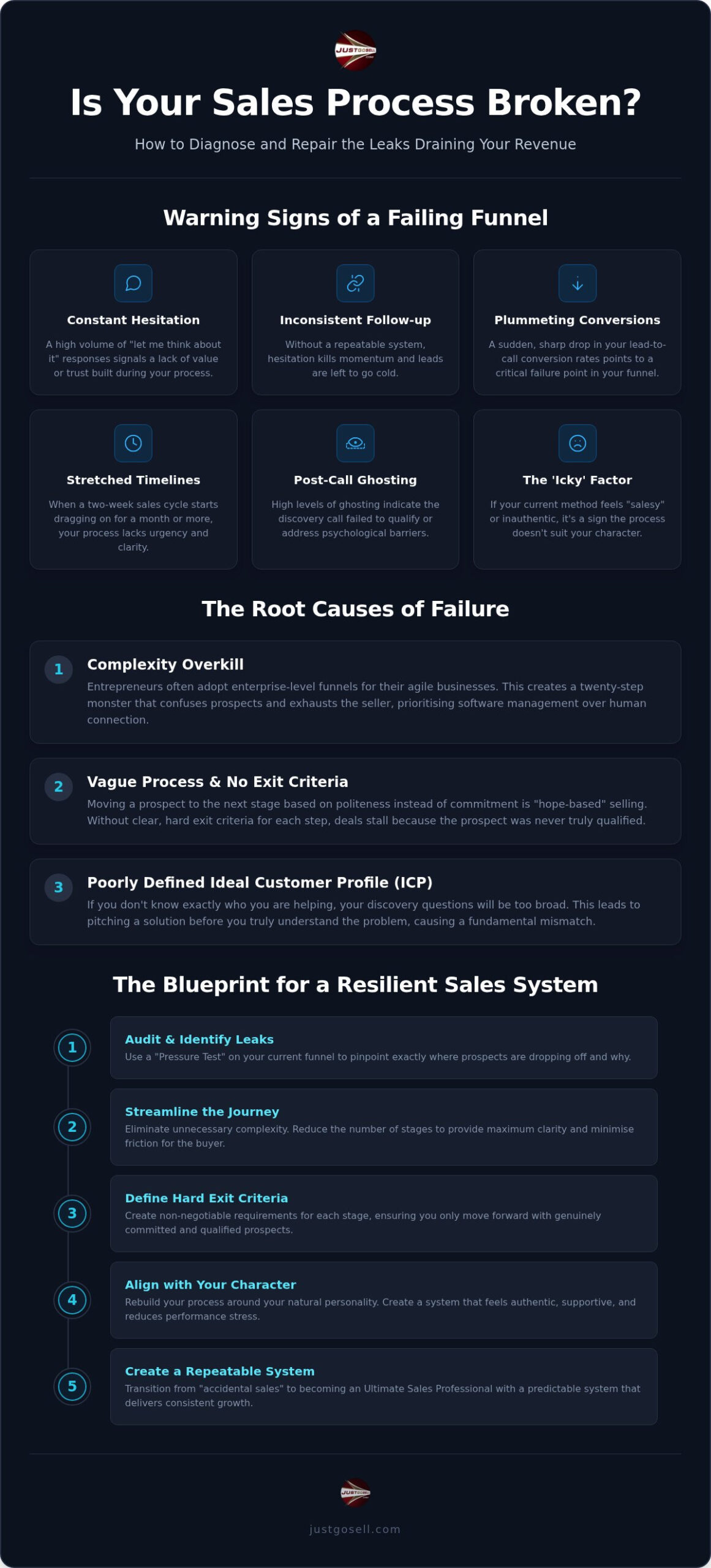
In the world of Sales Process Engineering, every step should serve a specific purpose. When your system fails, you’ll notice a high volume of "let me think about it" responses. This isn’t usually a price objection. It’s a sign that your process didn’t build enough value or trust to warrant a "yes". Inconsistent follow-up is often the most glaring indicator of failure. If you don’t have a repeatable system to guide your next move, you’ll naturally hesitate, and that hesitation kills momentum.
Inconsistency is a silent killer. When you lack a defined path, you end up treating every lead as a brand-new experiment. This creates a massive mental load. You aren’t just selling; you’re trying to invent a new way to sell every single day. This exhaustion leads to the "Leaky Bucket" syndrome, where leads simply go cold because you don’t have the energy or the system to keep them engaged. Identifying these signs early is the only way to understand how to fix a broken sales process before it costs you even more in lost opportunities.
The Quantitative Signs: When the Numbers Lie
Data doesn’t have feelings, but it tells a story. You might notice your lead-to-call conversion rates have suddenly plummeted. Perhaps your sales cycle, which used to take two weeks, is now dragging on for a month or more. High levels of "ghosting" after a discovery call are particularly telling. It usually means your initial conversation didn’t qualify the prospect properly or failed to address their specific psychological barriers.
The Qualitative Signs: The "Icky" Factor
How you feel during a call matters just as much as the numbers. Do you feel like you’re winging it every time you pick up the phone? That lack of structure leads to performance stress. You might find yourself dreading the moment you have to mention your pricing, or worrying that you sound like a robot reading a script. True mastery comes from a foundation that allows your personality to shine. If your current method feels "icky", it’s a sign that the process doesn’t suit your character. Moving toward becoming an Ultimate Sales Professional starts with choosing a more authentic path.
The Root Causes: Why Sales Processes Fail in 2026
Understanding why your current system isn’t delivering results is the first real step in learning how to fix a broken sales process. Many entrepreneurs fall into the trap of complexity overkill. They download enterprise-level funnel templates designed for massive corporations and try to squeeze their agile business into a twenty-step monster. This doesn’t just confuse your prospects; it exhausts you. When your process is too heavy, you spend more time managing software than building genuine human connections.
Modern buyers in 2026 are more sophisticated than ever. They can smell a high-pressure, outdated closing tactic from a mile away. If your process relies on "limited-time offers" that aren’t actually limited, or aggressive follow-ups that border on harassment, you’re pushing people away. Setting Your Team Up For Success, or even just setting yourself up, requires a shift toward transparency and empathy. A failure here is often a failure of alignment between your values and your actions.
The Fragility of a Vague Process
A major cause of failure is the lack of clear exit criteria. You might move a prospect from "Discovery" to "Proposal" simply because the call went well and they were polite. Without a specific commitment or a confirmed pain point, you’re just "hoping" for a deal. This vagueness usually stems from a poorly defined Ideal Customer Profile (ICP). If you don’t know exactly who you’re helping, your discovery questions will be too broad, leading to "stage-jumping" where you pitch a solution before you truly understand the problem. This mismatch is a primary reason why so many deals stall at the final hurdle.
Mindset as a Structural Component
We often treat sales as a purely technical exercise, but your internal state is actually a structural part of the funnel. When you’re struggling with sales anxiety, it manifests as "sales breath"; a palpable sense of desperation that prospects find deeply off-putting. This anxiety often causes you to skip the difficult, crucial discovery questions because you’re afraid of hearing a "no" too early. Your mindset serves as the invisible foundation upon which all your technical sales mechanics are built. If that foundation is shaky, even the most expensive CRM won’t save the deal. If you feel like your mindset is holding your growth back, it might be time to reach out for a chat about how to realign your approach.
To truly master how to fix a broken sales process, you must bridge the gap between your technical steps and your personal confidence. By simplifying your stages and defining exactly what needs to happen before moving forward, you create a system that supports you rather than one that adds to your daily stress.
Auditing Your Current Funnel: Finding the Leaks
Before you can start rebuilding, you have to look honestly at what’s happening right now. Auditing your funnel isn’t about finding someone to blame; it’s about finding where the energy is leaking out. Start by mapping your current journey from that very first contact to the moment the contract is signed. By visualising every touchpoint, you can perform a "Pressure Test" to see where prospects most frequently drop out. Learning how to fix a broken sales process requires you to be a detective in your own business, looking for the quiet moments where momentum simply stops.
Effective Sales Process Optimization often reveals that the biggest leaks aren’t technical, but relational. A study mentioned by the Martal Group highlights how a formalised process significantly impacts revenue, yet many entrepreneurs still rely on gut feeling. To truly understand how to fix a broken sales process, you must move beyond intuition and look at the hard evidence of your interactions. It is about identifying whether your follow-up cadence is actually helpful or just another annoying notification in a prospect’s inbox.
The Discovery Call Audit
Recording your calls might feel uncomfortable at first, but it’s the most powerful tool for growth. When you listen back, pay close attention to your "Listen-to-Talk" ratio. Are you talking 80% of the time? If so, you’re presenting, not discovering. A professional discovery call should feel like a deep-dive problem-solving session, not a surface-level interrogation. You’re looking for the emotional drivers behind the purchase, not just the logical requirements. If you find yourself sticking to a script and missing subtle cues, you might benefit from Mastering the Sales Discovery Call to refine your approach and build a more natural connection.
Follow-Up and Closing Friction
Once the call ends, the momentum often stalls. Analysing your "Next Steps" language is crucial. Are you being firm, or are you using wishy-washy phrases like "I’ll leave it with you" or "Let me know what you think"? These phrases transfer the burden of the next move to the prospect, which creates anxiety and leads to ghosting. Another vital metric is your "Time-to-Proposal". If it takes you three days to send a summary, the emotional spark from the call has already faded. Checking for "Proposal Ghosting" usually reveals a lack of pre-emptive scheduling. Always book the follow-up meeting whilst you’re still on the discovery call to ensure the process keeps moving forward with purpose.

The 5-Step Repair: How to Rebuild for Consistency
Once you’ve identified the gaps, the actual work of how to fix a broken sales process begins by stripping away the clutter. You don’t need a twenty-stage pipeline that requires a PhD to manage. You need a lean, reliable system that supports your natural way of communicating. This structured repair is the most effective way to understand how to fix a broken sales process for the long term, moving you from reactive "winging it" to proactive mastery.
- Step 1: Simplify the stages. Aim for 4-5 clear milestones, such as Initial Inquiry, Discovery, Proposal, and Decision. Any more than this creates administrative friction that will tempt you to skip steps when you’re busy.
- Step 2: Define "Hard" Exit Criteria. Never move a prospect to the next stage just because the conversation was pleasant. A "hard" exit criterion might be a confirmed budget, a scheduled follow-up date, or a signed mutual action plan.
- Step 3: Develop a non-pushy script framework. This isn’t about memorising lines. It’s about having a consistent flow for your conversations that ensures you cover the essentials whilst leaving room for your personality to shine through.
- Step 4: Implement a "Help-First" follow-up system. Stop "just checking in". Instead, send a relevant article, a case study, or a helpful observation. This keeps you top-of-mind without making you feel like a nuisance.
- Step 5: Schedule a weekly "Process Review". Block out thirty minutes every Friday to look at your pipeline. Adjust your approach based on real-world feedback and celebrate the small wins that prove your new system is working.
Simplifying and Standardising
Creating a visual map of your new, streamlined process is a game-changer. It allows you to see at a glance where every prospect sits, reducing the mental energy required to manage your day. This clarity ensures your process continues to work even whilst you are busy with client delivery. If you find it difficult to see the forest for the trees, our 1-to-1 Sales Coaching can help you design a bespoke process that fits your specific business model and personality.
Creating Your Non-Pushy Script
The secret to a great script is moving from "Features" to "Transformation". Your prospects don’t care about the mechanics of what you do; they care about the result you can deliver for them. Use "Permission-Based" selling techniques to reduce your own anxiety. Phrases like "Would it be helpful if I shared how we usually handle that?" give the prospect control and make the interaction feel like a partnership. When you lead with empathy, you can handle objections naturally without ever sounding defensive or aggressive. If you’re ready to build a system that feels like you, get in touch today to discuss your strategy.
From "Accidental Sales" to the Ultimate Sales Professional
There is a world of difference between "accidental sales" and intentional mastery. Many entrepreneurs rely on luck, hoping that the right prospect will land in their lap at exactly the right time. When you finally learn how to fix a broken sales process, you move away from this reactive state and into a position of true authority. A professional isn’t someone who follows a rigid, robotic script; a professional is someone who has a reliable system that allows their natural personality to shine. Mastering how to fix a broken sales process is the key to closing the gap between your current results and your business potential.
The best sales process is one you actually enjoy using. If your current system feels like a chore or triggers a sense of dread, you’ll naturally avoid it. This avoidance is often what leads to those inconsistent revenue months. By building a foundation that respects your character and your values, you transform sales from a high-pressure hurdle into a supportive service. Investing in your foundational skills beats "hustle" every single time. Hard work is essential, but without a clear structure, you’re just spinning your wheels in the mud.
Building Long-Term Sales Mastery
True mastery requires a commitment to continuous improvement. Once your new process is in place, you need a feedback loop to keep it healthy and relevant. This involves looking at your wins and losses with a mentor-like curiosity rather than self-criticism. You’ll find that self-belief is the final gear in a well-oiled sales machine. When you trust your process, you project a level of calm confidence that prospects find incredibly attractive. If you’re ready to move beyond the basics and truly own your expertise, The Ultimate Sales Professional Course provides the deep-dive training needed to turn these principles into permanent habits.
Taking the First Step Toward Repair
Don’t feel like you have to overhaul everything by tomorrow morning. Start small. Commit to fixing just one stage of your funnel this week, perhaps by clarifying your discovery questions or tightening your follow-up cadence. It’s often difficult to see the structural leaks when you’re too close to the daily operations. Seeking an outside perspective can provide the "aha" moment you’ve been searching for, helping you spot the friction points you’ve become blind to over time. The most successful entrepreneurs aren’t those who work the longest hours, but those who choose to fix their foundations today.
Build a Sales System That Works for You
Fixing a sales process isn’t just about technical tweaks; it’s about aligning your methodology with your unique character. By identifying structural leaks and simplifying your funnel to a few essential milestones, you remove the administrative friction that leads to inconsistent revenue. Focus on establishing "hard" exit criteria and engaging in permission-based discovery calls to replace anxiety with genuine connection. Learning how to fix a broken sales process is ultimately about moving from a state of uncertainty to a position of professional mastery. It’s time to build.
You don’t have to navigate this transition alone. With personalised coaching available to fix your specific leaks, you can finally build a system that feels natural. We focus on confident, non-pushy closing that respects both you and your client. If you’re ready to secure predictable growth, you can master the art of selling with the Ultimate Sales Professional course today. You have the expertise and the drive. Now, let’s create the structure that allows your business to reach its full potential.
Frequently Asked Questions
How do I know if my sales process is broken or if I just need more leads?
You know your process is broken if you have a steady stream of inquiries but a very low conversion rate. If leads are reaching the discovery call stage but "ghosting" you or stalling at the proposal phase, adding more leads will only waste your time and marketing budget. Focus on repairing the structural leaks in your funnel before you try to increase the volume of people entering it.
Can I fix my sales process if I have never had any formal training?
Yes, you can absolutely rebuild your system by focusing on authentic human connection and clear milestones. Many entrepreneurs successfully move away from "winging it" simply by documenting what works and removing unnecessary complexity. However, learning the psychological principles behind how to fix a broken sales process can significantly accelerate your journey from an insecure beginner to a confident professional.
What is the most common reason a sales process fails for entrepreneurs?
The most common cause of failure is complexity overkill paired with vague exit criteria. Entrepreneurs often try to implement enterprise-level funnels that don’t suit their agile business model or personal character. When you move a prospect to the next stage because they were "polite" rather than because they made a firm commitment, you’re setting the deal up to stall later in the cycle.
How long does it typically take to see results after fixing a broken process?
You will often feel an immediate shift in your confidence and the quality of your conversations the moment you implement a simplified framework. Whilst a full increase in monthly revenue might take a few sales cycles to manifest, the reduction in performance anxiety and the clarity of your pipeline are usually visible within the first week of applying a more structured approach.
Do I need expensive CRM software to have a functional sales process?
No, you don’t need high-cost software to maintain an effective and professional sales system. A simple spreadsheet or a basic project management tool can work perfectly well provided you have clearly defined stages and consistent follow-up habits. The mastery comes from your methodology and your discipline, not the technical complexity of the tools you choose to use.
How can I sell effectively without sounding pushy or aggressive?
Selling effectively without being pushy is achieved by using permission-based techniques and conducting deep-dive discovery. By asking insightful questions and seeking the prospect’s permission to share your solution, you position yourself as a helpful mentor rather than a high-pressure salesperson. This approach ensures the prospect feels supported and in control of the final decision throughout the entire interaction.
What should I do if my prospects keep saying "I need to think about it"?
When prospects consistently ask for more time, it’s usually a sign that your discovery phase didn’t uncover a specific, urgent problem. To prevent this, ensure you are identifying the emotional drivers behind their inquiry and always schedule the follow-up meeting whilst you are still on the initial call. Addressing potential objections early in the conversation reduces the need for "thinking time" at the end.
Is it better to fix a broken process myself or hire a coach?
Fixing the process yourself is possible, but a coach provides the vital outside perspective needed to spot leaks you might be blind to. A mentor can guide you on how to fix a broken sales process by identifying the specific psychological barriers holding you back. This objective feedback often saves months of frustrating trial and error, allowing you to reach your revenue goals much faster.


Article by
Colin Knowles
Sales Growth Consultant | Sales Director | Author | Founder: JustGoSell
With an extensive background in corporate sales training and team leadership, my role as Sales Trainer and Director at Just Go S.L. revolves around empowering sales professionals to excel. My approach has consistently fostered environments where sales teams surpass targets, thanks in part to my focus on effective sales processes and direct sales techniques.
At the core of my professional ethos lies the commitment to continual development and adaptation of sales strategies to stay ahead in a dynamic market. Through one-on-one coaching, group webinars, and the authorship of "JustGoSell," I have solidified my reputation as a catalyst for transformative sales results and an advocate for sustained sales skill advancement.