
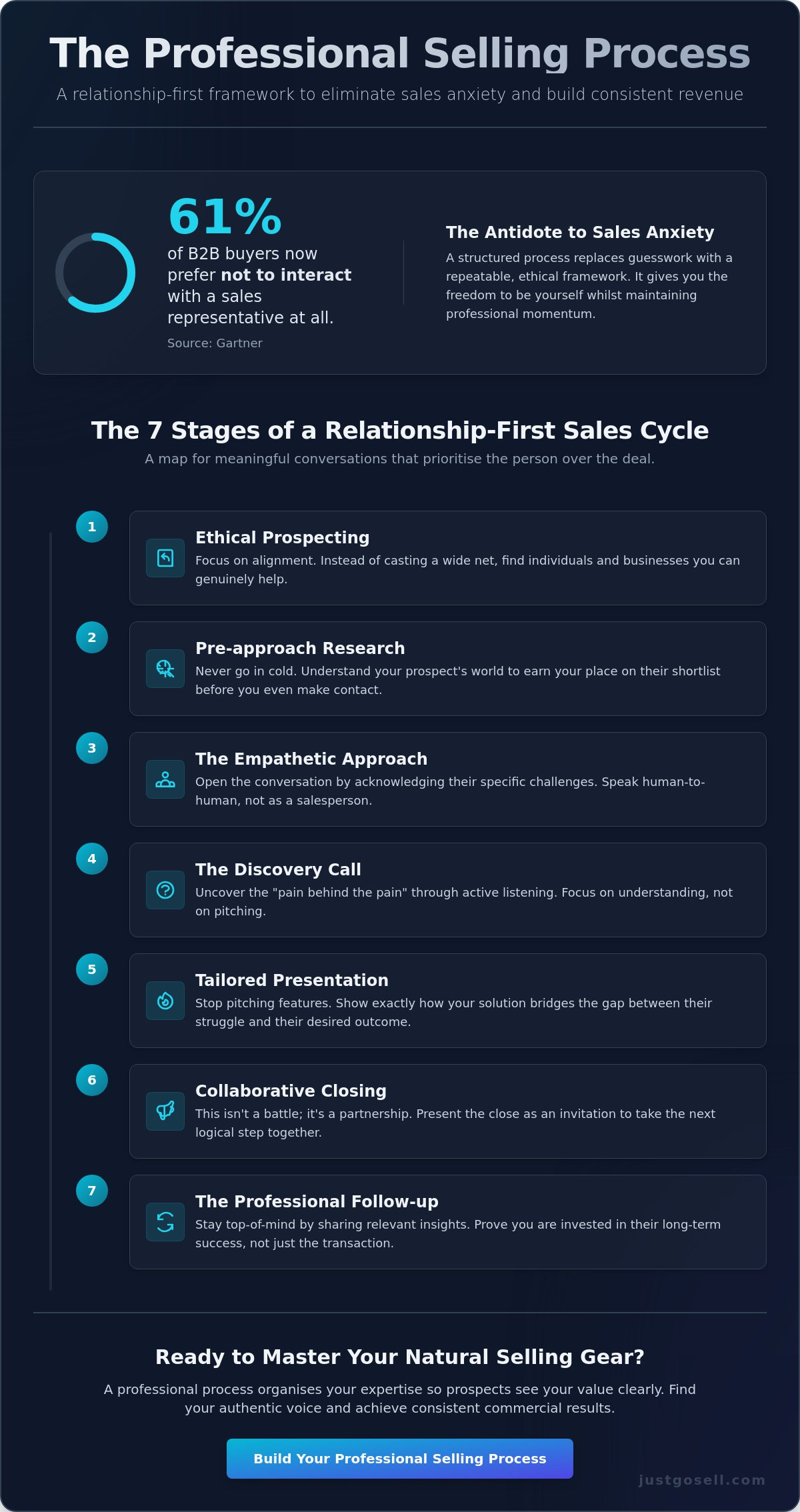
Did you know that 61% of B2B buyers would now prefer not to interact with a sales representative at all? It’s a sobering statistic from Gartner that highlights a growing tension in the market. Most entrepreneurs feel a genuine pang of anxiety at the thought of being perceived as pushy or aggressive. You likely want to help your clients, but without a clear professional selling process, that fear of overstepping often leads to inconsistent results and a closing phase that feels more like an apology than a professional conclusion.
I understand that hesitation; it comes from a place of wanting to build real relationships rather than just hitting targets. The good news is that you can master a structured, relationship-first framework that eliminates that tension and builds consistent revenue whilst keeping your integrity intact. This isn’t about robotic scripts or manipulation. Instead, it’s about a repeatable method that feels natural to you and your prospect alike. In this guide, we’ll explore how to lead discovery calls with genuine confidence, handle objections with ease, and finally give you the courage to charge exactly what your expertise is worth.
Key Takeaways
- Learn how a structured professional selling process acts as the ultimate antidote to sales anxiety by replacing guesswork with a repeatable, ethical framework.
- Discover the seven stages of a relationship-first sales cycle, starting with ethical prospecting to ensure you only connect with those you can truly help.
- Understand why rigid scripts often backfire in modern business and how to maintain your authentic voice whilst building deep rapport with high-ticket prospects.
- Identify the psychological hurdles that prevent entrepreneurs from closing and learn how to transition naturally from helping to asking for the business.
- Explore how a mentor-led approach through The Ultimate Sales Professional can help you find your natural selling gear and achieve consistent commercial results.
Table of Contents
What is a Professional Selling Process?
At its heart, a professional selling process is a repeatable, logical sequence of steps designed to guide a lead through to becoming a loyal client. It isn’t a cage. It’s a framework. Many entrepreneurs feel a sense of dread when they think about "selling" because they associate it with the aggressive tactics of the past. Professional selling is the complete opposite. It is a relational journey that prioritises the client’s needs above the immediate transaction. It allows you to lead with your values rather than a script.
When you have a structured sales process, you no longer have to worry about what to say next or how to steer the conversation. This structure acts as a safety net for your confidence. It allows you to be fully present with the person in front of you, knowing that the next phase of the journey is already mapped out. This removes the "winging it" anxiety that often leads to awkward silences or missed opportunities. Structure creates freedom. It gives you the space to be yourself whilst maintaining professional momentum.
The Core Philosophy: Selling as Problem Solving
The most successful professionals aren’t the loudest talkers. They are the most attentive listeners. Modern commercial behaviour has shifted significantly. Buyers are savvy. They can detect a generic pitch instantly. By reframing your interaction as a collaborative solution design, you move from being a "vendor" to a trusted advisor. This requires deep empathy and a genuine desire to help. You must understand the specific pain points your prospect faces before you ever mention your own services. When you lead with curiosity, the "selling" part happens naturally. It becomes a shared discovery of the best way forward.
Why Your Business Needs a Defined Sales Cycle
Relying on gut feeling might work occasionally, but it rarely builds a sustainable business. A defined cycle provides the data you need to grow. If you notice that most of your leads drop off after the initial discovery call, you know exactly which part of your professional selling process needs refinement. This clarity is incredibly empowering. It takes the mystery out of your revenue. Additionally, when you follow an organised path, your authority increases. Clients are willing to pay more for a professional who demonstrates a clear, structured route to solving their problems. This is the foundation of the work we do in The Ultimate Sales Professional, where we help you build a system that reflects your unique character.
A professional process doesn’t change who you are. It simply organises your expertise so your prospects can see the value you provide more clearly. It’s about building a bridge between their problem and your solution, one step at a time.
The 7 Stages of a Relationship-First Sales Cycle
A relationship-first cycle isn’t a rigid checklist; it’s a map for a meaningful conversation. Whilst some organisations prefer a simplified five-step selling process, a more nuanced 7-stage approach ensures no emotional or tactical stone is left unturned. This professional selling process prioritises the person over the deal, ensuring that every interaction adds value even if a sale doesn’t happen immediately.
-
Step 1: Ethical Prospecting. This is about alignment. Instead of casting a wide net, focus on finding individuals you can genuinely help.
-
Step 2: Pre-approach Research. Never go in cold. Since 94% of B2B buying groups create a shortlist before even contacting a vendor (6sense buyer research 2025), you must understand their world to earn your place on that list.
-
Step 3: The Empathetic Approach. Open the conversation by acknowledging their specific challenges. Drop the "salesy" veneer and speak human-to-human.
-
Step 4: The Discovery Call. This is where you uncover the "pain behind the pain" through active listening.
-
Step 5: Tailored Presentation. Stop pitching features. Show exactly how your solution bridges the gap between their current struggle and their desired outcome.
-
Step 6: Collaborative Closing. Closing shouldn’t be a battle. It’s an invitation to take the next logical step together.
-
Step 7: The Professional Follow-up. Stay top-of-mind by sharing relevant insights or resources, proving you are invested in their long-term success.
Mastering the Discovery Phase
The discovery call is the engine room of your entire professional selling process. If you get this wrong, the rest of the cycle will feel uphill. Focus on asking open-ended questions like "What happens if this problem isn’t solved by next quarter?" This helps the prospect identify the true cost of inaction. When they articulate the stakes themselves, the value of your solution becomes self-evident. It’s about guiding them to their own conclusions rather than pushing them toward yours. For a comprehensive breakdown of how to structure these conversations effectively, our guide on sales discovery call tips will show you how to transform awkward interrogations into high-value diagnostic rituals that accelerate your pipeline.
Handling Objections with Empathy
It’s natural to feel a sting when a prospect says "it’s too expensive," but try to view this as a request for more information rather than a rejection. Use the "Feel, Felt, Found" technique to lower the tension. You might say, "I understand why you feel that way; other clients have felt the same about the initial investment, but they found that the long-term savings far outweighed the start-up costs." Stay curious and calm. If you find yourself struggling to maintain this composure, you might find it helpful to reach out for a chat to refine your approach.
Why Rigid Scripts Fail Modern Entrepreneurs
We’ve all experienced that moment on a call where the person on the other end suddenly switches gears. Their tone shifts; their pace becomes artificial; and you realise they’ve stopped listening to you and started reading from a piece of paper. This is the "Uncanny Valley" of sales. It’s a jarring experience that immediately erodes trust. For modern entrepreneurs, especially those offering high-ticket services, rapport is the currency of the professional selling process. If you sound like a telemarketer, you’ll be treated like one. Your prospects want to feel heard, not processed. This consistency is just as important for your online presence, where PurpleCow Digital Marketing specialises in strategic website design that captures your authentic brand voice and builds rapport with prospects from their very first visit.
Rigid scripts fail because they assume every conversation follows a linear path. In reality, human interaction is messy and unpredictable. When you’re tied to a script, you’re so busy looking for your next line that you miss the vital clues your prospect is giving you about their needs. Whilst some might suggest a five-step selling process to keep things simple, the key is to treat those steps as a framework rather than a monologue. A framework gives you the destination; a script tries to dictate every single footstep along the way.
Developing Your Authentic Sales Voice
Your unique personality isn’t a distraction from the sale; it’s your greatest competitive advantage. People buy from people they like and trust. By using your natural vocabulary and speaking style, you signal that you’re a genuine partner rather than a desperate vendor. To stay present, focus entirely on the prospect’s answers. If you’re truly listening, your next question will often form itself based on what they just said. Professional selling is the art of following a proven commercial structure whilst allowing your natural curiosity to drive the conversation. Building this kind of authentic confidence starts with the right sales mindset tips that help you reframe selling as something you do for people, not to them.
Frameworks Over Scripts
Instead of a full script, try using a simple list of bullet points for each stage of your professional selling process. These act as signposts to ensure you hit the necessary milestones without losing your spontaneity. You can move between the stages of the cycle by using natural transitions that reference what the prospect has already shared. For instance, moving from discovery to presentation becomes as simple as saying, "Based on what you’ve told me about your current bottlenecks, I think this specific approach would work best for you." For a deeper dive into refining your message, take a look at our guide on mastering your sales pitch strategy to see how a flexible framework beats a rigid script every time.
Practical Implementation: Moving from Helping to Closing
You’ve done the hard work. You’ve listened, empathised, and shown exactly how you can solve the prospect’s problem. Yet, for many founders, this is where the professional selling process hits a sudden, invisible wall. There’s a common psychological hurdle that makes us want to stop just before the close. We worry that asking for the business will ruin the rapport we’ve built. In reality, failing to lead the prospect to a decision is a disservice to them. If you truly believe your solution provides real value, then closing is simply the final act of that help.
Transitioning doesn’t require a clunky gear shift. Instead of a hard pivot, use a bridge. You might say, "Based on our conversation, it’s clear that solving [Problem X] is your priority. Would you like to discuss how we can get started?" This moves the conversation forward naturally. You can choose a closing style that fits your character. An "Assumptive Close" works well when the fit is obvious; you simply discuss start dates. A "Permission-Based Close" feels softer, asking the prospect if they feel ready to move to the next stage. Both are valid parts of a professional approach.
To avoid the dreaded "let me think about it" limbo, always set clear next steps. Never leave a call without a specific date and time for the next interaction. This maintains momentum and shows that you value both your time and theirs. It prevents the lead from cooling off and keeps the professional energy high.
The Art of the Soft Close
Before you ask for the final commitment, use temperature check questions. Ask, "On a scale of one to ten, how well does this solution align with your goals?" This reveals any hidden hesitations early. When it’s time to present your price, do so with absolute certainty. State your fee clearly and then stop talking. Silence is a powerful professional tool. If you apologise for your pricing, the prospect will wonder if you truly believe in your own worth. Create urgency not by being pushy, but by referencing their timeline. If they need results by next quarter, they need to start now.
Post-Sale Professionalism
The professional selling process doesn’t end when the invoice is sent. Buyer’s remorse can settle in quickly, especially with high-ticket services. A thoughtful follow-up message within 24 hours can eliminate this anxiety and reinforce their decision. Organise your CRM meticulously to track every interaction. This ensures that a "No" today can be nurtured into a "Yes" in six months through consistent value-add. If you’re finding the transition from helping to closing difficult, you can get in touch to discuss a more confident approach for your business.
Mastering the Process with Just Go Sell
Learning to sell shouldn’t feel like learning a foreign language you’ll never actually speak. Most founders struggle because they’ve gathered fragmented advice from various sources, leading to a disjointed approach that lacks a cohesive core. At Just Go Sell, we specialise in helping non-sales professionals and seasoned professionals find their "Ultimate Sales" gear. This isn’t about changing your personality. It’s about organising your natural expertise into a professional selling process that feels as comfortable as a conversation with an old friend. When you move from "winging it" to a repeatable system, the anxiety of the unknown simply evaporates.
True mastery requires more than just information; it requires a shift in mindset. We believe that self-belief is the absolute foundation of any commercial success. If you don’t believe in your value, your prospect won’t either. Developing the right sales mindset tips for entrepreneurs is therefore just as important as mastering any tactical step in the cycle. Our mentor-led approach provides the supportive environment you need to bridge the gap between your current hesitation and professional mastery. We act as your reliable partner, helping you challenge traditional norms to find a voice that is uniquely yours.
The Ultimate Sales Professional Course
This comprehensive programme is designed to build your commercial foundation from the ground up. Through a series of structured video modules, we take a deep dive into the mechanics of the sale whilst directly addressing the specific psychological hurdles that hold many entrepreneurs back. You’ll learn how to structure your discovery calls, handle objections with grace, and close with confidence. It’s about creating a system that works for you, not the other way around. You can discover the full curriculum and start your journey by exploring The Ultimate Sales Professional.
Personalised 1-to-1 Coaching
Sometimes, you need a second pair of eyes on your specific business model. Our personalised coaching allows you to work directly with a mentor (myself, Colin Knowles) to refine your pitch and strategy. We help you tailor the 7-step professional selling process to your unique character and market. This ensures that every word you say feels authentic and every action you take leads toward a consistent commercial result. Whether you’re refining a high-ticket offer or looking to increase your conversion rates, having an innovative guide by your side makes all the difference. Book your 1-to-1 sales coaching session today to start building the revenue your expertise deserves.
Step Into Your Natural Sales Gear
You now have the map to transform your commercial interactions from anxious "pitches" into confident, value-driven conversations. By moving away from rigid scripts and embracing a flexible framework, you allow your authentic character to lead the way. You’ve seen how a structured professional selling process provides the safety net you need to stay present, listen deeply, and guide your prospects toward a decision that genuinely serves their needs. This shift in approach ensures that your revenue growth is built on a foundation of trust rather than pressure.
True mastery comes from combining this structure with a resilient mindset. Through mentor-led training by myself (Colin Knowles), we focus on helping you communicate with absolute sincerity whilst providing downloadable templates for immediate implementation in your daily workflow. This isn’t just about closing more deals; it’s about building a sustainable, relationship-first system that reflects your true worth and expertise. You don’t have to navigate these psychological hurdles alone. Start your journey to becoming The Ultimate Sales Professional today and discover how rewarding selling can be when it finally feels like you.
Frequently Asked Questions
What is the most important step in the professional selling process?
The discovery phase is arguably the most vital part of the professional selling process because it lays the foundation for everything that follows. Without a deep understanding of your prospect’s specific challenges and goals, any solution you present will feel generic and unconvincing. By asking insightful, open-ended questions, you uncover the true stakes of their problem. This allows you to position your expertise as a targeted remedy rather than a broad service. If you want to sharpen this skill further, our detailed resource on mastering sales discovery call tips provides a proven framework for building trust and qualifying leads with confidence.
How long does a typical sales cycle take for a small business?
Sales cycle lengths vary significantly depending on your industry and the complexity of your offering. According to 6Sense research from 2025, the average B2B sales cycle is approximately 10.1 months. For smaller businesses with less complex decision-making units, this can be much shorter. However, it’s essential to track your own data to identify your unique average. This helps you manage your pipeline and revenue expectations with greater accuracy.
Can I be successful in sales if I am an introvert?
Absolutely. Introverts often make exceptional sales professionals because they are naturally inclined to listen more than they talk. Since modern selling is rooted in empathy and problem-solving, your ability to process information and ask thoughtful questions is a massive advantage. You don’t need to be the loudest person in the room to succeed. Instead, focus on building deep, meaningful rapport through the structured framework we teach at Just Go Sell.
What is the difference between a sales process and a sales methodology?
A sales process is a specific, repeatable sequence of steps your team follows to turn a lead into a client. In contrast, a sales methodology is the underlying philosophy or "how" you approach those steps. Think of the process as the map and the methodology as the driving style. For example, your professional selling process might include a discovery call, whilst your methodology focuses on being relationship-first and empathetic throughout that call.
How do I handle a prospect who keeps delaying their decision?
Delays often stem from a hidden fear of making the wrong choice rather than a lack of interest. To handle this, gently bring the conversation back to the cost of inaction. Ask them what the impact will be if the problem remains unsolved for another three months. By refocusing on their original goals and the stakes involved, you help them move past the stall without appearing pushy or aggressive.
Do I really need a CRM to manage my selling process?
Whilst you can start with a spreadsheet, a dedicated CRM or a workflow management tool like TrackMyBusiness becomes essential as your business grows. It ensures that no lead falls through the cracks and provides a centralised place to track every interaction. This level of organisation allows you to follow up at exactly the right time with the right information. It transforms a chaotic list of contacts into a manageable, professional pipeline that supports consistent monthly revenue.
How can I improve my closing rate without being aggressive?
Improving your closing rate is about leading the prospect to a natural conclusion rather than pushing them toward a sale. Use "temperature check" questions throughout the conversation to ensure you’re still aligned. If you’ve done a thorough job in the discovery phase, the close should feel like a logical next step. When you invite them to start, it feels like a professional recommendation rather than a high-pressure demand.
What should I do if a prospect says my price is too high?
When a prospect questions your price, it’s usually a signal that they haven’t fully grasped the value of the solution yet. Avoid the urge to discount immediately. Instead, use the "Feel, Felt, Found" technique to empathise with their concern whilst re-establishing the return on investment. Remind them of the specific pain points you’re solving and the long-term benefits they’ll receive. This keeps the conversation focused on value rather than just cost.

Article by
Colin Knowles
Sales Growth Consultant | Sales Director | Author | Founder: JustGoSell. With an extensive background in corporate sales training and team leadership, my role as Sales Trainer and Director at Just Go S.L. revolves around empowering sales professionals to excel. My approach has consistently fostered environments where sales teams surpass targets, thanks in part to my focus on effective sales processes and direct sales techniques. At the core of my professional ethos lies the commitment to continual development and adaptation of sales strategies to stay ahead in a dynamic market. Through one-on-one coaching, group webinars, and the authorship of "JustGoSell," I have solidified my reputation as a catalyst for transformative sales results and an advocate for sustained sales skill advancement.