

What if the secret to a brilliant sales opening isn’t a flawless script, but the courage to be human instead? Most of us have felt that cold spike of anxiety whilst staring at the phone or walking into a meeting room, terrified that an awkward silence will ruin the mood before we’ve even begun. You’ve likely spent hours trying to figure out how to start a sales conversation that doesn’t make you sound like a desperate telemarketer or a programmed robot. It’s a common struggle, and it’s perfectly natural to worry about rejection when your heart is truly in your business.
You don’t need to change your personality to succeed; you simply need a better foundation. In this guide, we’ll show you how to master the art of the opening using a stress-free framework designed to build genuine trust from the very first second. We’ll move past rigid industry stereotypes to focus on a more empathetic, relationship-based approach. You will discover a repeatable method that helps you find your own voice, ensuring every connection feels authentic whilst leading naturally towards a professional result. This is the same philosophy we use in The Ultimate Sales Professional to help beginners bridge the gap between insecurity and mastery.
Key Takeaways
- Learn how to shift from a “pitch-first” mindset to an act of service, removing the psychological pressure of being perceived as pushy.
- Discover a flexible three-part framework for how to start a sales conversation that acts as a safety net whilst allowing your genuine personality to shine.
- Understand why rigid scripts often lead to awkward silences and how a flexible approach helps you stay present and responsive to your prospect.
- Gain a list of practical, open-ended questions designed to uncover a prospect’s true challenges and build an immediate, human connection.
- Identify the path from beginner insecurity to professional mastery by focusing on individual-centric methodologies and mindset.
The Psychology of the First Move: Why Starting a Sales Conversation Feels Daunting
Starting a conversation with a stranger can feel like walking a tightrope. In business culture, the dread of being "too much" often leads to being "not enough". You might worry that your opening line will be met with a cold stare or a polite but firm rejection. This anxiety is rarely about your product; it’s about the fear of being perceived as pushy or insincere. Most entrepreneurs struggle because they’ve been taught that the personal selling process is a series of aggressive manoeuvres designed to corner a prospect. This couldn’t be further from the truth. Realising that how to start a sales conversation is about psychology, not just scripts, is the first step towards mastery.
The confusion often stems from the fragmented information found online. One blog tells you to be "disruptive" whilst another suggests being "passive". This lack of a clear, repeatable framework erodes your self-belief. When you don’t have a reliable foundation to lean on, you’re forced to wing it. This leads to inconsistent results and a constant state of performance-related stress. You don’t need a louder voice or a more aggressive persona; you need a system that allows your natural character to shine through whilst you provide value to your prospect.
Overcoming the Fear of Being Pushy
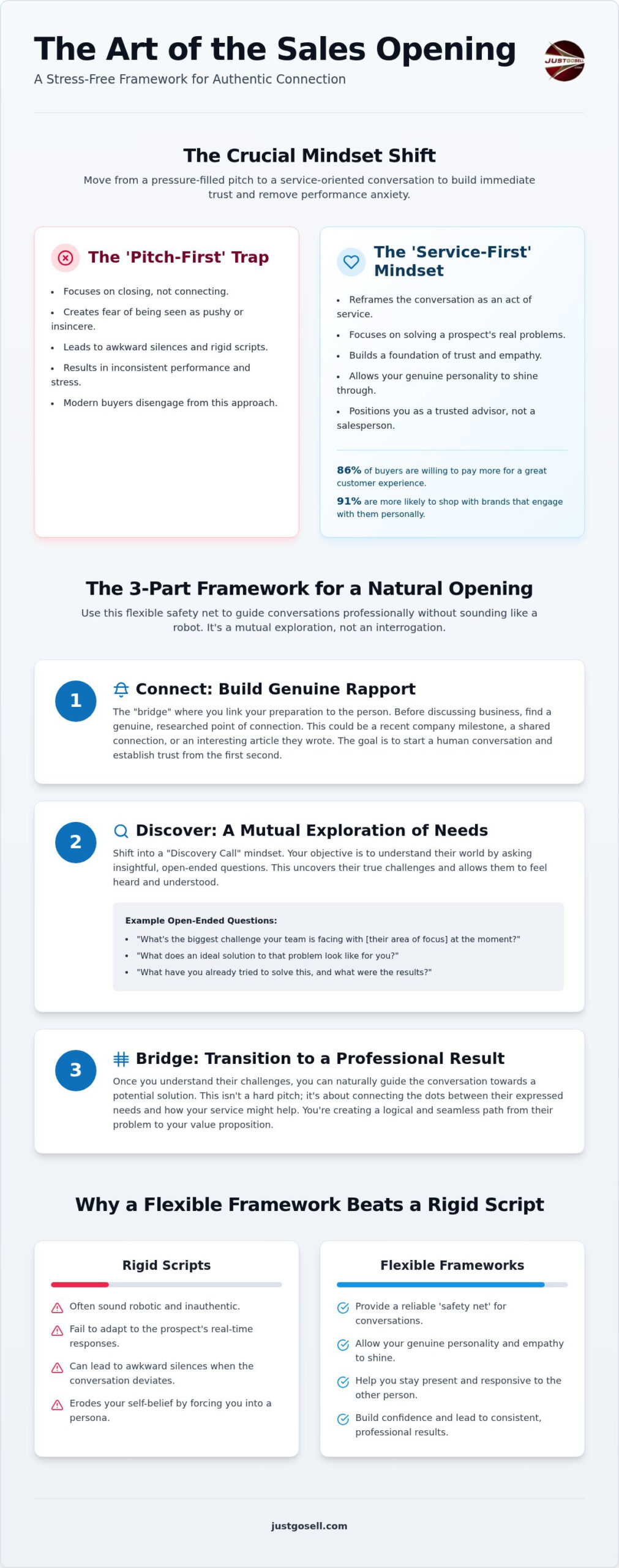
The most effective way to lower your stress levels is to reframe the entire interaction. Instead of focusing on "closing" a deal, focus on "connecting" with a human being. When you view your sales opening as an act of service, the pressure vanishes. You aren’t bothering someone; you’re potentially solving a problem that keeps them awake at night. This shift in mindset is the cornerstone of a professional foundation. It allows you to approach every meeting with a sense of relief and excitement rather than dread. By prioritising the needs of the client you genuinely care about, you move from being a "salesperson" to becoming a trusted advisor. Our flagship training, The Ultimate Sales Professional, focuses on this very mindset to help you find your unique voice.
Why the ‘Pitch-First’ Approach Fails in 2026
Today’s buyers are increasingly discerning, placing greater importance on trust, personalised attention and the overall customer experience. According to PwC’s 2025 Customer Experience Survey, 86% of consumers consider human interaction important to their experience with a brand, while 29% have stopped purchasing from a company because of poor customer experience. The message for sales professionals is clear: building genuine relationships, understanding individual needs and delivering meaningful value are no longer optional; they are fundamental to sustainable sales success. They can spot a traditional sales pitch from a mile away and will disengage the moment they feel managed. A "pitch-first" approach fails because it ignores the emotional environment of the conversation. If you lead with a product description, you’ve already lost the opportunity to build trust.
Winging your openings also carries a heavy cost. It leads to mental fatigue and a "boom and bust" revenue cycle. Non-traditional, mentor-led methods are far more effective for small business owners because they adapt to the person rather than forcing the person to fit a rigid script. Having a repeatable framework gives you the confidence to know exactly how to start a sales conversation without that sinking feeling of dread, ensuring every connection you make is grounded in authenticity and mutual respect.
The 3-Part Framework for a Natural Sales Opening
Mastering how to start a sales conversation doesn’t require a scripted monologue. It requires a safety net. We use the ‘Connect, Discover, Bridge’ framework because it provides a reliable structure whilst giving you the freedom to be yourself. This isn’t a rigid set of rules; it’s a flexible guide that ensures you stay on track without sounding robotic. By following this flow, you transform a potentially awkward encounter into a professional Discovery Call. We define this call as a mutual exploration of needs, not a one-way interrogation. It’s a chance for both parties to see if a partnership makes sense. This approach is a core part of The Professional Selling Process: A Modern Framework for Confident Closing, which helps entrepreneurs move from uncertainty to mastery.
Phase 1: Research and the ‘Bridge’ Technique
The bridge is where you link your preparation to the person sitting across from you. Before you even pick up the phone, find a genuine point of connection amongst their recent business milestones or social media activity. Perhaps they’ve just launched a new project or shared an insightful article. Mentioning these specifics shows you’ve done the work. It moves the conversation beyond generic small talk and proves you value their time. Research is the foundation of professional respect. When you show that you understand their world, the prospect’s defensive walls begin to crumble. They stop seeing you as a vendor and start seeing you as a peer who is actually paying attention. If you’re finding it difficult to find these connection points, you can always reach out for guidance on your specific industry.
Phase 2: The Empathy Statement
An empathy statement sets the psychological scene for the rest of the meeting. It involves acknowledging the prospect’s likely situation or the specific pain points common in their industry. By using active listening from the very first second, you validate the buyer’s experience. This isn’t about guessing; it’s about demonstrating that you understand the weight of their challenges. You might say, "I’ve noticed many founders in your position are struggling with [X], and I imagine that’s taking up quite a bit of your focus lately."
Statements like this lower the prospect’s guard immediately because they feel understood rather than sold to. You can find several effective sales conversation starters that use this empathetic approach to build rapport quickly. When you lead with empathy, you create a supportive atmosphere where the prospect feels safe to share their real goals. This transition from "pitching" to "listening" is what separates a beginner from a professional. It turns the opening into a collaborative moment rather than a high-pressure hurdle.
Frameworks vs Scripts: Why Rigid Openers Often Fail Entrepreneurs
Many entrepreneurs treat the "perfect script" like a protective shield. They search for a word-for-word manual on how to start a sales conversation, hoping it will magically prevent rejection. In reality, a rigid script is often the enemy of a genuine, human connection. When you’re tethered to a pre-written speech, you stop being present. You’re so focused on remembering the next line that you miss the subtle cues your prospect is giving you. This creates a psychological hurdle where you begin to fear the moment a client goes "off-script". If they ask an unexpected question, the rehearsed facade crumbles, leaving you feeling exposed and anxious.
The Ultimate Sales Professional doesn’t rely on a teleprompter. They use a flexible framework that acts as a compass rather than a map. By using bullet-point guides instead of full paragraphs, you maintain a professional structure whilst allowing the conversation to flow naturally. This approach ensures you hit your key objectives without losing your individual character. It moves you away from the robotic persona that many beginners adopt out of fear and towards a style that is adaptable, supportive, and results-oriented. Learning how to start a sales conversation is ultimately about developing a reflex, not memorising a monologue.
The Robotic Script Trap and How to Avoid It
You can usually tell when an opening is rehearsed. The delivery becomes monotone; the pauses feel unnatural; the transition to the pitch is rushed. This lack of authenticity is a major red flag for modern buyers. Being "too polished" can actually backfire, especially with small business clients who value transparency. If you sound like a recording, you seem less trustworthy. To avoid this trap, practice your framework until the core concepts are second nature, but leave the specific phrasing to the moment. This allows you to stay flexible whilst keeping the conversation on track, ensuring the prospect feels heard rather than managed.
Building Flexibility into Your Sales Methodology
A successful opening must adapt to the personality of the person you’re speaking with. A direct, high-energy prospect will appreciate you getting to the point quickly, whilst a relational buyer might need more time to build that initial bridge of trust. This level of customisation requires deep self-belief. You have to trust that your foundational knowledge is strong enough to handle "off-book" questions without losing your composure. This is where mindset becomes just as important as mechanics. If you’re looking to refine your personal approach and move beyond generic advice, our 1-to-1 Sales Coaching provides the tailored support needed to find your unique voice in every interaction.

Practical Conversation Starters That Don’t Feel Awkward
Once you’ve embraced the mindset of service, the actual words you use become much easier to find. You’ve already built your framework; now you need the specific tools to open the door. The goal is to move away from binary "yes or no" questions that stall momentum. Instead, you want to invite the prospect to lead the way. Open-ended questions are the master key to discovery. They unlock the prospect’s "why" and provide the raw data you need to be truly helpful. When you know how to start a sales conversation using these prompts, you stop guessing and start listening.
Try using these starters to uncover challenges and future goals:
- "What’s the one thing about your current process that’s causing the most frustration for your team right now?"
- "If we were sitting here twelve months from today, what would have to happen for you to feel this year was a total success?"
- "I noticed your organisation is expanding into [X] market; how is that shift affecting your day-to-day operations?"
One of the most powerful tools in your arsenal isn’t a word at all; it’s the pause. After you ask an opening question, give the prospect space to speak. Beginners often rush to fill the silence because of their own anxiety, but a professional knows that the silence is where the prospect does their thinking. Resisting the urge to jump in shows confidence and respect for their internal process.
Starters for Cold Calls and Warm Leads
The context of your connection changes your opening line. For a cold call, a permission-based approach is often the most respectful. You might say, "I know I’ve called you out of the blue, do you have two minutes to see if this is relevant for you, or have I caught you at a terrible time?" This gives the prospect a sense of control. For warm leads, context is your best friend. Reference the specific resource or interaction that brought them to you, such as a recent webinar or a guide they downloaded. Before you pick up the phone, it’s vital to review these essential sales mindset tips to ensure you’re approaching the call with the right energy and focus.
Transitioning from Small Talk to Business Naturally
The "awkward pivot" is a common trap where a seller moves too abruptly from chatting about the weather to a hard sales pitch. This makes the prospect feel manipulated. To avoid this, use a transition statement that leads with professional authority. A simple phrase like, "The reason for my call today is specifically related to the [X] challenge we discussed briefly on LinkedIn," bridges the gap between rapport and business. It shows you value their time and have a clear purpose. If you’re struggling to find the right words for your industry, you can book a strategy session with us to refine your personal approach.
Mastering the Art of Selling with The Ultimate Sales Professional
Mastering the mechanics of an opening is just the beginning. To truly excel, you need to internalise these habits until they become second nature. The Ultimate Sales Professional course is designed to be your definitive path to this level of mastery. It moves beyond surface-level tips to provide the deep foundational layers you need to approach every prospect with unwavering confidence. When you know exactly how to start a sales conversation in a way that feels natural to your character, the fear of rejection simply evaporates. You stop worrying about what might go wrong and start focusing on the value you can provide.
We understand that as an entrepreneur, your schedule is likely packed. That’s why this training is delivered through self-paced video modules, allowing you to build your skills amongst your daily responsibilities. You won’t find any high-pressure tactics or rigid scripts here. Instead, you’ll discover a mentor-led approach that respects your voice and your values. It’s about building a sustainable business through genuine relationships, ensuring your sales process feels like an extension of your brand rather than a forced performance. Anyone can master sales with the right guidance, regardless of their previous experience or personality type.
How Personalised Coaching Accelerates Your Results
Whilst online modules provide the structure, 1-to-1 Sales Coaching with myself (Colin Knowles) offers the nuance. There is a vast difference between watching a generic video and having a mentor identify your specific psychological hurdles. A coach acts as a mirror. They help you see the barriers you’ve built around the idea of selling. Whether it’s a deep-seated fear of being pushy or a struggle with "off-book" questions, personalised guidance helps you break through those blocks. The training serves as the perfect companion to this coaching, providing the theory whilst the 1-to-1 sessions focus on your real-world application and individual character.
Take the First Step Towards Consistent Sales Success
You’ve seen that the journey from opening anxiety to professional mastery is possible. By moving from a "pitch-first" mindset to a "help-first" framework, you’ve already taken the most important step. You now have the tools to understand how to start a sales conversation that builds immediate trust and leads to consistent revenue. You don’t have to do this alone. Join a community of like-minded entrepreneurs who are all prioritising relationship-building over aggressive tactics. The relief of knowing your sales process is both effective and ethical is life-changing for any business owner. It allows you to grow your organisation with a sense of pride and professional authority.
Book a consultation or explore our resources today to begin your transformation and claim your place as a confident, professional seller.
Transform Your Approach and Find Your Voice
Mastering how to start a sales conversation isn’t about becoming a different person; it’s about refining the person you already are. By shifting your focus from a rigid pitch to a genuine act of service, you remove the psychological barriers that lead to performance anxiety. You’ve seen how a flexible framework provides a safety net that scripts simply cannot match, allowing you to stay present and empathetic whilst building professional authority.
Our non-traditional methods are designed for entrepreneurs who value authenticity over aggression. We specialise in both the mindset and the mechanics of selling, providing mentor-led warmth to help you bridge the gap between beginner insecurity and professional mastery. You don’t need to feel pushy or robotic to see consistent results. With the right foundation, you can start every meeting with a sense of relief and excitement.
Start your journey with The Ultimate Sales Professional course today. You have everything you need to succeed whilst remaining entirely yourself, and we are here to support you every step of the way.
Frequently Asked Questions
What is the best way to start a sales conversation with a complete stranger?
The most effective way to begin is by leading with a "bridge" based on specific research. Instead of a generic greeting, mention a recent company milestone or a challenge unique to their industry. This shows immediate respect for their time and positions you as a peer rather than a nuisance. It transforms the start from a cold pitch into a relevant, human connection.
How do I avoid sounding like a salesperson when I first call someone?
To avoid sounding like a traditional salesperson, use a permission-based opening that acknowledges the prospect’s autonomy. Phrases like "I know I’ve caught you out of the blue" or "Do you have a moment to see if this is relevant?" lower the buyer’s guard. By prioritising their comfort over your pitch, you create an atmosphere of mutual respect and empathy.
Should I use a script for the first 30 seconds of a sales call?
You should avoid rigid scripts and use a flexible framework instead. Whilst it’s tempting to memorise the first 30 seconds to ease anxiety, a script often makes you sound robotic and prevents you from being truly present. A bullet-point guide allows you to hit your key objectives whilst maintaining a natural, conversational tone that builds genuine trust.
How do I handle the ‘I’m too busy’ objection right at the start?
When a prospect says they’re too busy, the best approach is to validate their situation immediately. Don’t try to push through; instead, offer a specific, low-pressure alternative. You might say, "I completely understand. Would it be better if I sent a quick summary over email, or should we find two minutes later in the week?" This keeps the door open without being pushy.
What are some non-awkward icebreakers for B2B sales?
Effective B2B icebreakers focus on the prospect’s professional world rather than generic small talk about the weather. Mentioning a recent LinkedIn post they wrote or a specific award their company won is far more engaging. These context-heavy starters prove you’ve done your homework and are genuinely interested in their success, making the transition to business feel seamless.
How long should the ‘small talk’ phase of a sales conversation last?
The small talk phase should be brief and purposeful, usually lasting no more than a minute or two. In a professional setting, people value their time and often want to get to the heart of the matter. If you’ve built a strong "bridge" through research, you can move into the discovery phase quite quickly without the conversation feeling rushed or cold.
How can I build self-belief before starting a difficult sales meeting?
Building self-belief starts by reframing the meeting as an act of service rather than a high-stakes performance. Remind yourself that you’re there to solve a problem for someone you care about. When you focus on helping the client rather than "closing" them, your internal pressure drops. This shift in mindset is a vital part of learning how to start a sales conversation with professional authority.
Is it better to start with a question or a statement in a sales opening?
It’s almost always better to start with an open-ended question that invites the prospect to share their perspective. A statement often feels like a lecture or a pitch, whereas a well-crafted question initiates a collaborative dialogue. Understanding how to start a sales conversation with a question ensures you lead with curiosity, which is the most effective way to uncover a prospect’s true needs.


Article by
Colin Knowles
Sales Growth Consultant | Sales Director | Author | Founder: JustGoSell
With an extensive background in corporate sales training and team leadership, my role as Sales Trainer and Director at Just Go S.L. revolves around empowering sales professionals to excel. My approach has consistently fostered environments where sales teams surpass targets, thanks in part to my focus on effective sales processes and direct sales techniques.
At the core of my professional ethos lies the commitment to continual development and adaptation of sales strategies to stay ahead in a dynamic market. Through one-on-one coaching, group webinars, and the authorship of "JustGoSell," I have solidified my reputation as a catalyst for transformative sales results and an advocate for sustained sales skill advancement.