

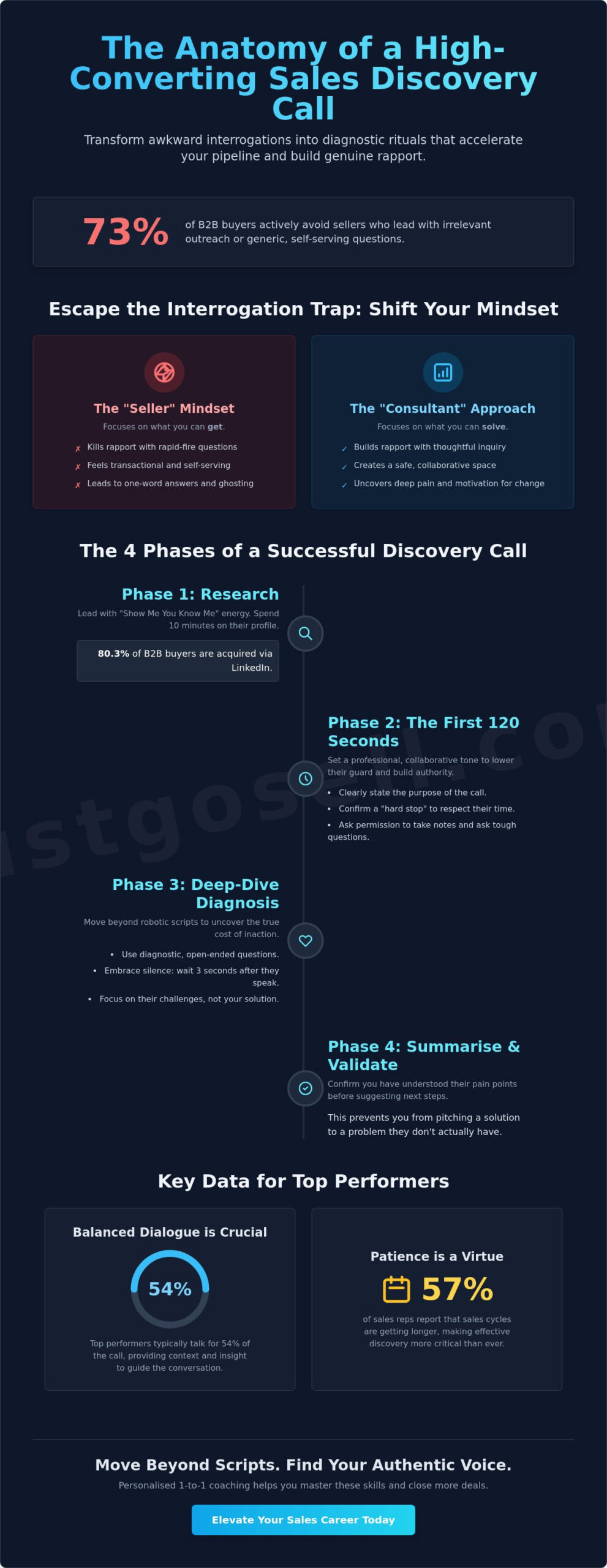
Research by Gartner found that nearly three-quarters (73%) of B2B buyers actively avoid suppliers whose outreach feels irrelevant. It is incredibly frustrating when you’re trying your best, yet your prospects keep shutting down with one-word answers. You likely want to qualify the lead without sounding like a pushy salesperson, but often the transition from chatting to uncovering real pain feels clunky and forced. We understand that feeling of imposter syndrome that can creep in when a call starts to go cold. This guide provides the essential sales discovery call tips you need to transform these awkward interrogations into high-value, diagnostic rituals that accelerate your pipeline.
You’ll gain the confidence to lead every conversation with a clear framework designed to build rapport and uncover what truly matters to your buyer. We are going to explore how to move beyond the rigid checklist and use personalised strategies to ensure your discovery leads directly to a closed deal. By the end, you will have the tools to turn every initial chat into a meaningful professional relationship and drive results even though 57% of reps report that sales cycles are getting longer (7th Edition of Salesforce’s State of Sales Report (2026))
Key Takeaways
- Shift your mindset from a “seller” to a “consultant” to escape the interrogation trap and build genuine rapport from the first minute.
- Master a high-impact opening that sets a clear agenda whilst using pre-call research to establish your professional authority.
- Implement actionable sales discovery call tips to uncover hidden pain points by exploring the true cost of a prospect’s inaction.
- Learn how to open up prospects who give one-word answers and gracefully pivot price objections back to your core value.
- Discover how personalised 1-to-1 Sales Coaching helps you move beyond scripts to find your own authentic and successful sales voice.
Table of Contents
Why Most Discovery Calls Fail (and How to Fix the ‘Interrogation’ Vibe)
Many sales reps fall into the "Interrogation Trap" without even realising it. You have a list of questions, you need the data, and you start firing them off like a police officer under a flickering light. This rapid-fire approach kills rapport instantly because it feels transactional rather than relational. When you treat the sales process as a data-mining exercise, the prospect feels used. They retreat into one-word answers, and you’re left wondering why the energy died. It is a common hurdle, but it’s one you can absolutely overcome with the right mindset.
The secret to better outcomes lies in your internal identity. If you enter the call as a "Seller", your focus is on what you can get. If you shift to being a "Consultant", your focus is on what you can solve. This identity dictates every nuance of your tone. Poor discovery is expensive; surface-level conversations are exactly why prospects ghost you later. Mastering effective sales discovery call tips ensures you dig beneath the surface to find the real motivation for change. Building self-belief whilst on the line is vital. Take a breath. Stay curious. Your job isn’t to "win" the call; it’s to see if there’s a problem worth fixing.
The Psychology of the Discovery Phase
Prospects often start a call with a wall up. They’re defensive because they expect to be sold to. To break this down, you must create a "safe space". This means validating their challenges so they feel comfortable admitting business failures. One of the most powerful sales discovery call tips is actually to talk less. Use the power of silence. After a prospect finishes a sentence, wait three seconds. You’ll be amazed at the deep, emotional insights they share just to fill the gap. It’s about empathy, not just efficiency.
Moving Beyond the Robotic Script
Rigid scripts sound insincere. They prevent you from actually listening because you’re too busy looking for your next line. Instead, use a flexible framework. This allows you to adapt your behaviour to match the prospect’s energy. If they’re high-energy and fast-paced, keep up. If they’re reflective, slow down. A "Mentor-led" approach involves guiding the prospect to their own conclusions through thoughtful inquiry. When they "discover" the solution themselves, the path to a deal becomes much smoother. You’re not just a voice on a line; you’re a reliable partner helping them find their own voice.
The Anatomy of a High-Converting Discovery Call
A successful discovery call is never an accident; it is a meticulously crafted journey that moves a prospect from cautious curiosity to genuine commitment. To achieve this, you must move beyond the "winging it" mentality that leaves so many sales professionals feeling like imposters. The first step happens long before you dial. According to Salesforce, top-performing sellers are 1.7 times more likely to use AI prospecting agents than underperformers. LinkedIn is responsible for around 80% of B2B social media leads, making it the dominant social platform for B2B lead generation, so spend ten minutes on their profile to understand their recent wins and challenges. This allows you to lead with "Show Me You Know Me" energy, which instantly builds trust.
Once you are on the line, your goal is to lead the dance without stepping on toes. One of the most effective sales discovery call tips is to focus on a balanced dialogue. Gong’s analysis of 326,000 sales calls found that winning sales conversations aren’t defined by talking less; they’re defined by maintaining a consistent, balanced dialogue. Successful calls averaged around 57% rep talk time, while the best sellers were distinguished by the consistency of their conversations rather than a fixed talk-to-listen ratio. This isn’t about dominating the airtime; it is about providing enough context and insight to keep the prospect engaged. After the opening, move into a deep-dive phase using diagnostic questions that uncover the operational gaps in their current process. Finally, ensure you summarise their pain points before transitioning. If you don’t validate what you’ve heard, you risk pitching a solution to a problem they don’t actually have.
Setting the Stage: The First 120 Seconds
The first two minutes dictate the power dynamic of the entire call. Start by stating the purpose clearly; this builds authority without sounding subservient. Always confirm a "hard stop" to show you respect their time. This small gesture of professional courtesy often lowers their guard. Finally, ask for permission to take notes and ask "tough" questions. This sets a collaborative tone and signals that you are there to do serious work, not just have a polite chat. If you’re finding it difficult to strike this balance, you might want to speak with a mentor to refine your approach.
The Art of the Transition
Moving from rapport-building to business-talk can feel jarring if you don’t use "bridge phrases". A simple "Based on what you’ve shared about your growth targets, I’d love to dig into the specifics of your current workflow" creates a natural pivot. This keeps the flow energetic and forward-moving. Once you have uncovered the deep pain points, you’ll need a clear path forward. You can learn more about this in our guide on Mastering Your Sales Pitch Strategy, which helps you turn these insights into a compelling offer.
Essential Discovery Questions to Uncover Deep Pain Points
Asking the right questions is the difference between a lead that stalls and a deal that closes. Once you have set the stage, your goal is to move beyond surface-level facts. Many reps focus on the "what" of a business, but the most effective sales discovery call tips focus on the "why". You must understand the stakes. A powerful way to do this is by asking, "What happens if you do nothing?". This uncovers the cost of inaction. Since 57% of sales professionals report that the sales cycle is getting longer, identifying the urgency early is vital to keeping your pipeline moving. If there is no pain in staying the same, there is no reason for them to buy from you.
Diagnostic vs. Descriptive Questions
Descriptive questions like "What software do you use?" only provide a map. Diagnostic questions like "Why did you choose that specific workflow?" provide the story. Your objective is to layer your inquiries to get past the first, superficial answer. A second-level question is a follow-up inquiry that asks for the "why" behind a prospect’s initial "what" to reveal deeper motivations. By using this tactic, you show the prospect that you are listening intently and are genuinely invested in their specific challenges.
Qualifying Without the Interrogation
Qualifying for budget and authority often feels like the most awkward part of the call. However, it doesn’t have to be a confrontation. You can assess these factors whilst maintaining a helpful, mentor-like tone. Focus on identifying "Champions" who will fight for your solution and "Gatekeepers" who might slow things down. If you want to master this balance, The Ultimate Sales Professional Course provides the structural fundamentals to lead these conversations with ease. Remember, you’re not just checking boxes; you’re determining if you can truly add value to their journey.
Handling Common Discovery Hurdles and Objections
Even the most seasoned professional faces a "tough room" occasionally. You might encounter a prospect who is having a bad day, or perhaps you’re feeling that familiar sting of imposter syndrome whilst speaking to a high-level executive. These moments are where your professional mastery is truly tested. If you find yourself facing a wall of one-word answers, it is often a sign that the prospect doesn’t yet feel safe or doesn’t see the value in the exchange. Instead of pushing harder, try shifting your energy. Acknowledge the tension. Sometimes a simple, "It feels like we’re rushing through this; should we take a step back?" can break the ice and humanise the interaction. These sales discovery call tips are about more than just mechanics; they are about managing the emotional temperature of the room.
Managing sales nerves is a skill developed through repetition and self-belief. When the stakes are high, it is easy to forget that you are there as a partner, not a servant. If you realise mid-call that a prospect isn’t a good fit, don’t be afraid to be honest. It is far better to disqualify a lead early than to waste hours on a deal that will never close. This level of integrity builds long-term authority. If you’re struggling to lead these high-pressure conversations with confidence, our sales strategy consulting can help you build a robust framework for handling even the most difficult prospects.
The Price Pivot Strategy
When a prospect demands a price in the first five minutes, it’s tempting to comply just to keep them happy. However, giving a number before you understand their operational gaps is a disservice to both parties. It kills your leverage and turns the conversation into a commodity auction. Instead, validate their need for a price whilst explaining that a proper diagnosis must come first. Use a phrase like, "I’d love to give you an accurate figure, but I’d be guessing until I understand the scale of the problem we’re solving. Can we spend ten more minutes on the workflow first?". This keeps you in the consultant role.
Recovering a Call That Is Going South
Signs that you’ve lost control of a discovery call include the prospect interrupting frequently or checking their watch. Chartbeat found that 55% of visitors spend fewer than 15 seconds actively engaging with a webpage, and that same need for speed often carries over into business calls. If the conversation feels rushed or fragmented, use the "Reset" technique. Pause, acknowledge the time constraints, and ask if it makes sense to continue or reschedule. Sometimes, the most powerful move is to walk away. Disqualifying the wrong leads ensures your energy is saved for the 20% of prospects who will actually drive your commercial results.

Elevating Your Sales Career with Personalised Coaching
Reading through a list of sales discovery call tips is an excellent way to begin your journey, but internalising these skills requires more than just passive consumption. Knowledge without application often leads back to old, ineffective habits when the pressure of a live call mounts. To truly transform your performance, you need the opportunity to practice in a controlled environment. Role-play and direct feedback allow you to stumble, refine your approach, and rebuild your confidence before you ever speak to a high-value prospect. This process bridges the gap between knowing what to do and actually being able to execute it whilst under pressure.
Every professional has a unique character, and the most successful sellers don’t rely on being a carbon copy of a top performer. Instead, they find their own "Sales Voice". Personalised coaching helps you identify your natural strengths and align them with a structured selling process. Since 57% of sales professionals report that the sales cycle is getting longer, your ability to build deep, authentic rapport is more critical than ever. By focusing on internal growth and structural fundamentals, you can overcome the specific psychological barriers, like the fear of being perceived as pushy, that often hold your revenue back.
This focus on finding your authentic voice is also a cornerstone of successful academic applications; for those planning to advance their careers through further study, you can learn more about Top Colleges to discover how expert consulting supports the university admissions process.
From Anxiety to Authority
At Just Go Sell, we believe that success in discovery is rooted in mindset as much as tactical mechanics. We focus on helping you move from a state of performance-related stress to one of professional authority. Having a mentor to review your discovery call recordings is one of the fastest ways to spot the subtle mistakes that lead to ghosting. You’ll learn to hear the difference between a missed opportunity and a successful pivot. If you are ready to stop guessing and start leading, our 1-to-1 Sales Coaching with Colin Knowles provides the tailored support you need to master these conversations.
Join a Community of Master Sellers
Investing in a structured framework is the most reliable way to scale your business and achieve consistent commercial results. The Ultimate Sales Professional methodology moves beyond the rigid, one-size-fits-all scripts that often alienate modern B2B buyers. Instead, it empowers you to lead with empathy and solve real problems. By embracing relationship-based selling, you ensure that every discovery call adds value to the prospect’s journey, regardless of the outcome. Take the next step in your professional development and start your journey to becoming an Ultimate Sales Professional today.
Take the Lead in Your Sales Conversations
Mastering the art of discovery is about more than just asking questions; it’s about leading with empathy and professional curiosity. You’ve seen how to ditch the interrogation vibe by adopting a consultant’s mindset and using diagnostic inquiries to uncover the true cost of inaction. These frameworks help you find your own authentic voice whilst building genuine trust with every prospect. By applying these sales discovery call tips, you move away from robotic scripts and towards a more human, relationship-based approach to selling.
If you’re ready to stop feeling like an imposter and start closing deals with confidence, we are here to guide you. We focus on non-traditional, non-pushy methods that respect both you and your buyer. You can receive personalised feedback on your real-world sales challenges to accelerate your growth and refine your technique. Book a 1-to-1 Coaching Session to Master Your Discovery Calls and take control of your sales career today. You have everything you need to succeed with the right mentor by your side.
Frequently Asked Questions
How long should a discovery call typically last?
Most initial discovery calls should last between 15 and 30 minutes to ensure you respect the prospect’s schedule whilst leaving enough time for a deep dive. If you’re dealing with a complex enterprise solution, you might find that 45 to 60 minutes is more appropriate for a thorough diagnosis. The goal is to gather enough information to determine a fit without overwhelming the prospect with too much detail in one sitting.
Is it okay to use a sales script during a discovery call?
It is better to use a flexible framework rather than a rigid script to avoid sounding robotic or insincere. Whilst having a list of essential questions is vital, you must be able to adapt your behaviour to the flow of the conversation. This allows you to listen actively and ask meaningful follow-up questions that a script might overlook, helping you build genuine rapport instead of a transactional vibe.
What is the most important question to ask in a discovery call?
The most critical question is often "What happens if you don’t solve this problem?". This inquiry uncovers the cost of inaction and helps you understand the true urgency behind the prospect’s search for a solution. It moves the focus from features to business outcomes, ensuring you are solving a problem that actually matters to their bottom line and team morale.
How do I handle a prospect who refuses to answer discovery questions?
If a prospect is being guarded, take a step back and explain the reason behind your questions to lower their defensive wall. You might say, "I’m asking this so I don’t waste your time with a solution that doesn’t fit your specific workflow." Sometimes providing a small piece of value or an industry insight first can help build trust and turn an awkward silence into a collaborative discussion.
Should I talk about my product features during the discovery call?
You should avoid deep-diving into product features during the initial discovery phase. This call is a diagnostic ritual, not a pitch, and your focus should remain entirely on the prospect’s challenges and goals. Mentioning a specific feature is only useful if it directly addresses a pain point they’ve just mentioned, but you should save the full demonstration for the next stage of the journey.
What should I do immediately after the discovery call ends?
Send a personalised follow-up email within a few hours to summarise the key pain points you discussed and confirm the agreed next steps. This shows you were listening and helps to maintain the momentum you built during the call. Implementing these sales discovery call tips ensures you stay top-of-mind and professional. Very few meaningful sales are won in a single conversation. Research consistently shows that buyers often require multiple interactions before they’re ready to make a decision, making thoughtful follow-up one of the most valuable skills in professional selling
How do I transition from discovery to a formal sales pitch?
Transition by summarising their pain points and asking for validation before suggesting a formal pitch or demonstration. You could say, "Based on your goal to improve efficiency, I believe our solution could be a great fit; would you like to see how it works?". This ensures the prospect feels understood and agrees that a pitch is the logical next step in their decision-making process.
Can I do discovery via email instead of a phone call?
Whilst you can gather basic data via email, it is much harder to uncover deep emotional pain or build rapport without a real-time conversation. Discovery is about more than just data; it’s about hearing the nuance in a prospect’s voice and asking spontaneous follow-up questions. You can use email for initial qualification, but aim for a call to conduct a truly high-value diagnostic session.


Article by
Colin Knowles
Sales Growth Consultant | Sales Director | Author | Founder: JustGoSell
With an extensive background in corporate sales training and team leadership, my role as Sales Trainer and Director at Just Go S.L. revolves around empowering sales professionals to excel. My approach has consistently fostered environments where sales teams surpass targets, thanks in part to my focus on effective sales processes and direct sales techniques.
At the core of my professional ethos lies the commitment to continual development and adaptation of sales strategies to stay ahead in a dynamic market. Through one-on-one coaching, group webinars, and the authorship of "JustGoSell," I have solidified my reputation as a catalyst for transformative sales results and an advocate for sustained sales skill advancement.