
What if the very tool you fear makes you sound like a robot is actually the secret to finding your most authentic professional voice? You’ve likely felt that familiar knot of anxiety before a call, worrying that sales scripts for beginners will make you sound insincere or leave you stuck the moment a prospect says "no". It’s a common frustration for newcomers who want to help clients but feel held back by the fear of losing control or appearing aggressive. We’re here to bridge the gap between that current hesitation and the professional mastery you’re capable of achieving.
This guide will show you how to use scripts as a flexible framework rather than a rigid cage. You’ll learn to use these structures to build deep rapport, overcome performance stress, and close deals whilst staying entirely true to your character. Gartner predicted that by 2025, 80% of B2B sales interactions between suppliers and buyers would occur through digital channels; your ability to lead a conversation with warmth and clarity is your greatest asset. We’re going to explore a repeatable framework that replaces your anxiety with a sense of excitement, transforming your approach from nervous presenting to confident, non-aggressive consulting.
Key Takeaways
- Reframe your approach by viewing scripts as flexible conversational roadmaps that protect your authenticity instead of rigid monologues that kill trust.
- Implement a proven 5-step framework for sales scripts for beginners that prioritises discovery and problem-solving over aggressive product pitching.
- Master the art of multi-channel communication by tailoring your delivery for cold calls, emails, and personalised video messages to cut through digital noise.
- Neutralise sales anxiety by shifting your focus from securing a transaction to identifying a genuine fit between your solution and the prospect’s needs.
- Discover how a supportive, mentor-led philosophy through The Ultimate Sales Professional can help you develop a consistent, professional sales voice.
Why Most Sales Scripts for Beginners Fail (And How to Fix It)
Many people start their journey with sales scripts for beginners expecting a magic set of words that will force a "yes". This is the first mistake. If you treat a script like a rigid monologue, you’ve already lost. We call this the "Script Trap". It happens when you focus so much on reading the next line that you stop hearing what the prospect is actually saying. This robotic behaviour kills rapport instantly because the person on the other end feels handled rather than heard. Real mastery comes from understanding that a script is a strategic framework designed to protect your authenticity, not a script you read verbatim.
You can usually spot a failing script by three distinct red flags. First, it uses pushy, high-pressure language that triggers immediate defensiveness. Second, it lacks space for listening; it’s all "tell" and no "ask". Finally, it focuses on generic features that the buyer likely already found during their own research. To bridge the gap between your current insecurity and professional mastery, we use "Unconventional Methods" that prioritise the human connection over the transaction. This approach moves you away from the stress of performance and towards the relief of a genuine conversation.
The Difference Between a Cage and a Compass
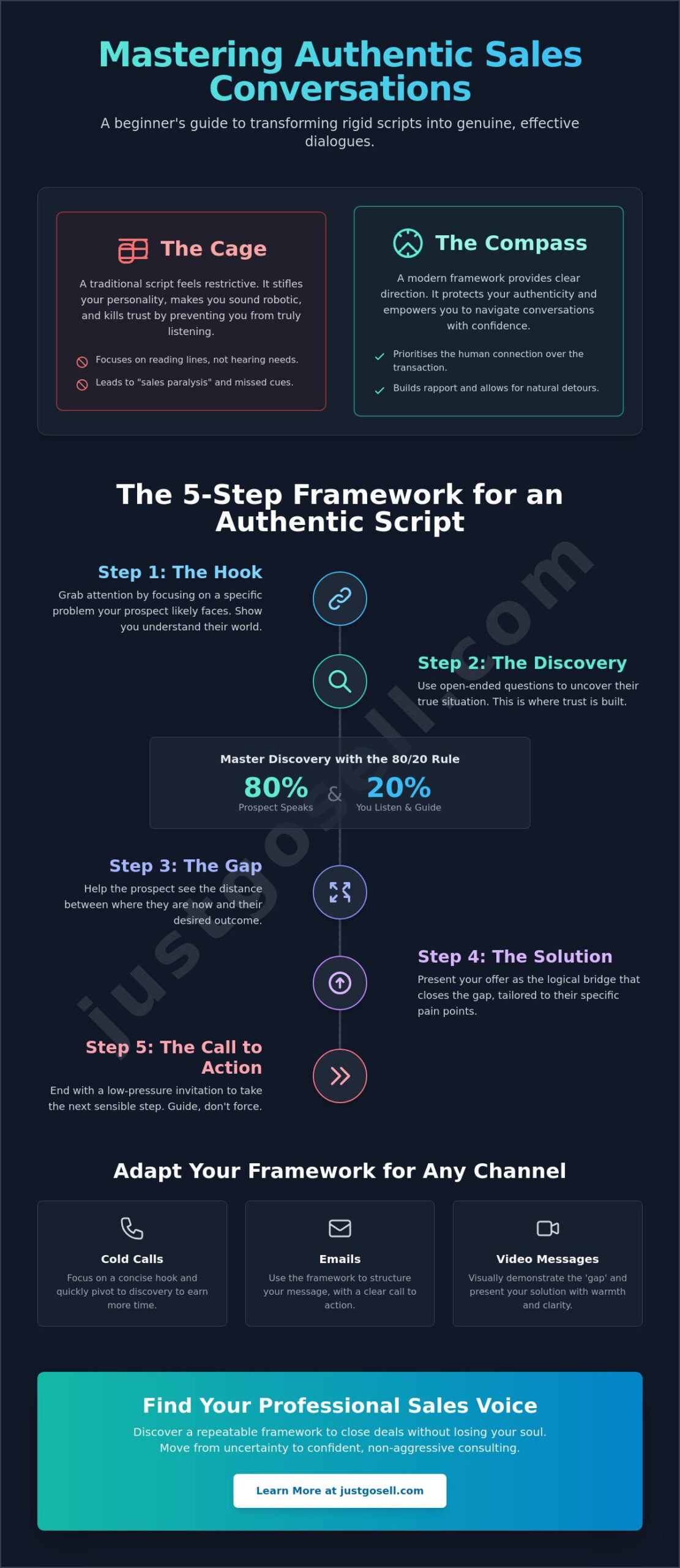
A traditional script often feels like a cage. It restricts your personality, makes you stiff, and prevents you from reacting to the natural flow of a conversation. You become so worried about staying "on script" that you miss vital cues from your prospect. In contrast, a "compass" script provides a clear direction whilst allowing for natural detours based on the prospect’s responses. It gives you the safety net you need without stifling your unique character. A successful script is one that prioritises the prospect’s needs over the pitch.
Moving Beyond the "Telemarketer" Stereotype
Most of us dread being "that" salesperson; the one who interrupts someone’s day with a scripted, aggressive pitch. This fear of being perceived as insincere often leads to "sales paralysis", where you’re too afraid to say anything at all. However, modern sales training has evolved far beyond these outdated, high-pressure tactics. By rooting your framework in empathy and relationship-building, you can use your own natural vocabulary to lead a prospect to a decision.
When you use words that feel like "you", your confidence naturally increases. You don’t need to adopt a fake persona to be effective. Instead, you can lean into a supportive structure like The Ultimate Sales Professional to find a repeatable way to close deals without losing your soul. It’s about finding your voice, not memorising someone else’s. This shift in mindset allows you to move from a state of uncertainty to a state of action, knowing you have a reliable partner in your process.
The 5-Step Framework for an Authentic Sales Script
Building effective sales scripts for beginners isn’t about writing a rigid play; it’s about mapping a journey. This five-step framework ensures you lead with value whilst keeping the conversation fluid and human. By following a structured roadmap, you can stay present in the moment rather than worrying about what to say next.
- Step 1: The Hook – Grab attention immediately by focusing on a specific problem your prospect is facing. Avoid opening with your product features; instead, show them you understand their world.
- Step 2: The Discovery – Use open-ended questions to uncover their current situation. This is the foundation of trust.
- Step 3: The Gap – Help the prospect see the distance between where they are now and where they want to be. If they don’t feel the gap, they won’t see the need for a solution.
- Step 4: The Solution – Present your offer as the logical bridge that closes that gap. Tailor your explanation to the specific pain points they just shared.
- Step 5: The Call to Action – End with a low-pressure invitation to take the next sensible step. You aren’t forcing a decision; you’re suggesting a path forward.
Mastering the Discovery Phase
The secret to a great script is actually silence. Follow the 80/20 rule: let the prospect speak for 80% of the time whilst you listen for 20%. Your job is to be a detective, not a presenter. When you listen deeply, the prospect feels understood, which naturally lowers their guard. Try including these three essential discovery questions in your framework:
- "What is the biggest challenge you’re facing with [Topic] right now?"
- "How is that challenge affecting your daily results or stress levels?"
- "If you could fix this by next month, what would that change for your business?"
Refining these questions to suit your specific industry is a core part of 1-to-1 sales coaching, where we help you find the exact words that feel natural to your personality.
Crafting a Non-Pushy Call to Action
Many beginners feel a surge of anxiety when it’s time to ask for the business. You’ve been helpful and empathetic, and suddenly it feels like you’re "selling". To fix this, use "if/then" logic. This makes the next step feel like a mutual decision rather than a high-pressure demand. For example, you might say: "If you feel this could solve the problem we discussed, then perhaps the next step is a quick demo?"
Low-friction CTAs keep the momentum going without triggering rejection. You could ask, "Does it make sense to explore this further?" or "Would it be helpful to see how this works in practice?" These phrases lead the prospect to a decision without being aggressive. If you’re struggling to find the right words for your offer, reach out for guidance on building a framework that works for you.
Adapting Your Script for Phone, Email, and Social Media
In 2026, your prospect isn’t just sitting by a desk phone waiting for a call. As mentioned, research predicts that 80% of B2B sales interactions now occur through digital channels. This means sales scripts for beginners must be agile; they need to work just as well in a LinkedIn inbox as they do on a traditional voice call. The core of your message stays the same, but the delivery must change to suit the medium. Success comes from knowing how to pivot your framework whilst maintaining that essential human connection.
On a cold call, you have roughly ten seconds to earn the right to continue. Don’t waste them with a generic "How are you today?" which immediately signals a telemarketing vibe. Instead, use a pattern interrupt that acknowledges you’re a stranger but offers immediate value. If you can survive those first ten seconds by being transparent and respectful of their time, you’ve already won half the battle. McKinsey research found that more than 70% of B2B decision-makers now prefer remote human interactions or digital self-service over traditional face-to-face engagement, so your digital presence and phone manner are your most powerful tools.
Personalised video messages are the breakthrough tool of 2026. A 30-second clip where you mention a specific challenge the prospect is facing can cut through the noise of a crowded inbox. It shows effort and character. When you use video, your script shouldn’t be read from a screen; it should be a loose guide that allows your natural energy to shine through. This is where your self-belief becomes contagious. If you’re struggling to find that confidence, The Ultimate Sales Professional training program provides the structural fundamentals to help you project authority on camera.
The Art of the Social Media "Opener"
The quickest way to get blocked on LinkedIn is "pitch-slapping", which is sending a sales pitch the moment a connection request is accepted. It’s aggressive and insincere. Instead, start your script by mentioning a favourite piece of their recent content. This shows you’ve done your homework and actually care about their perspective. Your goal in a DM is never to close a deal; it’s simply to move the conversation from a comment thread to a discovery call. Keep your messages under three sentences; anything longer feels like a chore to read.
Email Scripts That Get Replies
Email is about starting a dialogue, not delivering a lecture. Use subject lines that balance curiosity with clarity. Avoid "clickbait" titles that lead to disappointment. The "Short and Sweet" rule is vital for beginner scripts; if your email takes more than twenty seconds to read, it’s too long. Every sentence should lead the reader to the next one, culminating in a simple question that’s easy to answer. The goal of the email is to spark a conversation, not to complete a sale. If you’d like to refine your outreach strategy, 1-to-1 sales coaching can help you craft templates that feel like a natural extension of your personality.
Overcoming Sales Nerves and Handling Rejection
If the thought of picking up the phone makes your heart race, you aren’t alone. Sales anxiety is a physiological response to the fear of social rejection, and it’s perfectly natural. Most online advice tells you to "just keep dialling" or "develop thicker skin", but that doesn’t address the underlying stress. Effective sales scripts for beginners act as a psychological shield. When you have a proven framework to follow, you don’t have to worry about "going blank" or saying the wrong thing. This structure allows you to stay calm whilst focusing on the person you’re trying to help. Mindset is your foundation, and your vocabulary is simply the tool that builds upon it.
Reframing rejection as a data point is a vital step in your professional growth. Every "no" is not a personal failure; it’s simply information telling you that the timing, the fit, or the need isn’t quite right. When you view conversations this way, the sting of rejection disappears. You’re no longer seeking approval; you’re seeking clarity. This shift builds incredible self-belief because your worth is no longer tied to the outcome of a single call. If you want to explore how empathy and mindset can transform your results, online sales training focused on these principles can help you unlearn the rigid tactics that hold you back.
The "Fit or No Fit" Mindset
Your primary goal isn’t actually to get a "yes". It’s to find out if there is a genuine fit between their problem and your solution. This shift in perspective is incredibly empowering. Instead of being a performer seeking approval, you become a consultant conducting an interview. Your job is to disqualify anyone who isn’t a good match for your help. This mindset instantly removes the pressure to perform because you’re no longer trying to force an outcome. The Ultimate Sales Professional course covers this mindset shift in depth, helping you bridge the gap between insecurity and professional mastery.
Dealing with Common Objections
When a prospect says "I need to think about it", it’s often a signal that a discovery step was missed earlier in the conversation. Don’t panic. You can stay in the conversation whilst remaining respectful and professional. Use a simple 3-part script to handle this calmly:
- Acknowledge: "That makes perfect sense; it’s a big decision."
- Validate: "I’d want to be 100% sure too before moving forward."
- Explore: "Just so I can be helpful, what’s the main area you’re still weighing up?"
This approach allows you to uncover the real concern without appearing pushy. It keeps the dialogue open and shows the prospect that you are a reliable partner, not just a salesperson chasing a commission. If you want to learn how to lead prospects to a decision with confidence, talk to me today about our personalised training options.
Mastering Your Sales Voice with The Ultimate Sales Professional
Finding the right sales scripts for beginners is only the first step on your journey. True success comes when those words stop feeling like a borrowed costume and start feeling like a natural extension of your character. At Just Go Sell, we lead with a philosophy of supportive, human-centric selling that rejects the aggressive, high-pressure stereotypes found in traditional industry training—a philosophy mirrored by independent, family-owned agencies like olliejamesrealestate.com.au that prioritise genuine connection. We believe that anyone can succeed if they have the right foundation and a mentor who understands the specific psychological hurdles of the profession.
Generic YouTube tutorials often provide fragmented information that leaves you more confused than when you started. A structured, mentor-led approach is different. It provides a cohesive roadmap that moves you from a state of uncertainty to a state of action. When you join a programme like The Ultimate Sales Professional, you aren’t just getting a static document; you’re gaining a reliable partner invested in your long-term growth. You can expect a deep dive into everything from the mindset required for high-stakes calls to the structural fundamentals that drive commercial results.
Why Customisation is Key
We avoid one-size-fits-all scripts because they ignore your unique personality. If a script doesn’t suit the person using it, the prospect will sense the disconnect immediately. Our "Unconventional Methods" focus on individual-centric methodologies, ensuring the process fits you rather than forcing you to change who you are. Having a professional review your script and delivery helps identify the subtle nuances that build trust and authority whilst you remain authentic. You can explore our full curriculum in the Ultimate Sales Professional Course 2026 Guide to see how we organise our training for maximum impact.
Your Path from Beginner to Mastery
The road to mastery is paved with action. It’s better to start today with an imperfect script than to wait for a perfect moment that never arrives. Every conversation you lead is an opportunity to refine your voice and strengthen your self-belief. Remember that your job is to be a consultant and a problem-solver; when you lead with that intention, the fear of rejection naturally fades away. We’re here to help you bridge that gap between where you are now and the confident, consistent closer you want to become. Book a discovery call and start your journey towards professional excellence today.
Take Control of Your Sales Future
You now have the tools to transform your approach from nervous pitching to confident consulting. By viewing sales scripts for beginners as a strategic compass rather than a rigid cage, you can navigate any conversation whilst staying true to your personality. Success in 2026 isn’t about having the loudest voice; it’s about having the most empathetic ear and a structured framework that guides your prospects to the right decision. This shift in perspective ensures you’re no longer seeking approval, but instead seeking a genuine fit for your solution.
The journey from a hesitant newcomer to a professional closer doesn’t have to be a lonely one. Mentor-led training, headed by myself (Colin Knowles), focuses on non-traditional, non-pushy methods designed specifically for entrepreneurs who want to lead with integrity. You can leave the telemarketer stereotypes behind and embrace a methodology that prioritises human connection and commercial results. By pairing your script framework with proven relationship selling techniques, you can build the kind of trust-based connections that generate consistent, long-term revenue. If you are ready to replace sales anxiety with a repeatable system for growth, it’s time to take the next step.
Alternatively, if you are looking to build a team, Coaching Sales allows you to explore Sales Recruiting and Placement to find high-performance talent for your organisation.
Transform your selling skills with The Ultimate Sales Professional course and discover how much you can achieve when you have the right partner by your side. You have everything it takes to succeed; you just need the foundation to let your character shine.
Frequently Asked Questions
How do I start a sales script without sounding like a telemarketer?
You can avoid the telemarketer stereotype by using a pattern interrupt that immediately acknowledges the nature of the call whilst offering value. Instead of asking how they are, try being transparent about why you’re calling and how it relates to a specific problem they might be facing. This respectful approach lowers their guard and shows you’ve done your research. It’s about starting a human conversation rather than delivering a rehearsed pitch.
What is the 80/20 rule and how does it apply to sales scripts for beginners?
The 80/20 rule states that your prospect should do 80% of the talking whilst you listen for the remaining 20%. When developing sales scripts for beginners, ensure your framework is built around open-ended discovery questions. This allows the prospect to describe their pain points in their own words. Your role is to guide the conversation with your script and listen for the "gap" where your solution can help.
Should I memorise my sales script or just keep it in front of me?
You should keep your script in front of you as a visual guide rather than trying to memorise every word. Memorisation often leads to a stiff, robotic delivery that kills rapport. Treat your script as a strategic compass that provides direction whilst allowing you to remain present and reactive. This flexibility helps you maintain your natural personality whilst ensuring you don’t miss any vital steps in your sales process.
How do I handle the "I am not interested" objection early in a call?
Handle early objections by acknowledging their response and asking a single, low-pressure question to clarify their situation. Sometimes "not interested" is a reflex reaction to being interrupted. By calmly stating that you understand and asking if they already have a solution for a specific problem, you can determine if there’s a genuine lack of fit or just a timing issue. It’s about seeking clarity, not forcing a "yes".
Can I use the same sales script for different types of customers?
You should use the same core framework but customise the specific hooks and pain points for different customer segments. Whilst the 5-step structure remains consistent, the vocabulary you use must reflect the unique challenges of each niche. This ensures your sales scripts for beginners feel relevant and personalised. Tailoring your language shows the prospect that you truly understand their world, which is essential for building trust quickly.
How long should an initial sales discovery script be?
Your initial discovery script should be concise enough to fit on a single page, focusing on three to five high-impact questions. Whilst a discovery call might last twenty minutes, the script itself is just the roadmap to keep you on track. It should provide enough structure to uncover the prospect’s needs without becoming a rigid monologue. Keep your questions focused on the problem you solve to ensure the conversation stays productive.
Why do I feel so anxious before using my sales script?
Anxiety is a natural response to the psychological hurdle of potential rejection. It often stems from a lack of certainty about what to say or how the prospect will react. Using a structured script provides a safety net that reduces this performance stress. By shifting your focus from "getting a deal" to "finding a fit", you can lower the stakes and feel more at ease during the conversation.
What are the best tools for organising my sales scripts in 2026?
In 2026, the best tools for organising your scripts are those that integrate directly with your CRM or communication platforms. Many sales professionals use digital workspaces or specialised sales intelligence tools that provide real-time prompts during calls. These tools help you stay organised whilst allowing for the customisation required in modern selling. Having your framework easily accessible ensures you can lead every conversation with professional confidence.

Article by
Colin Knowles
Sales Growth Consultant | Sales Director | Author | Founder: JustGoSell
With an extensive background in corporate sales training and team leadership, my role as Sales Trainer and Director at Just Go S.L. revolves around empowering sales professionals to excel. My approach has consistently fostered environments where sales teams surpass targets, thanks in part to my focus on effective sales processes and direct sales techniques.
At the core of my professional ethos lies the commitment to continual development and adaptation of sales strategies to stay ahead in a dynamic market. Through one-on-one coaching, group webinars, and the authorship of "JustGoSell," I have solidified my reputation as a catalyst for transformative sales results and an advocate for sustained sales skill advancement.