
What if the biggest barrier to your next record-breaking quarter isn’t your lead quality, but the secrets your top performers are keeping from the rest of the team? It is incredibly draining to manage fragmented channels whilst watching your best insights get trapped in individual silos. You know your team has the talent, yet the internal anxiety and lack of transparency often stall your momentum. It’s a common struggle; in fact, Gartner found that 83% of sales leaders believe their teams struggle to keep pace with changing buyer needs and expectations; a challenge that continues to shape modern selling.
You can change this dynamic. This guide will show you how to master sales team communication to transform your group into a collaborative powerhouse where psychological safety replaces stress. We will explore how to build a culture where wins and failures are shared openly, leading to clearer processes and higher conversion rates. By the end of this article, you will have a roadmap to reduce team turnover and create a supportive environment where every individual can truly master their professional craft.
Key Takeaways
- Understand why internal communication is more than just data exchange, but a vital support system that prevents revenue-killing silos and rep burnout.
- Discover how to foster psychological safety so your reps feel empowered to share “lost deal” post-mortems whilst learning from failures as a collective.
- Learn to balance formal meetings with organic moments by using your CRM as the absolute single source of truth for all team data.
- Master the five essential steps to audit internal friction and implement effective sales team communication rules that keep your channels clear and productive.
- Explore how bespoke Team Sales Training and the “Ultimate Sales Professional” philosophy can help your team move past performance anxiety toward collective mastery.
What is Sales Team Communication and Why Does it Matter?
Internal sales communication is the heartbeat of a high-performing department. It isn’t just about the words you use to close a deal; it’s the constant exchange of technical data, strategic insights, and emotional support amongst your reps. Effective Workplace communication ensures that when one person learns a new objection-handling technique, the whole floor levels up. Without this flow, you fall victim to the ‘Silo Effect’. This happens when top performers hoard their best tactics, leading to a fragmented culture where revenue plateaus whilst individual burnout sky-rockets. When your team stops talking, they stop growing.
To master sales team communication, you must focus on three essential pillars. First, there is written communication, which lives in your CRM and Slack channels; this provides the ‘single source of truth’ for every lead. Second, verbal communication occurs during your daily stand-ups and strategy sessions, allowing for real-time problem-solving. Finally, non-verbal communication is the collective team energy and body language that dictates the ‘vibe’ of the office. When these pillars are strong, internal transparency directly fuels higher external closing rates because your team feels confident, supported, and fully informed.
The Hidden Cost of Poor Communication
When information is fragmented, the business suffers in ways that don’t always show up on a spreadsheet immediately. Fragmented lead data leads to poor handovers, which means prospects have to repeat themselves, killing rapport and losing deals. Junior reps often face intense sales anxiety when they feel unsupported by a lack of clear internal dialogue. This pressure is real; 83% of sales leaders recently reported that their teams struggle to adapt to evolving customer needs. If your top performers feel they’re carrying the entire weight alone, turnover rates will inevitably climb as they seek a more collaborative environment.
Internal vs. External Communication: The Crucial Difference
Many leaders focus exclusively on how their team speaks to prospects, yet they ignore how the team speaks to each other. Your internal ‘vibe’ is the foundation for every external interaction. If your internal culture is hyper-competitive and secretive, that tension will bleed into sales calls, making prospects feel uneasy. Moving from a competitive to a collaborative mindset requires a fundamental shift in leadership. The sales manager should act as a communication facilitator who encourages open dialogue rather than a lecturer who simply barks orders. Adopting the Ultimate Sales Professional philosophy helps bridge this gap, turning individual insecurity into collective mastery by focusing on the person behind the script.
The Psychology of Collaboration: Building a "Safe" Sales Floor
High-performance environments often breed a culture of silence. Reps are frequently terrified that admitting a mistake will lead to a reprimand or a loss of status amongst their peers. However, true sales team communication flourishes only when people feel safe enough to be honest about their struggles. Psychological safety isn’t a "soft" HR concept; it’s a vital commercial asset, and professional HR consultancies like The Greater Change can help you embed these values into your organisational structure. When your team isn’t afraid of being judged, they share the raw truth about why deals are stalling, which allows for rapid pivot strategies that save revenue.
Leaders who demonstrate vulnerability build the strongest foundations of trust. By sharing your own "lost deal" stories, you give your team permission to do the same. This openness is often found through unconventional methods that challenge the traditional, high-pressure industry stereotypes. It’s about creating an atmosphere where the human element is front and centre, moving beyond simple metrics to focus on the individual’s character and growth. If you feel your current environment is too rigid, you might want to reach out for a fresh perspective on building a supportive culture.
Overcoming the Fear of Judgement
We must reframe rejection as collective team data rather than personal failure. If a rep loses a major account, the goal shouldn’t be to find fault, but to harvest the lesson for the entire group. Establishing "No-Judgement Zones" during weekly debriefs allows the team to dissect losses without the weight of shame. Psychological safety is the bedrock of sales innovation, allowing individuals to experiment with new tactics without the paralysing fear of getting it wrong.
Active Listening Within the Team
Sales managers often fall into the trap of being the loudest person in the room. To foster a truly collaborative culture, leaders need to listen far more than they speak during team huddles. This shift involves validating peer feedback amongst competitive reps so that advice feels like a gift rather than a critique. Encouraging peer-to-peer coaching over top-down instruction builds a resilient support structure where every voice matters. When reps coach each other, they develop a shared language that makes the entire sales team communication process more fluid and effective. This approach moves the team away from a one-size-fits-all script and empowers each person to find their unique professional voice.
Structured vs. Unstructured Communication: Finding the Balance
Finding the right rhythm for sales team communication is a delicate dance. You need enough structure to keep the wheels turning, but not so much that you stifle the organic, "water-cooler" moments where the best ideas often spark. Whilst formal meetings provide a necessary framework, the unscripted chats amongst reps are where tribal knowledge truly lives. It is in these unstructured moments that a senior rep might casually mention a specific trigger word that unlocked a difficult gatekeeper, a piece of gold that rarely makes it into a formal PowerPoint presentation.
To foster these organic connections, many leaders look to immersive team-building experiences; you can learn more about Perfect Murder to discover how their interactive dinner events help teams bond and communicate in a low-pressure environment.
The Daily Stand-up: 10 Minutes to Success
Run a high-energy morning huddle that feels like a launchpad rather than a chore. Keep it strictly to 10 minutes and ensure everyone is standing up to maintain a sense of urgency. Don’t waste time reading out numbers that are already visible on your dashboard. Instead, focus entirely on "Blockers" and "Wins". Ask your reps what is standing in their way and celebrate a specific success from the previous day. This keeps the rhythm energetic and forward-moving, ensuring the team starts the day with a sense of collective momentum.
Leveraging Technology Without Losing the Human Touch
Establish a "Centre of Excellence" for your sales documentation where anyone can find the latest scripts and strategy guides. Technology should empower your people, not isolate them. Know when to stop typing and pick up the phone. If a Slack thread involves more than five messages, it’s time for a quick internal call to clear the air. Building a culture that values the human voice helps reduce sales anxiety and fosters genuine trust. By integrating the insights gained from 1-to-1 coaching into your broader team learning, you ensure that individual breakthroughs become a shared asset for the entire group.
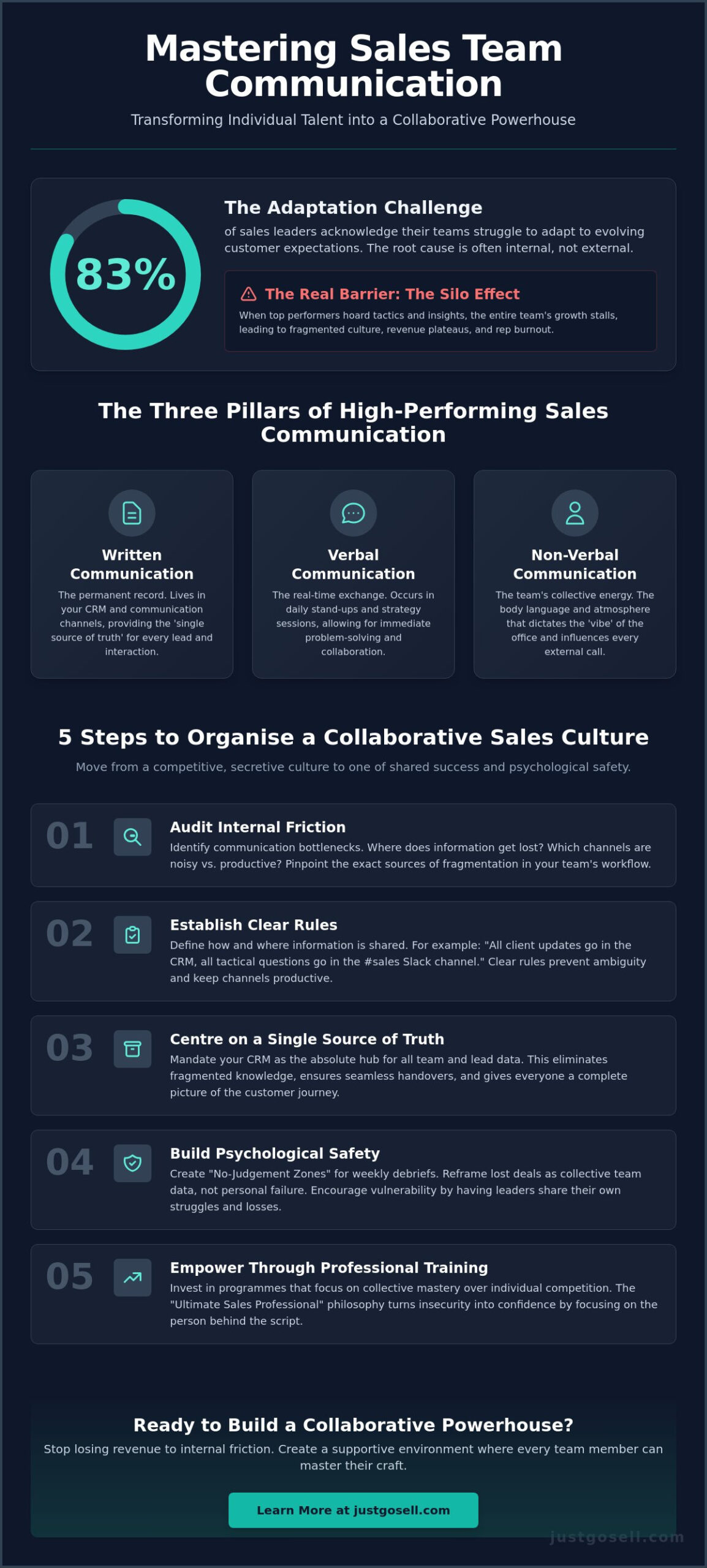
5 Steps to Organise a Collaborative Sales Culture
Transforming your team’s internal dialogue requires more than just a motivational speech; it demands a structured framework for change. To truly master sales team communication, you need to move beyond theory and into active implementation. Follow these five steps to build a culture that thrives on transparency and mutual support.
- Step 1: Audit your current communication friction points. Look for the gaps where information disappears, particularly during the transition from marketing to sales.
- Step 2: Establish "Rules of Engagement" for team channels. Define which updates belong in Slack, which require a CRM entry, and which warrant a face-to-face discussion.
- Step 3: Incentivise knowledge-sharing. Shift the focus so that reps are rewarded for helping the collective, not just for their individual closing figures.
- Step 4: Implement a "Buddy System" for junior and senior reps. This encourages the natural flow of tribal knowledge and reduces the sales anxiety often felt by new starters.
- Step 5: Review and refine your communication cadence monthly. What worked during a busy quarter might not suit a slower period, so keep your processes adaptable.
If you’re ready to overhaul your internal processes and build a truly collaborative force, get in touch with us today to discuss how our Team Sales Training can help you implement these steps effectively.
Auditing Your Communication Friction
Identify exactly where the ball is being dropped in your current workflow. This often happens when lead data is fragmented, leaving reps to guess a prospect’s history—a challenge where revenue-focused agencies like Stratagon help bridge the divide between marketing campaigns and sales execution. Survey your team to find out which meeting formats they find valuable and which ones they find soul-crushing. Customisation of your internal workflows is essential because a process that doesn’t fit your team’s unique character will never be followed. When you remove these friction points, you allow your reps to focus on their professional mastery rather than fighting against broken systems.
Incentivising the "We" Over the "Me"
Empowering Your Team Through Professional Training
Breaking cycles of silence often requires an outside voice. If your team has fallen into a pattern of hiding failures or working in silos, it is incredibly difficult to fix that from the inside. External Team Sales Training provides a necessary mirror to your current culture. It allows reps to see their own sales team communication blockers without feeling attacked by internal management. This is where the shift from a group of individuals to a collaborative powerhouse begins, moving beyond the mechanics of the job to the heart of how you work together.
The Just Go Sell Approach to Team Dynamics
Our approach focuses on the "Ultimate Sales Professional" mindset to instil a sense of genuine pride amongst your staff. We look past the scripts to identify the psychological hurdles that stop people from sharing their best ideas. Through personalised coaching, we can pinpoint individual blockers that might be stalling your collective progress. You can learn more about how this works by exploring The Ultimate Sales Professional Course, which is specifically designed to transform team dynamics from the ground up.
Next Steps for Your Sales Team
The journey toward better sales team communication starts with a single step of self-awareness. Booking a discovery call allows us to assess your team’s current skill level and identify the specific friction points that are costing you revenue. Whilst team training is vital, investing in 1-to-1 coaching for your leaders often pays the highest dividends, as it empowers them to facilitate this new culture every single day. If you are ready to move from fragmented data to a unified strategy, we invite you to explore our corporate training options and start your transformation today.
Transform Your Sales Floor Into a Collaborative Powerhouse
Mastering your internal dialogue is the most effective way to protect your revenue in an increasingly complex market. We’ve explored how psychological safety allows for honest "lost deal" post-mortems and why finding a balance between formal CRM data and organic water-cooler moments is vital. By following a structured five-step audit, you can strip away the friction that leads to rep burnout and silence.
Effective sales team communication isn’t just a management theory; it’s a practised discipline that requires the right mentorship. Founded by myself (Colin Knowles), Just Go Sell focuses on helping teams overcome sales anxiety by building deep-rooted self-belief. We provide customised workshops for global teams that move beyond generic scripts to address the human element of the industry.
If you’re ready to bridge the gap between individual insecurity and professional mastery, now is the time to act. Book a 1-to-1 Coaching Session to transform your team communication and start building a culture where everyone wins together. You have the talent; let’s give them the foundation to truly thrive.
Frequently Asked Questions
How often should a sales team have formal meetings?
Aim for a 10-minute high-energy stand-up every morning to align on blockers and immediate wins. Supplement this with a weekly strategy session lasting 45 to 60 minutes for deeper analysis and peer-to-peer coaching. Avoid "meeting for the sake of meetings" by ensuring every formal slot has a clear agenda. This structure keeps the team focused whilst leaving enough room for the organic, unstructured chats that drive innovation.
What are the best tools for sales team communication in 2026?
How do I get quiet sales reps to participate more in team discussions?
Focus on building psychological safety so quiet reps feel their voice holds equal weight to the top billers. Instead of asking open questions to the whole room, try a round-robin format during huddles where everyone shares one specific blocker. You can also ask quiet performers to lead a mini-session on a technical area where they excel. This builds their self-belief and professional mastery without the pressure of a high-stakes performance.
Can too much communication actually hurt sales performance?
Excessive communication becomes "noise" when it lacks a specific purpose or actionable outcome. If your reps spend hours responding to non-urgent Slack threads, their "time on tools" and closing rates will inevitably drop. High-performance sales team communication should be punchy, relevant, and timed to support the workflow rather than interrupt it. Audit your channels regularly to ensure you aren’t burying vital strategic data under a mountain of digital clutter.
How do I handle a "toxic" communicator in my sales team?
Address toxic behaviour immediately through a private session to understand the root cause of the negativity. Often, a cynical communication style stems from personal sales anxiety or a feeling of being unsupported. Be clear about how their tone affects the team’s psychological safety and collective results. If the behaviour doesn’t improve after coaching, you must protect the wider team culture to prevent a drop in overall morale and performance.
What is the best way to share sales wins without sounding arrogant?
Reframe the win as a learning opportunity for the whole floor by focusing on the "how" rather than the "how much". Instead of just announcing a figure, explain the specific strategy or objection-handling technique that secured the signature. Credit the team members who provided lead data or strategic advice during the process. This approach turns a personal victory into a collective asset that empowers everyone to master their professional craft.
How can remote sales teams maintain a strong communication culture?
Remote teams must be intentional about creating the "organic" moments that happen naturally in a physical office. Use short, daily video stand-ups to maintain a human connection and prevent the isolation that leads to burnout. Establish a clear "Centre of Excellence" for documentation so remote reps never feel out of the loop. Encouraging peer-to-peer coaching via asynchronous video helps bridge the physical gap and builds a supportive, global culture.
Is it better to use Slack or email for internal sales updates?
Slack is generally superior for the fast-paced nature of sales team communication and real-time collaboration. It allows for quick pivots and high-energy updates that email often stifles with its formal structure. Reserve email for permanent records, such as contract approvals or major policy changes. Using the right channel for the right purpose reduces digital fatigue and keeps your team’s focus exactly where it belongs: on the prospect.

Article by
Colin Knowles
Sales Growth Consultant | Sales Director | Author | Founder: JustGoSell
With an extensive background in corporate sales training and team leadership, my role as Sales Trainer and Director at Just Go S.L. revolves around empowering sales professionals to excel. My approach has consistently fostered environments where sales teams surpass targets, thanks in part to my focus on effective sales processes and direct sales techniques.
At the core of my professional ethos lies the commitment to continual development and adaptation of sales strategies to stay ahead in a dynamic market. Through one-on-one coaching, group webinars, and the authorship of "JustGoSell," I have solidified my reputation as a catalyst for transformative sales results and an advocate for sustained sales skill advancement.