

A 2026 study by Charlene DeCesare at Johnson & Wales University found that approximately 80% of 204 surveyed B2B sales professionals experienced moderate to intense feelings of imposter syndrome. (Source: Johnson & Wales University, 2026)
Even in 2026, the majority of us still feel like we’re just one discovery call away from being "found out" as a fraud. If you’re currently focused on overcoming imposter syndrome in a sales role, you’ve likely felt that exhausting anxiety that comes from attributing your hard-earned wins to luck whilst dreading being seen as pushy or insincere.
It’s a heavy burden to carry, but it doesn’t have to be your permanent reality. We believe that true sales confidence doesn’t come from a script or a "fake it till you make it" attitude. Instead, it comes from replacing stressful guesswork with a professional, relationship-driven framework. This shift allows you to stop feeling like a vendor and start acting as a genuine, trusted partner to your clients.
In this guide, we’ll show you exactly how to silence your inner critic by mastering a repeatable process. You’ll discover how to build a foundation of self-belief that transforms your pitches from high-pressure hurdles into helpful conversations. Let’s explore how you can reclaim your professional mastery and achieve the consistent results you deserve.
Key Takeaways
- Uncover why the high-visibility nature of sales often leads to feelings of inadequacy and how to reframe these common psychological barriers.
- Learn how overcoming imposter syndrome in a sales role requires shifting your identity from a “vendor” to a trusted, professional partner.
- Discover the power of a repeatable framework to remove the guesswork from your discovery calls and build genuine confidence.
- Master practical exercises like the “Evidence Journal” to catalogue your value and silence your inner critic for good.
- Find out how adopting the standards of the “Ultimate Sales Professional” provides a consistent roadmap for long-term commercial success.
What is Imposter Syndrome in a Sales Role?
At its core, imposter syndrome is the nagging, persistent belief that your successes are merely the result of luck or timing rather than genuine ability. In a commercial context, it manifests as the fear that you’ll be "exposed" as incompetent by a prospect or a colleague. To understand the psychological roots of this phenomenon, it helps to look at What is Imposter Syndrome? and how it specifically targets high-achievers. For many professionals, overcoming imposter syndrome in a sales role feels like an uphill battle because the profession is inherently measurable and public.
Sales is a unique breeding ground for these feelings. You face constant visibility, frequent rejection, and the relentless pressure of monthly quotas. When you win a deal, the voice in your head might whisper that the lead was just "easy." When you lose, it screams that you aren’t cut out for this. This leads to the "fraud paradox," where even top performers feel they’re faking it. They believe their success is an accident that could vanish at any moment. Whilst healthy nerves before a pitch are normal, debilitating imposter syndrome can paralyse your growth and lead to burnout.
Common Symptoms Amongst Sales Professionals
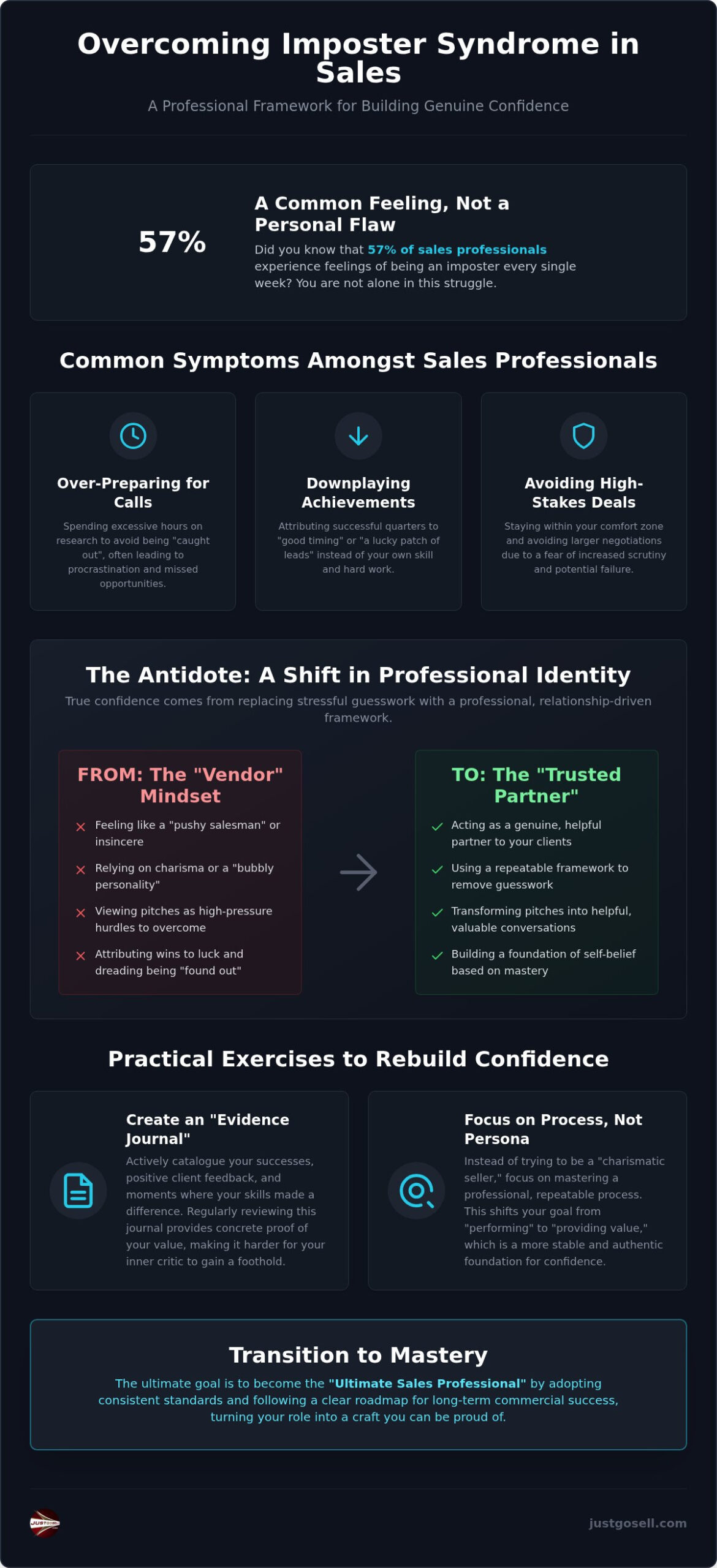
Recognising the signs is the first step toward reclaiming your confidence. Many talented individuals find themselves trapped in these specific behaviours:
- Over-preparing for calls: Spending hours researching a prospect to avoid being "caught out" by a question, often leading to procrastination and missed opportunities.
- Downplaying achievements: Attributing a successful quarter to "good timing" or "a lucky patch of leads" instead of your own skill and hard work.
- Avoidance of high-stakes negotiations: Staying within your comfort zone and avoiding larger deals because you fear you won’t be able to handle the increased scrutiny.
The Impact of 2026 Market Trends on Self-Belief
By the end of 2026, the rapid advancement of AI and automation has added a new layer of complexity to the salesperson’s psyche. With AI handling more administrative tasks, some sellers feel like redundant middlemen. Data from the 2025 PwC Global AI Jobs Barometer shows a wage premium for those with AI skills, which can create immense pressure to keep up with a shifting landscape. However, the market is also shifting towards relationship-first selling. This trend actually benefits the "quiet" professional who focuses on empathy over aggression.
Whilst overcoming imposter syndrome in a sales role is a journey, it starts with a simple reframe. Think of imposter syndrome not as a permanent personality flaw, but as a temporary gap between your current skill set and your evolving professional identity. If you feel these barriers are holding you back, 1-to-1 Sales Coaching can provide the personalised support needed to bridge that gap and build a foundation of genuine mastery.
Why Entrepreneurs and Beginners Struggle with Sales Identity
Many founders find themselves in a sudden identity crisis. They’ve spent months or years building a brilliant product, but they eventually reach a point where they must become the face of the business. This is the "Accidental Salesperson" trap. They often carry a negative, outdated stereotype of the "pushy salesman" in their minds, they feel a deep internal conflict. They worry that by engaging in commercial conversations, they’re becoming someone manipulative or insincere. This friction is a primary driver for those struggling with overcoming imposter syndrome in a sales role. It’s hard to feel like a professional when you’re terrified of being perceived as a "shyster."
Relying on charisma or a "bubbly personality" only makes the problem worse. If your success depends on being "on" or "charming," you’ll feel like an imposter the moment your energy dips or a prospect asks a difficult question. This reliance on personality creates a fragile foundation. Instead, focusing on sales mindset tips helps beginners shift from "performing" to "providing value." Current research from MIT Sloan on debunking imposter syndrome myths suggests that these feelings are often misplaced. Reframing your perspective is the most effective way to build lasting confidence without feeling like you’re wearing a mask.
Deconstructing the ‘Natural-Born Seller’ Myth
The idea that you need the "gift of the gab" to succeed is entirely outdated. In 2026, the most effective professionals are often introverts and analytical thinkers who prioritise active listening over constant talking. By reframing sales as a method of helping people solve specific problems, you remove the pressure to be a "performer." You aren’t taking someone’s money; you’re offering a solution that improves their life or business. This shift in behaviour allows you to show up as your authentic self whilst still achieving commercial results.
The Psychological Hurdle of ‘Asking for Money’
Conversations about pricing often trigger the most anxiety for those new to the field. Without a clear, professional selling process, beginners tend to drop their prices or offer discounts at the first sign of hesitation. This insecurity stems from a lack of structure. When you follow a proven framework, you realise that professional closing is an act of service, not a confrontation. It’s simply the final step in helping a client reach their desired outcome. If you’re ready to stop faking it and start building a real commercial foundation, feel free to get in touch with our team.
The Antidote: Replacing ‘Faking It’ with a Professional Process
The most common advice for sales anxiety is often the most damaging. You’ll hear that it’s just a "numbers game" or that you should simply "keep calling" until the fear vanishes. However, volume without structure is a recipe for burnout. It reinforces the idea that you’re just throwing things at the wall to see what sticks. True mastery comes from replacing that frantic guesswork with a repeatable, professional process. When you have a clear map for every conversation, you no longer feel like a fraud. You’re simply a professional following a proven path. This structural shift is the only permanent way of overcoming imposter syndrome in a sales role because it moves the focus from your personal "performance" to your professional "process."
Integrating specific strategies to overcome imposter syndrome involves creating a physical and digital toolkit. This includes discovery call templates, qualification checklists, and clear follow-up playbooks. These aren’t just administrative tasks; they are external evidence of your professional status. When you use a structured discovery framework, the pressure to "act" like a salesperson vanishes. You aren’t there to perform a monologue. You’re there to conduct a professional investigation. Documentation gives you something to lean on when your confidence dips, proving that your success is built on a foundation of method rather than luck.
Building a Foundation of Competence
Confidence is a natural byproduct of competence. By mastering the discovery call, you learn to lead with curiosity. You stop worrying about what you’re going to say next and start listening to what the client actually needs. Whilst scripts can be helpful, they should serve as a guide rather than a crutch. The goal is to maintain your authentic voice whilst staying within a professional boundary. Our Ultimate Sales Professional course provides the exact blueprint for this transition, helping you build a foundation that feels natural and sustainable. It turns the "salesperson" role into a structured discipline you can master.
Focusing on Lead Quality and Relationship Building
One of the biggest triggers for imposter syndrome is trying to sell to the wrong people. If you’re attempting to sell to everyone, you’ll face constant rejection from individuals who never needed your help in the first place. This fuels the belief that you’re incompetent. Conversely, "solving for the right person" builds immediate confidence because you can see the genuine impact of your work. This shift from transactional behaviour to long-term partnership changes the dynamic of every call. You stop being a vendor begging for a minute of their time and become a partner solving a critical problem. Measure your success by the quality of the insights you uncover, not just the final signature. This mindset ensures you remain a professional partner, even in a competitive 2026 market.

Practical Exercises to Rebuild Your Sales Confidence
Whilst visualisations or "power poses" might offer a fleeting boost, they don’t address the underlying lack of structure that fuels self-doubt. To truly succeed in overcoming imposter syndrome in a sales role, you need a body of evidence that contradicts your inner critic. Start an "Evidence Journal" today. Every time you help a client navigate a complex challenge or see a tangible result from your product, catalogue it. This isn’t about vanity; it’s about building a factual record of your value. When you can look back at twenty specific instances where you solved a real-world problem, the "fraud" narrative begins to crumble.
Another vital shift involves your definition of success. Most beginners focus entirely on "Outcome Goals," such as closing a specific deal or hitting a monthly target. As you cannot control a prospect’s final decision, this approach naturally breeds performance anxiety. Instead, set "Process Goals." These are entirely within your control, such as following your discovery framework perfectly or asking three specific qualifying questions. By measuring yourself against your professional standards rather than just the final signature, you build a resilient form of confidence that rejection cannot touch.
Sometimes, the psychological barriers are too deeply rooted to dismantle alone. Utilising 1-to-1 sales coaching allows you to identify specific limiting beliefs that are unique to your journey. A mentor provides the objective validation you need to see your progress clearly. Through role-play and structured feedback loops, you can refine your skills in a safe environment, ensuring that your first real-world interaction is grounded in competence rather than hope.
The ‘Pre-Call’ Ritual for Mindset Alignment
Preparation is the best cure for nerves. Develop a ritual for overcoming sales nerves that centres on your professional framework. Before a presentation, take five minutes to review your discovery notes and ground yourself in the client’s specific problem. By moving the spotlight off your own performance and onto the client’s needs, you naturally lower your anxiety. You aren’t there to be liked; you’re there to be helpful.
Post-Call Analysis: Learning from the ‘No’
Rejection is often the biggest trigger for imposter syndrome, but it’s actually your most valuable data source. After every call, ask yourself if the rejection was a "process gap" (something you can fix) or a "bad fit" (something out of your control). I strongly recommend that you record and listen to your calls to separate perception from reality. Often, we think we sounded "shaky" or "pushy," but the recording reveals a professional conversation. This objective analysis helps you identify specific areas for growth without attacking your personal character. If you’re ready to transform your approach and silence your inner critic, speak with our experts today.
Transitioning to Mastery: Becoming the Ultimate Sales Professional
Mastery is not a destination where you suddenly stop feeling doubt. Even the most seasoned professionals in 2026 occasionally hear that quiet voice of insecurity during a high-stakes negotiation. The difference between a beginner and a master is that the master relies on a constant process rather than a fluctuating mood. When you have a solid commercial framework to lean on, your feelings become secondary to your actions. Overcoming imposter syndrome in a sales role is ultimately about accepting that whilst the feeling may recur, your professional standards remain unshakeable.
Maintaining your "professional edge" in a rapidly shifting market requires a commitment to continuous learning. As AI and automation handle more of the administrative burden, your value as a human partner only increases. Transitioning from "surviving" your weekly calls to "thriving" as a confident sales leader means you stop viewing challenges as threats to your identity and start seeing them as opportunities to refine your craft. You are not a fraud; you are a professional in training who is brave enough to show up and solve problems for others.
The Value of a Mentor-Led Approach
Walking the path to mastery alone is often the slowest and most painful route. This is why 1-to-1 sales coaching is such a powerful tool for those serious about their growth. A mentor provides the external perspective needed to dismantle the specific psychological barriers that hold you back. We specialise in this journey, offering a supportive environment that values genuine relationship-building over aggressive, high-pressure industry stereotypes. Finding a community that encourages you to find your own voice is essential for long-term success.
Next Steps for Your Sales Growth
If you’re ready to move beyond the guesswork, your next logical step is building a structured foundation. Enrolling in the Ultimate Sales Professional course provides the blueprint you need to transform your approach. We recommend setting a clear 90-day plan to implement a structured selling process into your daily routine. This period of focused implementation allows you to see the tangible results of a professional method, which is the most effective cure for self-doubt. We invite you to book a personalised coaching session today to tackle your imposter syndrome head-on and start your transition to becoming a truly confident, relationship-driven professional.
Reclaim Your Authority as a Sales Professional
The journey toward overcoming imposter syndrome in a sales role isn’t about changing who you are. It’s about changing how you work. As we’ve explored, true confidence doesn’t stem from a "gift of the gab" or a bubbly personality; it grows from a repeatable, professional process that puts the client first. By cataloguing your wins in an Evidence Journal and shifting your focus to relationship-driven problem-solving, you can silence the inner critic that labels you a fraud.
You have the potential to transition from a hesitant "accidental salesperson" to a high-performing partner. By adopting a proven framework designed for non-sales founders, you ensure that every discovery call is grounded in competence rather than hope. With mentor-led coaching, you’ll have the support needed to navigate the challenges of the 2026 market whilst staying true to your authentic voice.
Ready to stop faking it and start closing with confidence? Enrol in The Ultimate Sales Professional Course today to start your transformation. You’ve already done the hard work of building your expertise; now it’s time to own your success and lead your business with the authority you deserve.
Frequently Asked Questions
Is imposter syndrome common in sales?
Yes, a 2026 study by Charlene DeCesare at Johnson & Wales University found that approximately 80% of 204 surveyed B2B sales professionals experienced moderate to intense feelings of imposter syndrome. Sales is a high-visibility profession where your results are public and measurable. This environment often makes even the most talented individuals feel like they’re just one bad call away from being exposed as a fraud.
How do I deal with imposter syndrome when starting a new sales job?
Start by prioritising your professional process over immediate outcomes. During your first few months, focus on mastering the company’s discovery framework and deeply understanding the client’s pain points. When you anchor your daily activity in a repeatable method, you remove the guesswork that fuels anxiety. Building this foundation of competence is the fastest way to feel like you truly belong in your new seat.
Can an introvert overcome imposter syndrome in a sales role?
Yes, and introverts often have a distinct advantage. Because modern sales in 2026 values empathy and deep listening over aggressive pitching, introverts are naturally equipped for success. By focusing on relationship-driven frameworks, introverts can excel at overcoming imposter syndrome in a sales role. They find confidence by being a quiet, reliable partner rather than a high-pressure performer.
What is the difference between imposter syndrome and a lack of training?
Imposter syndrome is the feeling of being a fraud despite having clear evidence of your achievements. Conversely, a lack of training is a genuine gap in your commercial toolkit. If you’ve never been taught a professional selling process, your nerves are a natural reaction to uncertainty. Once you learn a structured method, you can distinguish between a need for more practice and a psychological hurdle.
How long does it take to get over imposter syndrome in sales?
Whilst everyone’s journey is unique, most professionals see a significant shift within 90 days of adopting a structured process. Consistency is the key. As you move away from guesswork and begin to see repeatable results from your professional framework, your self-belief will naturally strengthen. Using an Evidence Journal to catalogue your successes helps accelerate this transformation by providing factual proof of your ability.
What should I do if I feel like a fraud during a sales pitch?
Immediately pivot your attention back to the prospect. Imposter feelings usually peak when you’re worried about how you’re being perceived. By asking a thoughtful, curiosity-led question about the client’s challenges, you move the spotlight off yourself. This allows you to stop "acting" and start being a helpful partner. It’s much harder to feel like a fraud when you’re actively solving someone’s problem.
How can a sales coach help with imposter syndrome?
A coach acts as a reliable partner who helps you dismantle psychological barriers. Through 1-to-1 Sales Coaching, you get a safe space to practice your discovery calls and handle objections. This external validation is vital because it provides an objective view of your skills. A coach helps you replace your inner critic’s narrative with a factual, professional standard of excellence that you can rely on daily.
Does imposter syndrome ever fully go away for sales professionals?
It might never vanish entirely, especially when you’re pushing into new territory or tackling much larger deals. However, the goal of overcoming imposter syndrome in a sales role is to ensure these feelings no longer dictate your behaviour. When you have a professional framework that you trust, you can perform at a high level even on the days when you don’t feel like an expert.


Article by
Colin Knowles
Sales Growth Consultant | Sales Director | Author | Founder: JustGoSell
With an extensive background in corporate sales training and team leadership, my role as Sales Trainer and Director at Just Go S.L. revolves around empowering sales professionals to excel. My approach has consistently fostered environments where sales teams surpass targets, thanks in part to my focus on effective sales processes and direct sales techniques.
At the core of my professional ethos lies the commitment to continual development and adaptation of sales strategies to stay ahead in a dynamic market. Through one-on-one coaching, group webinars, and the authorship of "JustGoSell," I have solidified my reputation as a catalyst for transformative sales results and an advocate for sustained sales skill advancement.