

According to research by Sales Insights Lab, 61% of salespeople consider selling harder or much harder than it was five years earlier. It’s completely normal to feel a sense of dread before a discovery call or to worry that you’re coming across as a fraud when you finally ask for payment. You’ve likely spent hours perfecting your service, yet the moment you need to talk about its value, that familiar anxiety takes over. We understand that pressure because we’ve helped countless entrepreneurs move past the psychological hurdles that keep them playing small.
In this guide, we’ll share essential sales mindset tips that will help you realise selling isn’t something you do to people; it’s something you do for them. You’ll discover how to transform your relationship with selling by mastering the psychological frameworks used by the world’s most successful professionals. We’ll walk you through a repeatable mental routine to build your confidence and ensure you step into every conversation as a reliable partner, helping you achieve higher conversion rates without ever resorting to high-pressure tactics.
Key Takeaways
- Understand why sales anxiety is a natural biological response and learn how to silence the inner “fraud” whilst asking for the value you deserve.
- Discover practical sales mindset tips that shift your focus from a transactional “yes” to a transformational, problem-solving partnership.
- Move from a scarcity mindset to an abundance framework, allowing you to navigate lost leads with composure and focus on the vast market of ideal clients.
- Establish a consistent “Post-Game” review habit to objectively analyse your performance and build long-term confidence after every discovery call.
- Learn the path to becoming the “Ultimate Sales Professional” by aligning your individual character with proven, service-led sales strategies.
Table of Contents
What is a Sales Mindset? Defining the Path to Success
At its core, a sales mindset is the internal collection of beliefs, attitudes, and psychological frameworks you bring to every commercial interaction. It isn’t just about being "good with people" or having a "gift of the gab". Instead, it’s the mental filter through which you view the entire Personal Selling Process. For many beginners, the struggle isn’t a lack of product knowledge but a shaky internal foundation. By implementing specific sales mindset tips, you can shift from seeing sales as a burden to seeing it as a vital service.
Traditional selling was often viewed as transactional; a simple exchange of goods for cash. Modern professionals, however, embrace a transformational view. They recognise that a successful sale changes the customer’s situation for the better. This mindset is the bedrock of our Ultimate Sales Professional philosophy. It’s the difference between feeling like a nuisance and feeling like a hero. You don’t inherit this perspective; you cultivate it through consistent practice and self-reflection.
Many entrepreneurs feel like they’re "bothering" people. This feeling stems from the belief that sales is something you do to someone. When you realise that your service provides a genuine solution, your confidence naturally rises. Your mindset dictates how every script or tactic performs. If the foundation is weak, the most expensive training in the world will struggle to produce results because the underlying energy remains misaligned. To help align your business with more sustainable, long-term goals, you can discover Jannine Barron and her work as a regenerative business strategist.
The Difference Between "Pushing" and "Solving"
When you focus on "pushing" a product, the pressure is entirely on you to perform. You’re constantly hunting for the right words to convince someone to part with their money. When you pivot to "solving", that pressure evaporates. Your focus shifts to the customer’s desired outcome. You’re no longer a salesperson; you’re a consultant identifying a gap and offering a bridge. The service-led sales approach is the gold standard for 2026, prioritising the client’s success as the primary metric of your own.
Why Technical Skills Fail Without the Right Foundation
You can memorise the most sophisticated scripts in the world, but if they’re delivered from a place of scarcity, they’ll always sound robotic. Prospects are incredibly intuitive. They can sense "commission breath", that subtle air of desperation that appears when you’re too attached to the outcome. If you don’t believe in the value you provide, your voice and body language will betray you. Self-belief acts as a powerful multiplier for every tactic you use. Without it, even the best online sales training won’t bridge the gap between a lead and a loyal client.
Overcoming Sales Anxiety and the Fear of Rejection
If your heart races before a discovery call, you aren’t alone. This anxiety is a natural biological response; our brains are wired to perceive social rejection as a threat to our survival. For entrepreneurs selling their own services, this fear is often amplified by imposter syndrome. When you are the product, a "no" feels like a personal judgement on your worth. You might feel like a fraud for charging professional rates, even whilst knowing your service delivers results. This feeling is common amongst home-based business owners who transition from being a technician to a salesperson. To move past this, we need to apply specific sales mindset tips that help desensitise the brain to the sting of rejection.
One effective approach is "Rejection Therapy", where you intentionally seek out small rejections to prove to your subconscious that you are still safe. You start to realise that a "no" is rarely a personal attack. More often, it’s simply a "not yet" or a "not for me". Shifting your perspective allows you to step into calls with a sense of curiosity rather than a desperate need for validation. It creates an environment where you can listen to the prospect’s needs without the static of your own insecurities drowning them out. Separating your personal self-worth from your professional closing rate is essential for longevity in business. This mental distance allows you to remain objective and professional, even when a deal doesn’t close. It ensures that your energy remains high for the next conversation, rather than spiralling into self-doubt after a single rejection.
Reframing the Meaning of "No"
Try using the "Data Point" method. Treat every rejection as a piece of market feedback rather than a failure. Was it the price, the timing, or the fit? Focus on "disqualifying" prospects early to protect your energy for the right clients. If you’re struggling to find that balance, you can always reach out for a chat about your current strategy.
Practical Exercises for Pre-Call Nerves
Try a 2-minute "Power Routine" to organise your thoughts before a call. Focus on active listening to reduce the pressure to "perform" or entertain. Many beginners find that 1-to-1 sales coaching is the perfect environment to role-play these scenarios and build muscle memory. Mastering these sales mindset tips ensures you ask for the sale with quiet confidence rather than trembling hands.
Scarcity vs Abundance: A Framework for Sales Growth
Your internal framework determines how you show up in every meeting. A scarcity mindset is the belief that there are limited clients and every lost lead is a total disaster. Conversely, an abundance mindset is the belief that the market is vast and the right clients are plentiful. These aren’t just abstract concepts; they dictate your behaviour during a pitch. When you operate from abundance, you can charge what you’re worth without a shred of guilt. You know that if this specific prospect isn’t the right fit, the next one will be. It’s one of the most powerful sales mindset tips we can offer: stop treating every "no" like the end of your business.
The psychological weight of scarcity makes you heavy and difficult to buy from. If you believe that leads are a finite resource, you’ll naturally become over-attached to every conversation. This attachment creates a barrier between you and the prospect. They feel the weight of your expectations, which often leads to them pulling away. Transitioning to an abundance framework allows you to be a reliable partner rather than a desperate seeker of approval. It gives you the "permission" to be picky about who you work with, which, ironically, makes you far more attractive to high-quality clients.
How Scarcity Sabotages Your Closing Rate
Scarcity projects subtle "desperation signals" that prospects pick up on instantly. You might find yourself talking too much, over-explaining your pricing, or agreeing to unreasonable demands just to keep the conversation alive. This fear-based approach often leads to taking on "nightmare clients" who drain your business resources and ignore your boundaries. You accept them because you’re afraid no one else will come along. Discounting your prices just to "win" a deal is a short-term fix that causes long-term damage. It erodes your profit margins and teaches the market that your value is negotiable.
Cultivating Abundance in Your Daily Routine
Building an abundance mindset requires practical, repeatable habits. One of the best ways to maintain this perspective is through rigorous pipeline management. When you always have multiple opportunities in progress, the sting of a single lost deal vanishes. A full pipeline is the ultimate cure for sales desperation. For students looking for freelance work, using a platform like Hustlance can help you maintain a consistent flow of professional projects. We also encourage the "Go-Giver" philosophy, which involves leading with value whilst expecting nothing in return. By focusing on how much value you can provide rather than how much you can get, you naturally build self-belief. This shift in focus reduces your internal pressure and allows your natural personality to shine through in every interaction.
Five Practical Sales Mindset Tips to Use Today
Moving from theory to practice requires a shift in your daily habits. It’s one thing to understand the psychology of selling, but quite another to apply it whilst your heart is pounding during a live call. These practical sales mindset tips are designed to ground you in the moment, allowing you to lead with value rather than anxiety. By focusing on the process rather than the prize, you’ll find that the results often take care of themselves.
-
Focus on the Next Best Action: Stop obsessing over the final "yes". Instead, aim for the next logical step, whether that’s a follow-up meeting or a technical demo. This reduces overwhelm and keeps the conversation moving.
-
Develop a Post-Game Review Habit: Analyse what went well after every call, regardless of the outcome. This turns every interaction into a training session.
-
Practise Detached Engagement: Be 100% present and empathetic with your prospect, but remain emotionally independent of their final decision. Your worth isn’t tied to their signature.
-
Curate Your Environment: Surround yourself with positive resources and your favourite motivational mentors to keep your internal dialogue constructive.
-
Celebrate Small Wins: High-five yourself for a well-handled objection or a successful follow-up. These micro-victories build the momentum needed for larger deals.
The Power of the Post-Call Review
The fastest way to improve is to become your own coach. After every interaction, ask yourself three specific questions: What did I do well? Where did the conversation lose momentum? What is one thing I will change for the next call? This habit fosters a growth mindset, ensuring you never truly "lose" a deal because you’ve gained valuable intel instead. If you have the legal permission to do so, recording your calls is an incredible way to observe your own communication patterns objectively. You’ll often spot "filler words" or missed cues that you didn’t notice in the heat of the moment.
Detaching Your Ego from the Sale
Top-tier consultants use a technique called "Professional Neutrality". They understand that their job is to diagnose a problem, not to beg for a sale. When you’re unattached to the result, you actually become more attractive to prospects because you don’t project that desperate energy we discussed earlier. Try using a simple mantra whilst dialling: "I am here to see if I can help." This reminds you that the call is about the prospect’s needs, not your ego. If you’re ready to refine these habits with expert guidance, you can book a call to discuss your specific challenges.

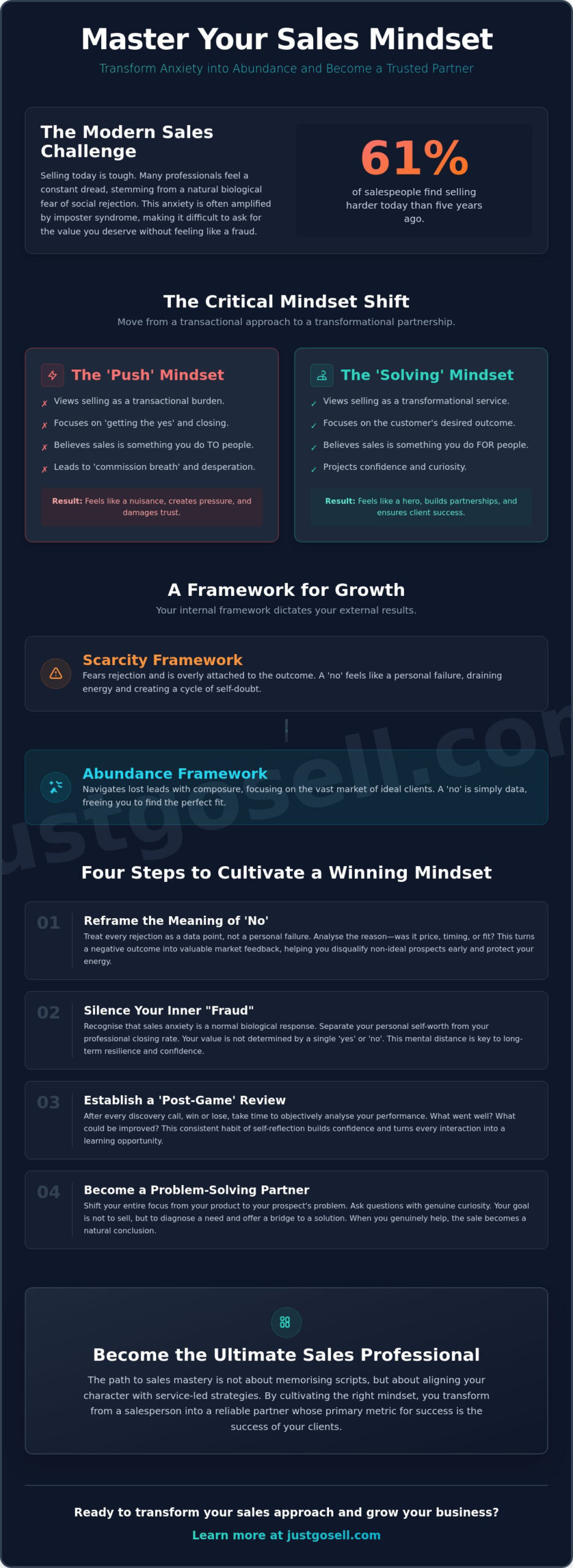
Becoming the Ultimate Sales Professional
The journey from a nervous beginner to a seasoned professional isn’t about learning a magic script. It’s about the steady accumulation of the sales mindset tips we’ve discussed, moving you from a state of fear to a position of service. By shifting your focus from your own performance to the client’s problem, you become a partner rather than a vendor. This is the heart of the "Ultimate Sales Professional" philosophy. It’s an approach that prioritises individual character and unconventional methods over rigid, high-pressure tactics. As we move through 2026, this service-led model has become the gold standard for those who want to build long-term trust in a crowded market. If you want to understand why empathy consistently outperforms scripted tactics, exploring online sales training built around mindset and empathy can help you see how the landscape has fundamentally shifted.
When your internal foundation is solid, your results become predictable. You no longer ride the emotional rollercoaster of "feast or famine" because your abundance mindset keeps your pipeline moving. This consistency is what allows for true, scalable revenue growth. You aren’t just closing deals; you’re building a reputation as a reliable expert in your field. This transition from uncertainty to action is where the real magic happens, as you start to see every conversation as an opportunity to provide value rather than a test of your worth. You’ll find that your confidence grows naturally as you align your commercial goals with a genuine desire to help others.
The Role of Continuous Mentorship
Even the most successful CEOs and elite athletes don’t work in isolation. They use coaches to maintain their edge and identify the blind spots that are impossible to see from the inside. Investing in personalised sales coaching provides you with a safe space to deconstruct your anxieties and refine your approach. It’s about having a loyal partner who is genuinely invested in your success, helping you find your own voice rather than forcing you into a pre-made mould. Amongst a supportive community, you’ll find it much easier to sustain the positive outlook required for long-term growth. A mentor bridges the gap between where you are now and where you want to be, providing the relief and excitement that comes with mastery.
Your Next Step to Sales Mastery
Mindset is the foundation, but mechanics provide the structure. The Ultimate Sales Professional course is designed to bridge this gap, giving you a comprehensive curriculum that covers both the psychological hurdles and the tactical execution of a deal. Building this solid foundation today has a lifetime value that far exceeds any single commission. It’s about equipping yourself with a repeatable routine that works for your personality, not against it. You’ll learn to lead with empathy whilst maintaining the commercial results your business needs to thrive. This structured approach ensures that you aren’t just guessing, but following a proven path to success.
Start your journey to becoming a confident sales professional with Just Go Sell.
Step Into Your New Identity as a Confident Closer
You now have the foundational tools to transform your relationship with selling. We’ve explored how shifting from a scarcity mindset to an abundance framework removes the crushing pressure of needing a win. By consistently implementing these practical sales mindset tips, you’re choosing to lead with value and empathy rather than outdated, high-pressure tactics. Remember, selling is a service you provide to those whose problems you can solve. You don’t have to change who you are to be successful; you just need to align your process with your purpose.
Founded by myself (Colin Knowles), our approach focuses on non-traditional, non-aggressive methods designed specifically for entrepreneurs and non-sales founders who want to stay true to their character whilst achieving commercial results. You have the value; now you have the framework to share it with the world. Your future clients are waiting for the solution only you can provide. It’s time to step out of the shadows and into your role as a reliable partner.
Master the mindset of a top-tier closer with The Ultimate Sales Professional course
Frequently Asked Questions
Can anyone learn to have a sales mindset, or is it a natural trait?
Anyone can develop a professional sales mindset through deliberate practice and the right psychological frameworks. It isn’t a "natural gift" that you’re either born with or without. Think of it like a muscle that grows stronger each time you choose to view a discovery call as a service rather than a performance. By applying consistent sales mindset tips, you’ll find that your confidence naturally builds as you see the positive impact your solutions have on your clients.
How do I get over the fear of being seen as "pushy" or "salesy"?
You overcome the fear of being "salesy" by shifting your focus entirely onto the prospect’s problem. If you truly believe your service can help them, staying silent would actually be a disservice to that person. When you approach a call as a consultant trying to diagnose a gap, the pressure to "push" disappears. You aren’t forcing a transaction; you’re offering a bridge to a better outcome.
What is the quickest way to build self-belief when I have no sales experience?
The fastest way to build self-belief is to focus on the tangible value your service provides rather than your lack of sales history. Collect testimonials or case studies that prove your work gets results. When you know your solution works, the "selling" part becomes an act of advocacy. It’s about being so certain in your value proposition that your enthusiasm becomes contagious to the person on the other end of the line.
How do I handle a prospect who is being confrontational or rude?
Maintain professional neutrality and remember that their behaviour is a reflection of their situation, not your worth. If a prospect is consistently rude, they’ve likely just "disqualified" themselves from being a good fit for your business. It’s okay to politely end the conversation to protect your energy for clients who respect your expertise. You aren’t a punching bag; you’re a professional partner looking for a mutual fit.
Should I use a script, or does that hurt my sales mindset?
A rigid script often sounds robotic, but a flexible framework is essential for maintaining your composure. Use a guide that outlines the key stages of the conversation whilst allowing your individual character to shine through. This ensures you hit your strategic points without losing the human connection. Authenticity is your greatest asset, so don’t hide it behind a set of words that don’t feel like your own. If you’re new to structuring these conversations, learning how to use sales scripts for beginners as a flexible framework rather than a rigid cage can help you find your most authentic professional voice.
How long does it take to see results from shifting my sales mindset?
You’ll often feel an immediate sense of relief once you start applying these sales mindset tips to your daily routine. Whilst internal shifts happen quickly, commercial results like higher conversion rates typically follow within a few weeks of consistent application. As your confidence grows, your prospects will sense your self-belief, making them more likely to trust your recommendations and commit to the next step.
What is the best way to handle a "no" from a dream client?
Treat a "no" from a dream client as a valuable data point rather than a final rejection. It might simply mean the timing isn’t right or their current budget is allocated elsewhere. Keep the relationship warm by providing value without expectation over the coming months. Many "dream" deals are won on the fifth or sixth follow-up, long after the initial conversation has ended.
How do I maintain a positive mindset during a sales slump?
Focus on your "Next Best Actions" and lean into your pipeline management habits during a slump. When you have multiple opportunities in progress, a single quiet week doesn’t feel like a disaster. Curate your environment with positive resources and revisit your past wins to remind yourself of your capability. Slumps are often just a natural part of the business cycle; staying active is the best way to break through them.


Article by
Colin Knowles
Sales Growth Consultant | Sales Director | Author | Founder: JustGoSell
With an extensive background in corporate sales training and team leadership, my role as Sales Trainer and Director at Just Go S.L. revolves around empowering sales professionals to excel. My approach has consistently fostered environments where sales teams surpass targets, thanks in part to my focus on effective sales processes and direct sales techniques.
At the core of my professional ethos lies the commitment to continual development and adaptation of sales strategies to stay ahead in a dynamic market. Through one-on-one coaching, group webinars, and the authorship of "JustGoSell," I have solidified my reputation as a catalyst for transformative sales results and an advocate for sustained sales skill advancement.