

For many entrepreneurs and business owners, the very idea of “sales” brings on a wave of anxiety. It conjures images of pushy tactics, insincere scripts and the constant, draining fear of rejection. You know you need to grow, but the path to consistent revenue feels like a minefield of awkward conversations and guesswork. This often leads to a feast-or-famine cycle, where a good month is followed by a terrifyingly quiet one, leaving you feeling perpetually on the back foot.
What if there was a way to sell that felt natural, authentic, and even empowering? A way to build a system that attracts the right clients and guides them on a journey, rather than pushing them towards a decision they are not ready for?
This is the power of strategic sales process development. It is not about becoming a corporate robot or memorising cheesy closing lines. It is an act of empathy; a method of organising the journey for your buyer whilst protecting the mindset and energy of you, the seller. It’s about moving from a state of reactive panic to one of proactive confidence, knowing exactly what step comes next and why it matters.
In this guide, we will explore how to build a non-pushy growth system from the ground up. We will look at a real-world case study, break down a step-by-step framework, and tackle the psychological hurdles that hold so many talented professionals back.
What is Sales Process Development in a Modern Business?
At its core, sales process development is the intentional design and refinement of a repeatable, step-by-step journey that moves a potential customer from initial awareness to a loyal client. It is the architectural blueprint for your entire commercial operation. However, let’s be clear about what it is not: it is not a rigid, word-for-word script that strips you of your personality. Instead, think of it as a flexible framework; a safety net that supports your individual character and allows your unique voice to shine through.
Many business owners make the mistake of trying to "scale" their sales efforts before they have a solid process in place. They hire more people or spend more on advertising, only to find they are magnifying existing problems. Pouring more water into a leaky bucket does not fix the holes; it just makes a bigger mess. True growth comes from first developing a reliable process and then scaling what is proven to work, which might involve partnering with an expert outsourced team like Sales Hero to handle lead calls. From a mentor-led perspective, a well-defined process is a safety net for your self-belief. When you have a bad day or a deal falls through, you do not fall into a spiral of self-doubt. You fall back on the process, trusting that it will guide you to the next opportunity.
The Difference Between Process and Methodology
It is crucial to distinguish between a sales process and a sales methodology, as they are often confused. The process is the "what"..the specific, sequential stages a buyer moves through (e.g., Prospecting, Discovery, Presentation, Follow-up, Close). It is the map of the journey.
The methodology, on the other hand, is the "how"..the communication style, philosophy, and set of principles you apply within those stages. It is how you talk, listen, and build relationships along the way. At Just Go Sell, we focus on embedding relationship-led methodologies within a structured process. This means prioritising understanding, empathy, and genuine problem-solving over aggressive tactics. A well-developed process does not stifle creativity; it creates the perfect environment for unconventional, personality-driven methods to flourish because the fundamental steps are already taken care of.
Why Entrepreneurs Struggle with Process Design
Many entrepreneurs find themselves trapped by fragmented information. They read a blog post about cold emailing, watch a video on closing techniques, and listen to a podcast about discovery calls. Whilst each piece of advice might be valuable, without a unifying structure, it creates more confusion than clarity. This patchwork approach leads to sales anxiety, as every interaction feels like an improvisation without a safety net.
Another common hurdle is the misconception that structure kills the "human touch" in selling. Founders who pride themselves on building strong relationships fear that a process will make them sound robotic or insincere. The opposite is true. A good process frees up your mental energy from worrying about "what to do next" and allows you to be fully present, listen deeply and connect with the person in front of you. By moving from reactive selling to proactive process management, you gain control, reduce stress, and create a consistently positive experience for your clients.
Establishing a solid legal foundation is another way to gain peace of mind; you can learn more about Massingill Attorneys & Counselors at Law to see how their expertise in business law and estate planning supports entrepreneurs as they scale.
Case Study: How Strategic Sales Process Development Transformed a Non-Sales Founder
To understand the real-world impact of sales process development, let’s consider a composite case study—a founder we will call "Alex." Alex was a brilliant creative consultant, but their revenue was a classic "feast or famine" rollercoaster. One month, they would land a huge project; the next two would be spent in a panic, desperately trying to fill the pipeline. The inconsistency was exhausting and made it impossible to plan for the future.
The "Before" state was defined by high anxiety, sporadic follow-ups, and a "winging it" mentality on every sales call. Alex knew their service was valuable but struggled to communicate it effectively, often giving away too much information for free or failing to qualify leads properly. This resulted in wasted hours on proposals for prospects who were never a good fit.
During the development phase, we worked together to identify the specific "leaky buckets" in their approach. It quickly became clear that the biggest issue was a lack of structure in the discovery calls. By implementing a clear framework, Alex learned to guide the conversation, ask better questions, and truly understand the client’s needs before ever mentioning a solution.
The "After" state was transformative. Within three months, Alex saw a 40% increase in their closing rate. More importantly, their sales nerves significantly reduced. They no longer dreaded sales conversations; instead, they saw them as collaborative problem-solving sessions. The process gave them the confidence and control they had been missing.
Identifying the Leaky Buckets
The first step in Alex’s transformation was a thorough audit of their existing "non-process." We reviewed past emails, call notes, and proposals to see exactly where and why prospects were dropping off. We discovered that a significant number of leads were lost after the initial discovery call because Alex was not effectively qualifying them.
This lack of qualification had a massive impact on Alex’s energy levels. They were spending hours crafting detailed proposals for people who either did not have the budget or were not the decision-maker. This is a common trap for service-based entrepreneurs. Effective lead qualification protects your most valuable asset: your time.
The Transformation: From Pitching to Problem-Solving
The most profound shift for Alex was in their communication style. They moved away from "selling features" (e.g., "we offer three rounds of revisions") to "understanding needs" (e.g., "what would a successful outcome from this project look like for you?"). This change was powered by a structured sales pitch strategy that focused on asking insightful questions rather than delivering a monologue.
This new approach completely changed the dynamic of the room. Alex was no longer seen as a vendor trying to make a sale, but as a trusted advisor genuinely interested in helping the client succeed. The role of 1-to-1 coaching was critical here, as it helped Alex refine this new framework to fit their natural personality. It was not about adopting a script; it was about discovering their own unique and powerful voice within a proven structure.

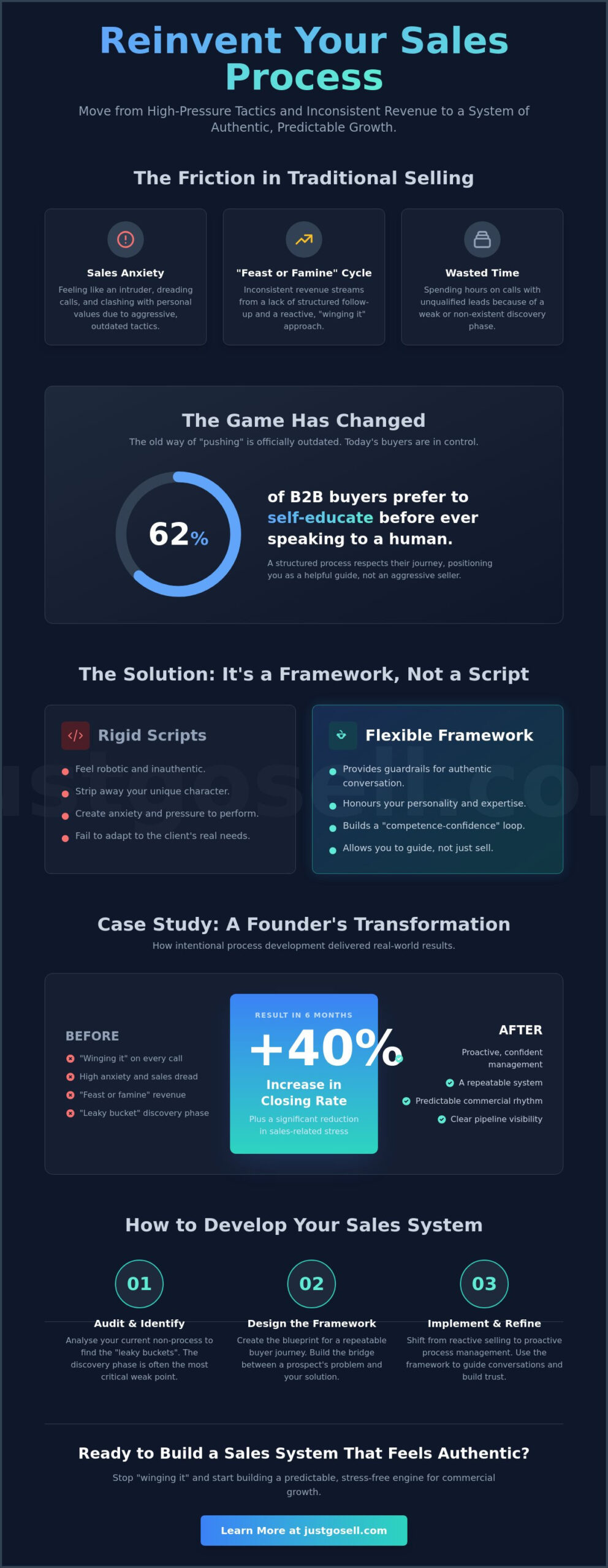
A Step-by-Step Framework for Developing Your Sales System
- Step 1: Define Your Ideal Buyer Persona. Before you can sell anything, you need to know exactly who you are selling to. A detailed buyer persona goes beyond basic demographics to include their pain points, goals, motivations, and common objections. This focus ensures your prospecting efforts are targeted and efficient.
- Step 2: Map the Discovery Phase. This is where you uncover the client’s true needs. Map out the key questions you need to ask to qualify a lead and understand their problem deeply. The goal is to ensure you are solving the right problems for the right people.
- Step 3: Develop a Value-Based Presentation. Armed with insights from the discovery phase, create a presentation or proposal that directly addresses the client’s challenges. It should be less about your company and more about their future success. Crucially, it must align with your personality and communication style.
- Step 4: Create a Relationship-Led Follow-Up Sequence. Most deals are not closed on the first call. Design a simple sequence for staying in touch that adds value without being pushy. We often talk about the "5-touch rule," which provides a structure for professional persistence.
- Step 5: Review and Refine. Your sales process is a living document, not a static one. Regularly review your real-world commercial results. Which stage has the highest drop-off rate? What objections are you hearing most often? Use this data to continually refine and improve your system.
Mastering the Discovery and Qualification Stages
The discovery call is arguably the most critical part of the entire sales process. It sets the tone for the entire relationship and determines whether you are building on a solid foundation or on sand. A great discovery call is not an interrogation; it is a conversation built on curiosity.
To qualify a lead without being confrontational, you can weave in questions like:
- "To make sure I’m best placed to help, could you tell me a bit about what prompted you to look for a solution now?"
- "What does a successful outcome look like for you and your team in six months’ time?"
- "So that I can provide the most accurate options, what sort of budget have you allocated for solving this challenge?"
- "Besides yourself, is there anyone else on the team who would be involved in making a final decision?"
These questions help you understand urgency, budget, authority, and need in a collaborative way. For a deeper dive into building these foundational skills, our Ultimate Sales Professional course provides comprehensive frameworks for mastering the discovery phase.
Designing a Non-Robotic Follow-Up System
The fear of being "pushy" often paralyses entrepreneurs when it comes to following up. The key is to reframe it. You are not chasing; you are demonstrating professional persistence. If you genuinely believe you can solve their problem, it is your professional duty to stay on their radar. Embracing modern automation can also ease the burden of consistent communication; resources from platforms like SocialPosterr show how multi-channel engagement and automated qualification can keep prospects warm without feeling intrusive.
Overcoming the Mindset Hurdles in Sales Process Development
You can have the most perfectly designed process in the world but it will not work if you do not have the right mindset to execute it. The number one objection we hear from entrepreneurs is, "I don’t want to sound like a corporate robot." This fear is valid, but it is based on a misunderstanding of what a process is for. The process should suit the person, not the other way around. It is a tool to empower your authenticity, not erase it.
True self-belief in sales is built through what is known as the "competence-confidence loop." When you have a process, you know what to do (competence). When you do it and see positive results, you start to believe you can do it again (confidence). This loop is how you build sustainable momentum. A structured system also allows you to "fail safely." When a deal is lost, you do not question your entire self-worth; you analyse which part of the process broke down and work on improving it for next time.
The Psychology of the Pushy Salesperson Myth
So many of us have been conditioned by the "Wolf of Wall Street" stereotype to believe that selling is an aggressive, manipulative act. This myth stops countless talented people from sharing their gifts with the world because they are terrified of being perceived as that kind of person.
Here is the truth: a well-designed sales process is the ultimate antidote to pushy behaviour. Pushiness happens when you do not have a clear path forward and resort to pressure because you do not know what else to do. A process provides clear "exit ramps" for both you and the prospect. If it becomes clear that you are not a good fit, the process gives you a graceful way to disengage, preserving the relationship. We encourage every professional to find their own "favourite" way to communicate within the framework; whether that is through humour, storytelling, or deep analytical insights.
Building Resilience Through Structure
One of the greatest gifts a sales process gives you is emotional detachment. When you are "winging it," every "No" can feel like a personal rejection of you and your worth. When you are following a process, a "No" is simply a data point indicating that this particular prospect was not a fit at this particular time. It allows you to detach your self-worth from the outcome of any single conversation.
This resilience is a muscle that needs to be trained. Often, deep-seated mindset blocks around money or self-worth can sabotage even the best process. This is where targeted 1-to-1 coaching can be invaluable, helping you identify and fix the invisible scripts that are holding you back. For leaders, implementing a team-wide process reduces collective workplace stress, as everyone is aligned on the rules of engagement and speaks a common commercial language.
Refining Your Commercial Results for 2026 and Beyond
Once your sales process is in place, the work shifts from creation to optimisation. To measure the success of your development efforts, you must track the right metrics. Instead of focusing on vanity metrics like the sheer volume of calls made, concentrate on what truly drives results; such as your conversion rate at each stage of the sales pipeline.
The market is constantly changing and so are your buyers’ needs. Continuous professional development is not a luxury; it is a necessity for long-term survival and growth. The fundamentals of a great process provide the structure but your skills in communication, negotiation, and relationship-building must be continually honed. At Just Go Sell, we provide the structural foundation and the expert guidance needed to build sustainable, long-term commercial success, preparing you for the challenges and opportunities of 2026 and beyond. Are you ready to take the next step toward becoming an Ultimate Sales Professional?
Measuring What Matters
To refine your process effectively, you need to move beyond vanity metrics. A high number of leads is meaningless if none of them converts. Instead, focus on operational efficiency and commercial results. Key metrics to track include:
- Lead-to-Opportunity Conversion Rate: How many of your initial leads are qualified enough to enter your pipeline?
- Sales Cycle Length: How long does it take on average to move a deal from discovery to close?
- Win Rate: What percentage of qualified opportunities do you successfully close?
By analysing these numbers, you can quickly identify which stage of your process needs the most refinement. For example, a low lead-to-opportunity rate suggests a problem with your prospecting or initial qualification. Improving collective performance across these metrics is a primary focus of effective team sales training.
Next Steps: Coaching vs. Self-Paced Learning
Now that you understand the principles of sales process development, you have a choice. For self-starters who want a comprehensive blueprint they can implement at their own pace, our self-paced video modules in The Ultimate Sales Professional course are the perfect solution. They provide the structure, tools, and knowledge you need to build your system from the ground up.
For those who want to accelerate their results and get personalised feedback on their unique challenges, our personalised 1-to-1 sessions offer a direct path to mastery. My mentor-like approach bridges the gap between knowing what to do and having the confidence to do it consistently. Whatever path you choose, the journey to becoming a confident, effective seller starts today. Master your sales process with The Ultimate Sales Professional course and build the non-pushy growth system your business deserves.


Article by
Colin Knowles
Sales Growth Consultant | Sales Director | Author | Founder: JustGoSell
With an extensive background in corporate sales training and team leadership, my role as Sales Trainer and Director at Just Go S.L. revolves around empowering sales professionals to excel. My approach has consistently fostered environments where sales teams surpass targets, thanks in part to my focus on effective sales processes and direct sales techniques.
At the core of my professional ethos lies the commitment to continual development and adaptation of sales strategies to stay ahead in a dynamic market. Through one-on-one coaching, group webinars, and the authorship of "JustGoSell," I have solidified my reputation as a catalyst for transformative sales results and an advocate for sustained sales skill advancement.