
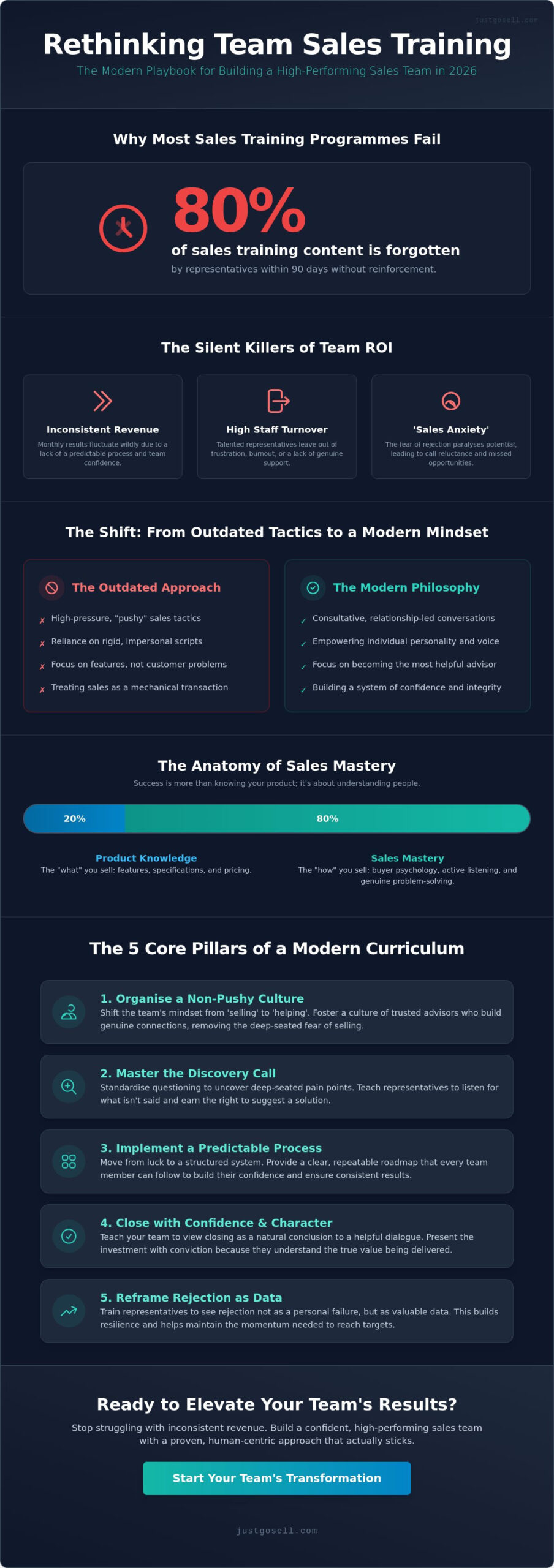
Did you know that without reinforcement, 80% of sales training content is forgotten by representatives within 90 days? It’s a staggering figure from SyncGTM that explains why so many businesses struggle with inconsistent monthly revenue and fragmented results. Effective team sales training in 2026 isn’t about memorising rigid scripts or aggressive tactics; it’s about organising a collective mindset of helpfulness that removes the fear of selling.
You’ve likely felt the frustration of watching talented team members dread ‘cold’ outreach whilst your monthly revenue fluctuates. We understand that high staff turnover and hesitant discovery calls are often symptoms of a lack of confidence rather than a lack of skill. This guide will show you how to transform your sales team from nervous callers into high-performing professionals using a human-centric approach. We’ll explore how to build a predictable sales process that empowers your people and delivers higher conversion rates through genuine connection. To help your team overcome the initial hurdle of cold calls, consider using physical marketing to create a warmer introduction; for professional support with these strategies, check out Micro Printing for their direct mail and custom printing services.
Key Takeaways
- Shift from outdated, high-pressure tactics to a consultative, relationship-led approach that transforms your team into trusted advisors.
- Evaluate the specific benefits of custom workshops versus online courses to find the perfect team sales training fit for your organisation’s unique needs.
- Master a two-step implementation strategy, starting with a rigorous sales audit to identify and eliminate the friction points in your current process.
- Create a “non-pushy” sales culture that empowers every team member to communicate with confidence whilst maintaining their individual personality.
- Learn how to structure discovery calls and follow-ups to ensure your training translates into predictable revenue and higher conversion rates.
Table of Contents
What is Team Sales Training? (And Why Most Programmes Fail)
At its heart, team sales training is a structured, intentional process designed to align individual talent with your company’s commercial goals. It isn’t just about handing out a folder of scripts or watching a few videos. It’s about building a sustainable system where every team member understands how to move a prospect from curiosity to commitment without losing their integrity. Most programmes fail because they treat sales like a mechanical transaction rather than a human interaction. They focus on the ‘pushy’ tactics of the 1990s, whilst modern buyers in 2026 demand consultative, relationship-led behaviour.
We often see ‘one-and-done’ workshops that spark excitement for 48 hours before everyone reverts to their old habits. Real transformation requires a shift toward becoming what we call The Ultimate Sales Professional. This standard isn’t about being the loudest person in the room; it’s about being the most helpful. When you move away from fragmented information and toward a cohesive philosophy, your team stops ‘selling’ and starts solving.
The Difference Between Product Knowledge and Sales Mastery
Many entrepreneurs make the mistake of thinking that if their team knows the ‘features’ inside out, the sales will follow. In reality, product knowledge is only about 20% of the battle. Mastery comes from understanding buyer psychology and developing the empathy required for active listening. Your team needs to know how to uncover the problem behind the problem rather than just reciting talking points. Modern team sales training must prioritise the ‘why’ behind a purchase, ensuring your staff can navigate complex customer needs with genuine curiosity.
Why ‘Sales Anxiety’ is the Silent Killer of Team ROI
You might notice staff members suddenly finding ‘urgent’ admin tasks to do when it’s time to make calls. This is call reluctance, and it’s amongst the most common reasons why training ROI stalls. Traditional methods often increase this pressure by demanding high-volume outreach without addressing the underlying fear of rejection. Our philosophy at Just Go Sell is different. We believe in building self-belief before building scripts. When a team feels supported and empowered, the anxiety fades, and the conversion rates on discovery calls naturally begin to climb. For individuals who need deeper support in overcoming these psychological hurdles, 1-to-1 sales coaching focused on selling without being pushy can be a powerful complement to group training.
The Core Pillars of a Modern Sales Team Curriculum
Building a high-performing team requires more than just a list of tactics. It demands a holistic curriculum that addresses the psychological hurdles of selling whilst providing a clear, repeatable roadmap. Effective team sales training shifts the focus from the ‘salesperson’ stereotype to the role of a trusted advisor. This isn’t about manipulation; it’s about organising your team’s mindset so they feel genuinely empowered to help your clients solve their problems.
Relying on luck or ‘natural’ charisma is a recipe for inconsistent revenue. Instead, your curriculum should provide a sequence that every team member can follow, regardless of their experience level. This structure provides a safety net, allowing reps to lean on a proven process whilst they build their own confidence. When your team views rejection as data rather than a personal failure, they maintain the momentum needed to reach their targets.
Mastering the Discovery Call as a Team
The discovery call is where deals are won or lost. Standardising the questions your team asks ensures you uncover the deep-seated pain points that drive a purchase. We teach reps to listen for what isn’t being said; the pauses, the tone of voice, and the hesitant answers that reveal the true obstacles. Transitioning from discovery to a solution shouldn’t feel forced. It should feel like the natural next step in a helpful conversation where the representative has earned the right to suggest a way forward. Equipping your team with a structured professional selling process built around confident closing ensures that this transition feels seamless rather than awkward.
Closing with Confidence and Character
Discussing pricing often triggers a wave of ‘sales anxiety’ that leads to awkward silences or defensive posturing. Modern training teaches your team to view the close as a natural conclusion to a supportive dialogue. It’s about presenting the investment with conviction because they know the value they provide. To ensure these skills stick, we often use 1-to-1 sales coaching to refine individual closing styles, helping each person find their unique voice within the framework. If you’re ready to see how this approach could work for your specific business, feel free to get in touch for a chat about your goals.
Custom Workshops vs. Online Courses: Which Suits Your Team?
Choosing the right delivery format for your team sales training is often where leaders feel the most friction. You want a solution that actually sticks, but you also need to protect your team’s time and your company’s budget. The choice isn’t always binary. It’s about understanding whether your team needs a foundational "single source of truth" or a deep, interactive dive into their specific daily challenges. In 2026, the most successful organisations are moving away from rigid, one-size-fits-all presentations and toward more flexible, outcome-focused learning paths.
Calculating the ROI of your investment should go beyond simple attendance metrics. Instead, look at the lift in conversion rates from discovery calls to closed deals. If a programme helps your team close just one additional high-value client per month, the training pays for itself almost immediately. Whether you choose digital or live, the goal is to bridge the gap between knowing what to do and actually doing it with confidence.
When to Choose Self-Paced Digital Training
Self-paced digital learning is an incredible asset for growing teams that need to onboard new hires quickly. It allows you to scale your methodology without disrupting your senior staff every time a new person joins the office. By using a programme like the Ultimate Sales Professional course, you ensure that every representative is working from the same playbook. To make this work, you must build in accountability. This might mean weekly check-ins to discuss specific video modules or using the content as a springboard for your internal sales meetings. It provides the structural fundamentals that every high-performing team needs.
The Power of Bespoke Team Workshops
How to Implement a Training Strategy That Actually Sticks
The most brilliant team sales training in the world is useless if it gathers dust on a digital shelf. Real transformation happens in the small, daily habits that your reps adopt long after the initial excitement of a workshop has faded. For entrepreneurs and small business leaders, implementation doesn’t require a massive HR department; it requires a consistent, human-centric approach that respects your team’s time and intelligence. To ensure your investment delivers a lasting return, we recommend a five-step implementation roadmap.
-
Step 1: Conduct a Sales Audit. Before you change anything, you must understand where your team is actually losing deals. Is it at the initial outreach, or are they stumbling during the final pricing conversation?
-
Step 2: Define a Non-Pushy Philosophy. Your team won’t buy into a system that feels ‘gross’ or manipulative. Clarify that your goal is to be the most helpful partner in the room.
-
Step 3: Schedule Micro-Learning. Avoid training fatigue by replacing eight-hour lectures with fifteen-minute ‘drills’ twice a week. These short bursts are easier to digest and implement immediately.
-
Step 4: Implement Peer-Review. Create a safe space where reps can listen to each other’s call recordings or review emails. This builds a culture of transparency rather than one of individual silos.
-
Step 5: Measure Leading and Lagging Indicators. Revenue is a lagging indicator; it tells you what happened in the past. Focus on leading indicators like the number of quality discovery calls booked or the speed of follow-up.
Creating a ‘Sales Playbook’ for Your Business
Every team needs a central ‘source of truth’ that documents your favourite closing techniques and objection-handling strategies. This isn’t a rigid script to be read word-for-word; it’s a living document that gives your team the confidence to know they’ll never be ‘caught out’ by a difficult question. Keep the playbook alive by regularly updating it with real-world wins and lessons learned from recent losses. It ensures that whilst individual styles vary, the core methodology remains consistent across the entire organisation. Grounding your playbook in a proven professional selling process framework designed for confident closing gives your team a reliable structure to return to whenever they face a challenging prospect.
The Role of the Leader in Ongoing Sales Coaching
Your role must shift from ‘Manager’ to ‘Mentor’ if you want to foster a truly high-performing culture. Providing feedback that empowers rather than discourages is an art form. It’s about acknowledging the psychological hurdles of the role whilst maintaining the high standards your business deserves. When you lead with empathy, your team feels supported enough to take the risks necessary for growth. A critical part of this mentorship is ensuring that insights from your top performers don’t stay trapped in individual silos; building strong sales team communication practices that create transparency and psychological safety is what separates good managers from truly transformational leaders. For team members who need more targeted support, pairing group training with personalised 1-to-1 sales coaching to master selling without being pushy can accelerate individual breakthroughs significantly. If you are ready to start building this culture within your own business, you can book a strategy call to discuss your custom implementation plan.
Elevate Your Results with Just Go Sell Team Training
Scaling your revenue in 2026 requires more than just a new piece of software or a fresh lead list. It requires a fundamental shift in how your people show up for their prospects every single day. At Just Go Sell, we specialise in team sales training that prioritises the human element of the transaction. Founded by myself (Colin Knowles), our methodology is built on the belief that anyone can become a high-performing professional if they’re given the right foundation of self-belief and tactical mastery. We don’t just teach your team how to sell; we teach them how to be helpful advisors who prospects actually want to hear from.
Our mentor-led approach bridges the gap between the ‘beginner nerves’ that often lead to call reluctance and the ‘professional mastery’ required to close complex deals. By focusing on mindset alongside mechanics, we ensure that the changes your team makes are permanent. We understand the psychological barriers that entrepreneurs and small teams face because we’ve been there. This empathy allows us to create a supportive environment where your staff feels understood rather than lectured, fostering a culture of loyalty and high performance.
Tailored Solutions for Your Unique Business
Your business is unique, so your training should be too. Whether you need a quick boost to hit a quarterly target or a total overhaul of your sales culture, we customise our workshops to fit your specific industry and challenges. We don’t believe in ‘off-the-shelf’ solutions that ignore the nuances of your favourite client types. Instead, we take a long-term partnership approach. We grow as you grow, providing the ongoing support and strategy consulting needed to keep your team sharp as the market evolves. It’s about finding the voice that fits your brand whilst maintaining a standard of excellence across the board.
Real Transformation: What to Expect After Training
When you invest in structured team sales training, the results should be visible in your bank account and your office culture. You can expect to see shorter sales cycles as your reps become more adept at qualifying prospects and uncovering pain points early. Higher average deal values often follow, as your team learns to sell on value rather than competing on price. Most importantly, you’ll gain the peace of mind that comes from a predictable, professional selling process. Your team will stop dreading the phone and start feeling excited about the opportunity to help new clients solve their problems. If you’re ready to transform your sales results, you can book a consultation for your team today to discuss your specific goals.
Ready to Build a Team of Confident Sales Professionals?
Transforming your sales results in 2026 isn’t about working harder; it’s about working with more character and clarity. We’ve explored how moving away from rigid scripts and toward a human-centric mindset can eliminate call reluctance and create a predictable revenue stream. By organising your strategy around a "non-pushy" philosophy, you empower your team to become trusted advisors rather than just another voice on the phone.
Founded by myself (Colin Knowles), Just Go Sell specialises in helping entrepreneurs overcome sales anxiety through unconventional, supportive methods. Whether you choose a digital curriculum or a bespoke workshop, the right team sales training provides the structural fundamentals your business needs to scale with confidence. It’s time to replace the "fear" of selling with the excitement of helping your clients find the solutions they truly need.
If you’re ready to bridge the gap between where your team is and where they could be, we’re here to help. Book a Discovery Call to Transform Your Sales Team. You have the foundation; now let’s build the mastery together.
Frequently Asked Questions
How long does it take to see results from team sales training?
You will likely notice a shift in your team’s confidence and the quality of their discovery calls within the first few weeks. Whilst revenue is a lagging indicator that may take a few months to fully reflect the changes, leading indicators like improved follow-up speed and better lead qualification usually appear almost immediately. A complete cultural shift typically requires three to six months of consistent reinforcement.
Can you train a team that has zero prior sales experience?
Yes, training a team with no experience is often a significant advantage because they haven’t developed outdated habits. We focus on building a strong foundation of self-belief and structural fundamentals from the ground up. By starting with a human-centric approach, your staff can learn to be helpful advisors without ever having to unlearn the aggressive tactics associated with traditional sales stereotypes.
What is the difference between sales coaching and sales training?
Sales training is generally a structured programme designed to transfer specific knowledge and methodologies to a group. Sales coaching is a more personalised, ongoing partnership that helps individual reps apply those skills to their unique daily challenges. Whilst training provides the map, coaching ensures that each team member has the support they need to navigate the psychological hurdles of the journey.
How do I know if my team needs custom workshops or just a digital course?
Digital courses are an excellent choice for establishing a "single source of truth" and onboarding new hires without disrupting your daily operations. If your team faces complex industry-specific obstacles or needs to rebuild their collective morale, a bespoke workshop is more effective. Many successful businesses use a hybrid approach to combine foundational digital learning with interactive, live sessions.
Is it possible to train people to sell without sounding pushy?
Absolutely, and this is the fundamental goal of modern team sales training. We move away from high-pressure tactics and toward consultative, relationship-led behaviour. When your team views themselves as problem solvers who are genuinely there to help, the "pushy" feeling is replaced by conviction. This shift allows your reps to build authentic connections that naturally lead to higher conversion rates.
How do we measure the ROI of our sales training investment?
You should measure ROI by tracking direct impact on business KPIs such as win rates, average deal values, and the length of your sales cycle. Beyond the numbers, look for qualitative improvements in team retention and the reduction of call reluctance amongst your staff. A successful programme should pay for itself by helping your team close deals that they previously would have lost.
What happens if my team is resistant to new sales methods?
Resistance usually comes from a place of insecurity or a fear that new methods will feel "salesy." We address this by involving the team in the "Sales Audit" phase and showing them how a non-pushy philosophy actually makes their jobs easier. When reps realise that these methods reduce their own stress whilst improving their results, resistance quickly turns into enthusiastic buy-in.
Do you offer training for remote or virtual sales teams?
Yes, our team sales training is specifically designed to support the needs of remote and virtual teams. We use interactive digital tools to ensure that your reps stay engaged and feel part of a cohesive unit, regardless of their physical location. This approach helps maintain a consistent sales culture and ensures that your remote staff feel just as empowered and supported as those in an office.

Article by
Colin Knowles
Sales Growth Consultant | Sales Director | Author | Founder: JustGoSell. With an extensive background in corporate sales training and team leadership, my role as Sales Trainer and Director at Just Go S.L. revolves around empowering sales professionals to excel. My approach has consistently fostered environments where sales teams surpass targets, thanks in part to my focus on effective sales processes and direct sales techniques. At the core of my professional ethos lies the commitment to continual development and adaptation of sales strategies to stay ahead in a dynamic market. Through one-on-one coaching, group webinars, and the authorship of "JustGoSell," I have solidified my reputation as a catalyst for transformative sales results and an advocate for sustained sales skill advancement.