
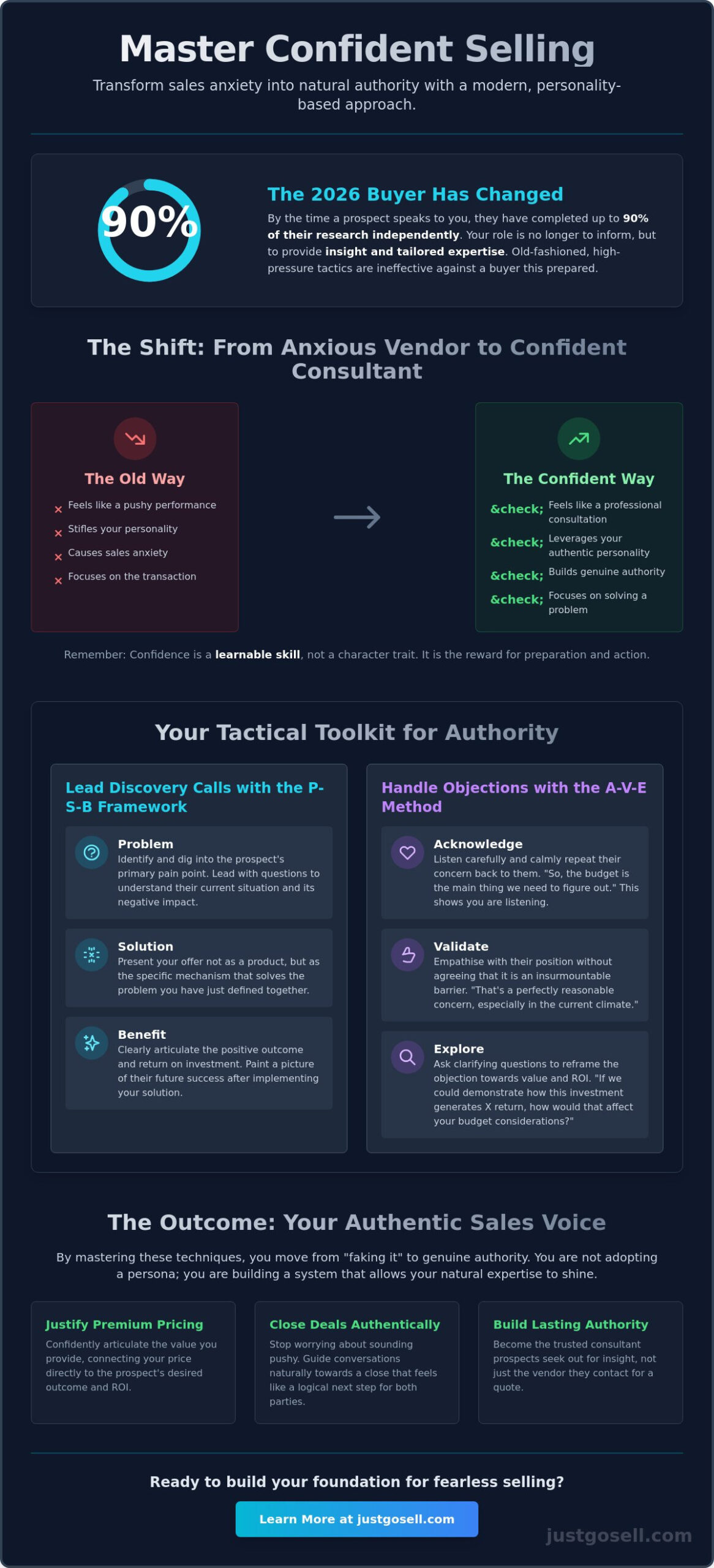
Did you know that by the time a prospect finally speaks to you in 2026, they have likely already completed up to 90% of their research independently? It is a daunting reality for many entrepreneurs who still feel a wave of sales anxiety the moment a discovery call begins. You have probably felt that familiar awkwardness during the price talk, or perhaps you worry that you’ll sound like a pushy stereotype if you don’t stick to a rigid, robotic script. It is frustrating to feel like your personality is being stifled by old-fashioned tactics that simply do not work in a market where buyers are more informed than ever before.
The good news is that you do not have to change who you are to be successful. This guide will show you how to master confident selling techniques that transform nervous energy into natural authority. We will help you move away from high-pressure tactics and towards a personality-based approach that closes deals whilst keeping your integrity intact. You will discover how to justify premium pricing with total calm and navigate the longer sales cycles of 2026 by becoming a trusted consultant rather than just another vendor.
In this guide, you will learn:
• Why sales anxiety is a natural response to the fear of rejection and how to bridge the confidence gap by treating selling as a learnable skill.
• How to master confident selling techniques by building a robust sales foundation and using “out of the box” thinking to stand out from the competition.
• A tactical Problem-Solution-Benefit framework to help you lead discovery calls with natural authority and a professional rhythm.
• The Acknowledge-Validate-Explore method for navigating difficult price talks and reframing objections as buying signals.
• How to develop a personality-based sales voice that allows you to close deals authentically whilst justifying your premium pricing.
Table of Contents
-
Overcoming Sales Anxiety: Why Confidence is a Skill, Not a Trait
-
Essential Communication Techniques for Projecting Natural Authority
-
Navigating Difficult Conversations and Objections with Poise
Overcoming Sales Anxiety: Why Confidence is a Skill, Not a Trait
Sales anxiety isn’t a character flaw or a sign that you aren’t "cut out" for entrepreneurship. It is a natural, biological response to the fear of social rejection. When you prepare to discuss pricing or ask for a commitment, your brain can perceive a potential "no" as a threat to your standing amongst your peers. This often leads to the "Confidence Gap," where entrepreneurs wait to feel brave before they start pitching. In reality, confidence is the reward for taking action; it is not the prerequisite. By mastering a repeatable process, you can move away from the high-pressure "boiler room" stereotypes and towards a sense of "clinical" calm that allows you to lead calls with professional authority.
Mastering confident selling techniques is about shifting your focus from your own internal nerves to the external needs of the person sitting across from you. When you have a solid foundation, the sales process stops feeling like a performance and starts feeling like a professional consultation—a method used by specialists like Educator Collars who prioritise expert guidance. This shift in perspective is what allows you to justify premium pricing without your voice wavering. It is a tactical evolution that turns a stressful obligation into a dynamic part of your business growth.
The Psychology of the "Pushy" Stereotype
Most entrepreneurs have a deep-seated fear of being perceived as manipulative or annoying. We’ve all encountered the aggressive salesperson who refuses to take no for an answer, and the last thing you want is to replicate that behaviour. However, a lack of structure actually makes you more likely to sound pushy. Without a clear framework, you might over-explain, interrupt, or rush the close out of pure nervous energy. You can avoid this by reframing the entire interaction. Selling is simply "helping someone solve a problem they already have." When you view yourself as a problem-solver rather than a solicitor, the awkwardness evaporates. You aren’t taking something from the prospect; you’re offering them a bridge to a better result.
Moving from "Faking It" to Genuine Authority
The old advice to "fake it till you make it" is often a recipe for increased anxiety and imposter syndrome. Trying to project a persona that isn’t yours creates a massive cognitive load, making it nearly impossible to listen to your prospect’s actual needs. Genuine authority comes from preparation, not performance. By using "if/then" logic, you can prepare for common conversational pivots before they happen. For example: if a prospect mentions a budget constraint, then you are already prepared to pivot the conversation toward the return on investment. This level of tactical readiness reduces the mental strain during a call. If you want to build this kind of "out of the box" resilience, programs like The Ultimate Sales Professional can provide the structured foundation you need to let your natural personality shine through whilst you maintain total control of the process.
The Foundation of Fearless Selling: Preparation and Mindset
If you step into a discovery call without a clear understanding of your own value, you’re essentially asking the prospect to do the work for you. Fearless selling doesn’t happen by accident; it’s built on a foundation of rigorous preparation and a fundamental shift in how you view your role. Instead of seeing yourself as a vendor pleading for a transaction, you must adopt a "Mentor Mindset." You are a trusted partner offering a specific solution to a problem your prospect is likely struggling with right now. Documenting your past "wins" and client success stories isn’t just for marketing material; it’s a tactical exercise to reinforce your own self-belief. When you can see the tangible impact you’ve made, implementing confident selling techniques becomes a natural extension of your conviction rather than a forced performance.
Standing out in 2026 requires "out of the box" thinking that goes beyond basic product knowledge. Since buyers now complete between 70% and 90% of their research independently before they ever engage with a representative, your role is no longer to provide information that they can find on Google. It’s to provide insight. You must differentiate yourself by showing how you tailor your expertise to their specific context, moving from a generic pitch to a clinical analysis of their business needs. This level of preparation is what separates the beginners from the masters.
Organising Your Sales Environment for Success
Your physical and digital workspace directly impacts your mental clarity and overall productivity. A cluttered desk or a chaotic CRM leads to decision fatigue, which saps your energy before you even start a call. Organise your digital tools so that every piece of data you need is accessible with one click. This tactical setup allows you to focus entirely on the human connection during the conversation. If you’re struggling to spot the friction points in your current workflow, personalised sales coaching can help you identify individual blind spots that might be holding you back from your full potential.
Internalising Your Value Proposition
The standard for an Ultimate Sales Professional is simple: you are a professional problem-solver who translates complex features into valuable outcomes. You need to move away from "feature-dumping" and start focusing on the "so what?" for the client. If you can justify your favourite pricing tiers with clinical data and social proof, you’ll find that "the price talk" loses its sting. Use the statistics from your previous projects to show a clear, data-driven return on investment. This approach provides the authority needed to increase sales revenue whilst remaining authentic to your personality. If you’re ready to refine your approach, you might want to discuss your specific sales goals with a mentor who understands your journey.
Essential Communication Techniques for Projecting Natural Authority
Once you have established your sales foundation, the focus shifts to the live interaction. Leading a discovery call isn’t about dominating the conversation; it is about controlling the rhythm. High-authority confident selling techniques rely on your ability to guide the prospect through a logical journey. You aren’t just reacting to their questions. You’re setting the pace. This control creates a sense of safety for the buyer, who wants to know they are in the hands of a professional who understands the path forward. When you lead with intent, you move from being a passive participant to a dynamic partner in their decision-making process.
The "Problem-Solution-Benefit" framework is your tactical map for impactful pitching. Instead of listing features, you start with the specific problem you’ve identified through active listening. Then, you present your solution as the direct remedy, followed by the tangible benefit the client will experience. It’s a simple yet powerful structure that ensures your message is easy to digest. By using emotional intelligence to read a prospect’s behaviour in real-time, you can adjust your delivery. If they seem hesitant, you slow down. If they are excited, you build momentum. This adaptability is a hallmark of the Ultimate Sales Professional standard.
The Art of the Strategic Pause
Silence is often the most underutilised tool in a salesperson’s kit. When we feel anxious, our natural instinct is to fill the air with words to avoid perceived awkwardness. However, "filling the air" often dilutes the value of what you’ve just said. Strategic pauses allow your points to sink in amongst the audience, giving them space to process the information. Use the "3-second rule" before responding to difficult questions. This brief moment of silence projects unshakeable confidence and shows that you are giving their concern the clinical consideration it deserves. It turns a rushed response into a thoughtful, authoritative answer.
Active Listening: Moving Beyond the Script
A robotic script is the enemy of natural authority. To truly connect, you must practice reflective listening, where you paraphrase the prospect’s words to confirm your understanding. This technique makes them feel heard and valued. It also helps you identify "pain points" that haven’t been explicitly stated, such as a fear of internal pushback or a lack of time. When you transition from listening to leading, do so by summarising their needs before proposing the next step. This ensures the transition feels like a logical progression rather than an abrupt shift in the conversation flow. It demonstrates that you are genuinely invested in their success.
Navigating Difficult Conversations and Objections with Poise
Many entrepreneurs dread the moment a prospect pushes back, but objections are actually buying signals in disguise. If a prospect had no interest in your service, they would simply end the call; a question about price or timeline is a request for more information to justify their investment. To handle these moments, you need a clinical approach that keeps your emotions in check. Mastering confident selling techniques involves moving away from defensive reactions and toward a structured dialogue. When you remain calm and authoritative during pushback, you demonstrate that you are a stable partner capable of handling their business challenges.
The "Acknowledge-Validate-Explore" (AVE) framework is a game-changing tool for these high-pressure moments. First, acknowledge the concern without agreeing with the objection. Second, validate their feeling to show empathy. Finally, explore the root of the issue with an open-ended question. This tactical flow prevents the conversation from becoming an argument and keeps you in the position of a consultant. It allows you to maintain your posture whilst navigating the nuance of their specific needs amongst a sea of competing priorities.
Handling the Price Objection without Apologising
Lowering your price the moment a prospect flinches is the fastest way to destroy your perceived authority. It suggests your original quote was arbitrary rather than based on the tangible value you provide. Instead, reframe the cost as an investment in a specific financial outcome. When a prospect says "it is too expensive," they are usually comparing the price to a vague idea of "cost" rather than the "return." Implementing these confident selling techniques allows you to hold your ground without sounding aggressive. If they mention a cheaper competitor, focus on the "out of the box" results and the comprehensive sales foundation you offer that justifies your premium tier.
The "Out of the Box" Approach to Rejection
True resilience comes from being loyal to your process rather than any single deal. Rejection is not a personal failure; it is a tactical data point. After a lost deal, conduct a clinical post-mortem. Was the timing wrong? Was the value proposition unclear? By treating every "no" as a learning opportunity, you refine your pitch strategy for the next interaction. This mindset keeps your self-belief intact and ensures your productivity remains high. If you want to transform how you handle these difficult conversations, you can book a strategy session to refine your negotiation posture and find your unique sales voice.
Developing Your Unique Sales Voice for Consistent Results
The final step in your journey isn’t about becoming someone else; it’s about becoming the most effective version of yourself. Many sales gurus push a high-energy, aggressive persona that feels fake and exhausting for most entrepreneurs. In reality, personality-based selling is the only way to build a long-term career without burning out. When you use confident selling techniques that align with your natural character, you don’t have to "switch on" a fake version of yourself every time the phone rings. You simply show up as a professional who knows their value and is ready to help.
Adapting your communication style to suit different buyer behaviours is a tactical skill, not a personality transplant. Some clients want clinical data and short, punchy answers whilst others prefer a more fluid, descriptive narrative that builds a personal connection. By tailoring your approach, you ensure the prospect feels understood rather than lectured. This level of "out of the box" adaptability is what separates a standard vendor from a trusted partner. Building a consistent routine is the final piece of the puzzle. An Ultimate Sales Professional doesn’t just "wing it" when they feel motivated; they have a tactical process for pre-call research and a clinical method for post-call follow-ups. This consistency ensures your results stop being a matter of luck and start being a predictable outcome of your daily habits. If you are looking for a broader strategy to increase sales revenue through relationship-led selling, a structured approach to your entire sales process will make your daily habits far more impactful.
Introverts vs. Extroverts: Finding Your Sales Power
It is a common myth that only loud extroverts succeed in sales. In fact, introverts often excel because their natural listening skills allow them to spot "pain points" that others might miss. They tend to be more tactical and less likely to overwhelm a prospect with unnecessary chatter. Conversely, extroverts can succeed by managing their energy to ensure they leave space for the prospect to lead the conversation. One "non-sales" founder we worked with saw a fantastic revenue increase simply by stopping the "performance" and starting a genuine conversation. They found that being themselves was their greatest competitive advantage in a crowded market; to see how this authentic approach can be applied to scaling a business online, you can discover Frank Novak and his methods for automation and marketing.
Next Steps: From Learning to Mastery
Fragmented internet advice often causes more confusion than clarity. You might find one blog post telling you to be aggressive and another telling you to be passive, leaving you stuck in a state of uncertainty. This lack of a cohesive foundation is why so many entrepreneurs struggle with sales anxiety. To truly master the process, you need a structured, self-paced framework that respects your individuality. The Ultimate Sales Professional course provides exactly that. It’s time to stop guessing and start selling with a professional framework that supports your growth. Become the expert your business deserves and close deals with total authority.
Step Into Your New Sales Reality
Mastering confident selling techniques isn’t about becoming a different person; it’s about refining the skills you already possess. You’ve seen how a solid sales foundation and a mentor-like mindset can turn a stressful discovery call into a professional consultation. By using tactical pauses and the "Acknowledge-Validate-Explore" framework, you can lead difficult conversations with poise whilst remaining authentic to your own voice. The goal is to move from a place of anxiety to one of clinical authority where you justify your value with conviction.
If you’re ready to lose the sales anxiety, I (Colin Knowles) have designed a path specifically for you. The Ultimate Sales Professional course focuses on "out of the box" personality-based selling, providing you with access to self-paced modules that build a lasting foundation for your business. You don’t have to guess your way through your next pitch. Enrol in The Ultimate Sales Professional course today and start closing deals with the natural authority you deserve. You’ve got the talent; now it’s time to back it up with a world-class process.
Frequently Asked Questions
How can I sell confidently if I am naturally an introvert?
You can sell with total authority by leaning into your natural listening skills rather than trying to perform like an extrovert. Introverts often make the best sales professionals because they allow the prospect to speak, which helps identify deep-seated pain points. By using a personality-based approach, you can lead discovery calls with a calm, clinical focus that builds trust without needing to be the loudest person in the room.
What are the best confident selling techniques for someone with zero experience?
The most effective confident selling techniques for beginners involve mastering your "Sales Foundation" before you ever pick up the phone. If you know exactly how your service solves a specific problem, you don’t need years of experience to sound authoritative. Focus on the "Problem-Solution-Benefit" framework to keep your pitch structured; this prevents you from rambling and ensures you always lead with value.
How do I stop sounding pushy whilst trying to project confidence?
You avoid sounding pushy by shifting your mindset from "convincing" to "consulting." Confidence is rooted in your belief that you can help the client, whereas pushiness comes from a desperate need to close the deal. If you focus on active listening and use strategic pauses, your confidence will be perceived as expertise. It’s about guiding the prospect to a solution they already need, not forcing them into a corner.
Can sales confidence really be learned, or is it a natural personality trait?
Confidence is a learnable skill that comes from having a repeatable, tactical process. While some people are naturally outgoing, professional selling requires a specific set of behaviours that anyone can master through preparation. Once you have a clinical understanding of your sales cycle and your value proposition, the "sales anxiety" naturally evaporates. It is a byproduct of mastery, not a fixed character trait you’re born with.
What should I do if a prospect asks a question I cannot answer on the spot?
Maintain your professional posture by being honest and promising to provide the data later. An Ultimate Sales Professional doesn’t guess or make up answers; they provide accurate, reliable information. Simply say, "That is a fantastic question; I want to ensure I give you the most precise answer, so I’ll check that and get back to you by tomorrow." This honesty actually increases your authority and builds long-term trust.
How does deep product knowledge impact my ability to sell confidently?
Deep product knowledge acts as the bedrock of your clinical authority during high-pressure calls. When you understand the "why" behind every feature, you can handle objections with ease because you aren’t reliant on a script. However, the key is to avoid "feature-dumping." Use your knowledge to translate technical details into valuable outcomes that matter to the prospect’s specific business goals.
Is there a difference between confidence and arrogance in a sales pitch?
Confidence is focused on the prospect’s success, whilst arrogance is focused on the seller’s ego. A confident seller is a "Trusted Partner" who listens more than they speak and adapts their pitch to the buyer’s behaviour. An arrogant seller ignores the prospect’s input and assumes their solution is the only choice. True confidence is quiet, supportive, and rooted in a genuine desire to solve a problem.
How can I maintain my confidence after a series of "no" responses?
Treat every rejection as a tactical data point rather than a personal failure or a flaw in your character. Use confident selling techniques to conduct a post-mortem on why the deal didn’t close. If you stay loyal to your process, you’ll realise that a "no" is often just a sign that the prospect wasn’t the right fit or the timing was off. Use that data to refine your pitch for the next opportunity.

Article by
Colin Knowles
Sales Growth Consultant | Sales Director | Author | Founder: JustGoSell. With an extensive background in corporate sales training and team leadership, my role as Sales Trainer and Director at Just Go S.L. revolves around empowering sales professionals to excel. My approach has consistently fostered environments where sales teams surpass targets, thanks in part to my focus on effective sales processes and direct sales techniques. At the core of my professional ethos lies the commitment to continual development and adaptation of sales strategies to stay ahead in a dynamic market. Through one-on-one coaching, group webinars, and the authorship of "JustGoSell," I have solidified my reputation as a catalyst for transformative sales results and an advocate for sustained sales skill advancement.