

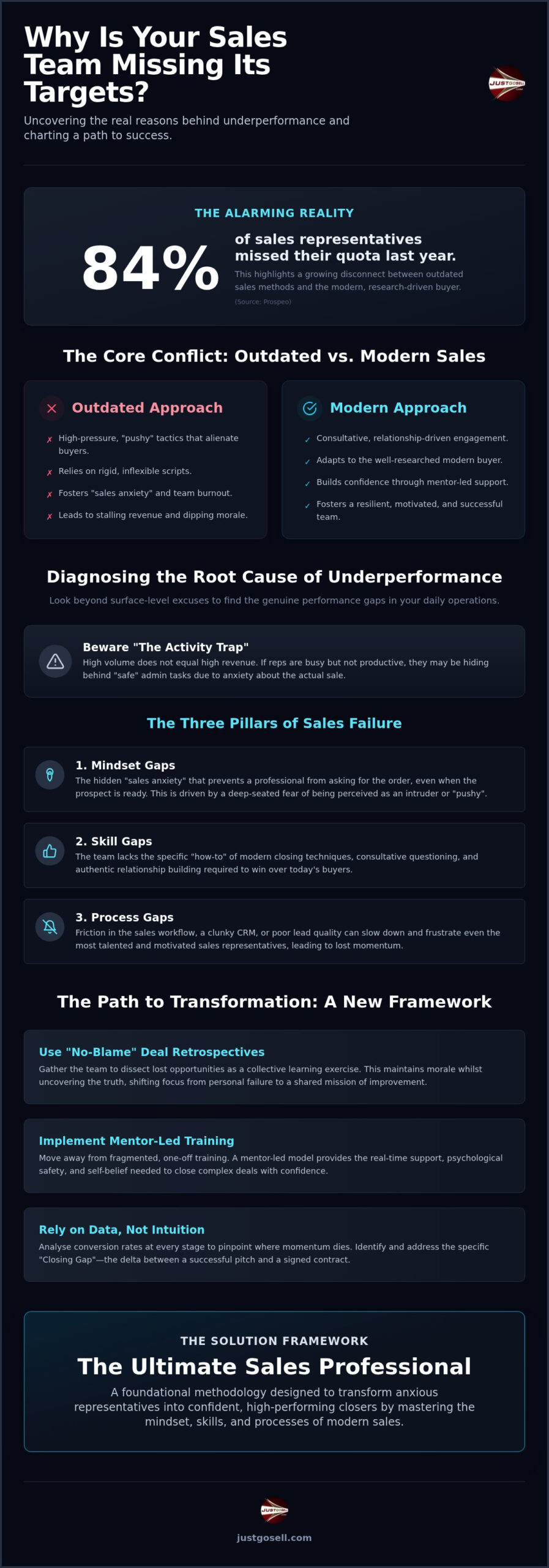
Did you know that 84% of sales representatives surveyed reported missing their sales quotas in 2023, according to Salesforce’s State of Sales, 6th Edition (2024)? It is a staggering figure from Prospeo that highlights a growing disconnect in the modern marketplace. If you are currently asking why our sales team is not hitting targets despite high activity levels, it is rarely a lack of effort. More often, it is a symptom of outdated, high-pressure methods clashing with a buyer who prefers to do their own research. You might see revenue stalling whilst your team’s morale dips, leaving everyone feeling anxious about being too "pushy" or "salesy".
We understand the frustration of watching a talented team struggle with the psychological barriers of rejection. You want a group that feels empowered and confident, not one that is burnt out by a rigid script. In this guide, we will uncover the structural gaps holding your people back and show you how a mentor-led approach can transform your results. You will discover a clear diagnostic framework to identify performance issues and learn how to foster the authentic behaviour that leads to higher closing rates and a more resilient, motivated team.
Key Takeaways
- Identify the true root causes of underperformance by using a “no-blame” deal retrospective that uncovers structural gaps whilst maintaining team morale.
- Uncover the psychological reasons why our sales team is not hitting targets, including the impact of “sales anxiety” and the fear of appearing too pushy.
- Learn why rigid, scripted sales frameworks are failing with modern buyers and how to pivot towards a relationship-driven, consultative approach.
- Discover the power of a mentor-led training model to provide your team with the real-time support and self-belief needed to close complex deals.
- Gain a clear roadmap for transforming anxious reps into confident closers through “The Ultimate Sales Professional” foundational methodology.
Beyond the Excuses: Diagnosing Why Your Sales Team Is Not Hitting Targets
Identifying the real reason why our sales team is not hitting targets often feels like trying to solve a puzzle with missing pieces. It’s easy to blame a sluggish economy or a sudden shift in the market, but these factors are often used as shields for internal fractures. Whilst market barriers are real, they affect every player in your industry. The difference between a team that thrives and one that stalls usually lies in how they adapt to those barriers. You need to look past the surface-level excuses to find the genuine performance gaps hiding in your daily operations.
A powerful way to begin this journey is through a "no-blame" deal retrospective. Instead of pointing fingers at individuals, gather the team to dissect lost opportunities as a collective learning exercise. Ask yourselves: where did the connection break? Was it a lack of rapport or a failure to address a specific objection? This approach maintains morale whilst uncovering the truth. It shifts the focus from personal failure to a shared mission of improvement, creating a safe space for reps to be honest about where they felt stuck.
Many managers fall into "The Activity Trap". They see a CRM full of logged calls and sent emails and assume results will follow. However, high volume doesn’t always lead to high revenue. If your reps are busy but not productive, they might be hiding behind "safe" activities like admin or low-value follow-ups because they’re anxious about the actual sale. You must evaluate whether the leak in your bucket is due to poor lead quality or, more commonly, ineffective lead handling.
The Three Pillars of Sales Failure
To fix the problem, you must categorise the failure into one of three pillars. First are Skill gaps, where the team lacks the specific "how-to" of modern closing and relationship building. Second are Process gaps. This often involves understanding sales operations and how friction in your CRM or workflow can slow down even the most talented reps. Finally, there are Mindset gaps. This is the hidden "sales anxiety" that prevents a professional from asking for the order, even when the prospect is ready to buy.
Data vs. Intuition: Using Metrics to Spot the Root Cause
Relying on gut feeling is dangerous. You should analyse conversion rates at every stage of your professional selling process to see exactly where the momentum dies. Is the issue at the "top of the funnel", meaning leads aren’t being contacted quickly enough? Or is it at the "bottom of the funnel", where the pitch is excellent but the deal never crosses the line? We define the Closing Gap as the delta between a successful pitch and a signed contract. Identifying this specific gap allows you to apply targeted 1-to-1 Sales Coaching to help underperforming stars find their rhythm again and reclaim their confidence.
The Mindset Gap: How Sales Anxiety and ‘Pushy’ Stereotypes Stifle Performance
We’ve explored the structural pillars, but often the most stubborn barrier is invisible. When you investigate why our sales team is not hitting targets, you’ll frequently find "Sales Anxiety" lurking beneath the surface. This isn’t just a bit of pre-call nerves; it’s a deep-seated fear of being perceived as an intruder. It manifests as hesitation, over-explaining, or failing to ask for the order. This behaviour isn’t a lack of talent. It’s a psychological response to the pressure of performance that can paralyse even the most capable individuals.
The "Wolf of Wall Street" stereotype has done more damage to the sales profession than almost anything else. It suggests that to be successful, one must be aggressive, manipulative, and loud. Many of your best people, especially those who value integrity and relationship-building, are subconsciously afraid to sell because they don’t want to become that caricature. They pull their punches because they don’t want to be "that person". This internal conflict creates "weak" pitching amongst even your most experienced staff, where the rep sounds apologetic for taking up the prospect’s time.
If you’re still puzzled about why our sales team is not hitting targets, it’s time to look at the psychological cost of fragmented training. If a rep receives a collection of random tips rather than a solid foundation, they never feel like a master of their craft. This lack of certainty translates directly into lost deals and falling revenue. If you’re ready to see how your team can shift their perspective and find their voice, you might want to chat about a more supportive approach.
Overcoming the Fear of Being ‘Salesy’
We need to reframe the entire conversation. Sales isn’t about "convincing" someone to part with their money; it’s about helping them solve a problem. When a rep truly believes their product will improve the buyer’s life, the anxiety begins to dissolve. A mentor-led culture provides the safety net needed to practice this new mindset without the fear of judgment. For those starting this journey, these Essential Sales Mindset Tips offer a brilliant starting point for foundational shifts.
Building Self-Belief in Your Selling Ability
Whilst product knowledge is essential, it simply isn’t enough on its own. A rep can know every technical specification, but if they don’t believe they deserve the win, they will struggle to close. Self-belief is built through consistent, positive communication and authority-building exercises that allow the individual’s character to shine through. We use 1-to-1 Sales Coaching to dig into these individual psychological blocks and build a foundation of mastery. It’s about moving from a state of insecurity to one of professional confidence, where the rep feels like a peer to the decision-maker rather than a subordinate.
Analysing the Process: Is Your Sales Framework Outdated for 2026?
If your current framework feels rigid, it’s likely because it was designed for a different era. In 2026, buyers are more independent and well-informed than ever before. Research from Gartner found that B2B buyers spent just 17% of their purchasing time meeting potential suppliers, compared with 27% researching independently online (2017). More recent Gartner research (2026) reveals that 67% of B2B buyers prefer a sales experience without representatives. This growing preference for independent purchasing helps explain why sales teams struggle to hit targets when they rely on outdated, high-pressure tactics rather than building trust, understanding customer needs and delivering genuine value. To succeed now, you must organise a process that prioritises effective communication and genuine connection over robotic efficiency.
Savvy buyers can sense a script from the first sentence. When a rep follows a linear, robotic path, they fail to adapt to the customer’s unique character. This kills conversion rates because it removes the human element from the transaction. Moving from transactional selling to relationship-driven consultation isn’t just a "nice to have" anymore; it’s a commercial necessity. You need a process that feels natural whilst remaining scalable across your entire organisation. It’s about creating a culture where the rep is a trusted advisor rather than a persistent vendor.
Traditional Scripts vs. Conversational Selling
The old way of selling relied on "pushy" closing techniques that often forced a prospect into a corner, leading to buyer’s remorse or ghosting. Today, we focus on a discovery-led approach that builds self-belief in the rep and trust in the buyer. Our flagship methodology, The Ultimate Sales Professional, teaches reps to focus on the person, not just the pitch. By building rapport first, you earn the right to ask for the sale. If you want to see how this looks in practice, explore The Professional Selling Process for a modern framework that builds trust from the very first hello.
Discovery Calls: Where Most Targets Are Actually Lost
Many managers wonder why our sales team is not hitting targets when their pitches sound perfect on paper. The answer often lies in the "Discovery Gap". This happens when reps rush to the pitch before they truly understand the prospect’s pain. They focus on features because they are afraid of the silence that comes with deep, diagnostic questioning. You must teach your team to ask the "uncomfortable" questions regarding budget and decision-makers early on. This ensures your sales pitch strategy aligns perfectly with the customer’s specific journey rather than being a generic presentation. It’s about uncovering the truth, even if that truth is that the prospect isn’t a good fit right now.

Practical Strategies to Re-energise Your Team and Reclaim Your Revenue
Once you’ve peeled back the layers to understand why our sales team is not hitting targets, you need a concrete roadmap for recovery. It isn’t enough to simply know what is wrong; you have to actively change the environment in which your reps operate. Start by auditing your current training culture. If your development consists of one-off seminars that occur once a year, the knowledge will inevitably evaporate. You need a continuous culture of learning where skills are refined daily rather than in a single, overwhelming burst.
A mentor-led approach is the most effective way to provide real-time support for tricky deals. Whilst some competitors suggest running a deal retrospective for every single lost opportunity, this can be incredibly time-consuming for smaller teams and often feels like a post-mortem. It’s far better to have a mentor available to guide the rep whilst the deal is still live. This proactive support builds self-belief and ensures that individual character isn’t lost to a rigid process. By customising the sales framework to suit the person, you allow their natural strengths to shine through, making the entire process feel more authentic to the buyer.
To break a cycle of missed targets, you must focus on "Confidence-Building Wins". This involves setting smaller, achievable milestones that allow the team to feel the excitement of progress again. If you’re struggling to find an objective view of your internal team dynamics, leveraging external expertise can provide the fresh perspective needed to spot hidden friction. If you’re ready to start this transformation, you can book a strategy call to discuss your specific challenges.
Custom Sales Workshops vs. Generic Courses
"Off-the-shelf" training often fails because it doesn’t account for your specific market challenges or unique revenue drivers. Generic courses might teach the "what" of selling, but they rarely address the "how" within your specific industry context. Tailored Team Sales Training provides a much higher ROI because it focuses on the actual hurdles your reps face every day. This bespoke approach ensures the team isn’t just learning theory but is gaining practical tools they can use in their very next call.
Individual Coaching for High-Potential Underperformers
Sometimes, a rep’s pitch is "90% there" but they are consistently missing the close. This is where 1-to-1 Sales Coaching becomes invaluable. Personalised feedback is the bridge between a manager’s order and a coach’s guidance. It allows for a deep dive into the specific psychological blocks or communication habits that are holding back a high-potential individual. By encouraging a positive mindset through consistent, small-scale victories, you help them reclaim their authority and move toward becoming a confident closer.
Transforming Performance Through ‘The Ultimate Sales Professional’ Framework
We have spent time dissecting the structural and psychological reasons why our sales team is not hitting targets. Now, it is time to focus on the transformation. The Ultimate Sales Professional framework provides a foundation rooted in relationship-building and effective communication. This isn’t about learning a new set of tricks; it is about adopting a methodology that removes the internal friction that leads to stalled deals. By following my approach, your reps move from being hesitant to being authoritative partners in the buyer’s journey. It allows them to find their own voice whilst maintaining a standard of excellence that buyers respect.
Securing your 2026 revenue requires an immediate investment in your team’s mindset. The landscape is moving away from the "hard sell", and those who fail to adapt will find themselves left behind. To ensure long-term success, we provide access to our video training modules. This is a vital asset for consistent team onboarding, ensuring that every new hire understands your specific sales culture from day one. It stops the "fragmented information" trap we discussed earlier and ensures that everyone is working from the same high-quality playbook. This consistency is what shifts a team from a state of anxiety to one of professional mastery.
A Scalable Solution for Entrepreneurs and Teams
Whether you are a solo entrepreneur or leading a growing department, this framework is designed to be a scalable standard of excellence. By reducing sales anxiety across the board, you create a more resilient team culture that is better equipped to handle rejection and complex negotiations. It is about building a foundation of self-belief that translates into every call and meeting. If you are ready to reset your foundations and empower your people, you can get started with The Ultimate Sales Professional Course today.
Next Steps: Personalised Support for Your Sales Journey
Every business faces unique challenges, and a generic solution is rarely enough to fix deep-seated performance gaps. To truly understand why our sales team is not hitting targets in your specific market, a strategy consultation can provide the objective clarity you need. We can help you identify the exact blockers holding your revenue back and suggest a tailored path forward. For your key players who need more intensive support, exploring 1-to-1 Sales Coaching can provide the personalised guidance needed to refine their pitch and reclaim their confidence. Don’t let another quarter slip away whilst your competitors gain ground. Take the first step toward mastery today and give your team the tools they need to succeed.
Reclaim Your Sales Momentum Today
Understanding why our sales team is not hitting targets is the first step toward a complete cultural shift. We’ve explored how to diagnose deep-seated performance gaps and why moving away from outdated, pushy stereotypes is essential for success in 2026. By focusing on non-pushy, high-conversion techniques, you allow your team’s individual character to shine through whilst maintaining professional authority. It’s about moving from a state of performance anxiety to one of quiet confidence.
Our mentor-led approach replaces generic scripts with authentic communication and relationship-building. Whether you need customised workshops for global teams or targeted support for individual reps, the focus remains on building self-belief and mastery. Book a 1-to-1 Sales Coaching session to fix your team’s blockers today and start seeing the results your hard work deserves. You’ve already done the hard part by identifying the need for change. Now, let’s build the foundation for your team to truly excel and reclaim your revenue growth with pride.
Frequently Asked Questions
What are the most common reasons sales teams miss their targets?
Common reasons include a disconnect between sales tactics and buyer behaviour. If you’re wondering why our sales team is not hitting targets, it often boils down to "pushy" stereotypes that create internal anxiety. When reps feel they have to convince rather than help, they hesitate. This leads to missed opportunities and falling revenue, especially amongst teams still using linear funnels in a market that has moved toward independent research and relationship-building.
How can I tell if my sales targets are unrealistic or if my team is underperforming?
Look for patterns in your data compared to industry benchmarks. If your entire team is missing the mark, your quotas might be disconnected from current market reality or lead quality. However, if there is a wide delta between your top performers and the rest, you likely have an internal performance gap. Analysing conversion rates at each stage reveals whether the issue is lead volume or ineffective closing techniques.
Is it better to retrain an underperforming sales team or hire new reps?
Retraining is almost always the more cost-effective and empowering choice. Replacing staff is expensive and disruptive to team morale. Many reps who appear to be underperforming are actually just struggling with sales anxiety or outdated scripts. Providing them with a supportive, mentor-led foundation can transform an "average" rep into a confident closer whilst preserving the valuable institutional knowledge and relationships they have already built.
How do I fix a sales team that has lost its motivation and confidence?
You must break the cycle of constant rejection by focusing on small victories. Start by celebrating non-revenue wins, such as a great discovery call or a well-handled objection. Shifting to a relationship-driven approach reduces the stress of "selling" and makes the process feel more natural. When reps feel understood and supported by leadership, their self-belief returns, which is the true engine of high performance.
Can sales anxiety be cured through training, or is it a personality trait?
It is a psychological barrier that can be overcome with the right training; it isn’t a permanent trait. Most sales anxiety stems from a fear of being perceived as intrusive or "salesy". Through mentor-led training, reps learn to reframe their role as a consultative problem-solver. This shift in perspective, combined with practical communication tools, allows even the most introverted individuals to lead calls with authority and ease.
What is the best way to handle a salesperson who is consistently missing quota?
Start with a "no-blame" diagnostic conversation to find the root cause of the issue. If you’re asking why our sales team is not hitting targets on an individual level, check for mindset blocks or a lack of real-time support. 1-to-1 coaching allows you to refine their specific pitch and address individual psychological hurdles, turning a struggling rep into a reliable asset without the need for a recruitment process.
How does relationship-based selling improve closing rates compared to traditional methods?
Relationship-based selling aligns with how people actually want to buy in 2026. Traditional methods often rely on pressure, which causes savvy buyers to retreat. By focusing on discovery and genuine connection, you earn the right to ask for the order. This consultative approach makes the final close feel like a natural next step rather than a confrontation, leading to much higher conversion rates and customer loyalty.
How much should I invest in sales training to see a real impact on revenue?
Focus on the quality and consistency of the training rather than just the initial cost. A one-off seminar rarely changes long-term behaviour. To see a genuine impact on revenue, invest in a programme that offers continuous support and lifetime access to resources. This ensures the methodology becomes part of your business’s DNA, providing a much higher ROI than generic, off-the-shelf courses that don’t address your specific challenges.


Article by
Colin Knowles
Sales Growth Consultant | Sales Director | Author | Founder: JustGoSell
With an extensive background in corporate sales training and team leadership, my role as Sales Trainer and Director at Just Go S.L. revolves around empowering sales professionals to excel. My approach has consistently fostered environments where sales teams surpass targets, thanks in part to my focus on effective sales processes and direct sales techniques.
At the core of my professional ethos lies the commitment to continual development and adaptation of sales strategies to stay ahead in a dynamic market. Through one-on-one coaching, group webinars, and the authorship of "JustGoSell," I have solidified my reputation as a catalyst for transformative sales results and an advocate for sustained sales skill advancement.