
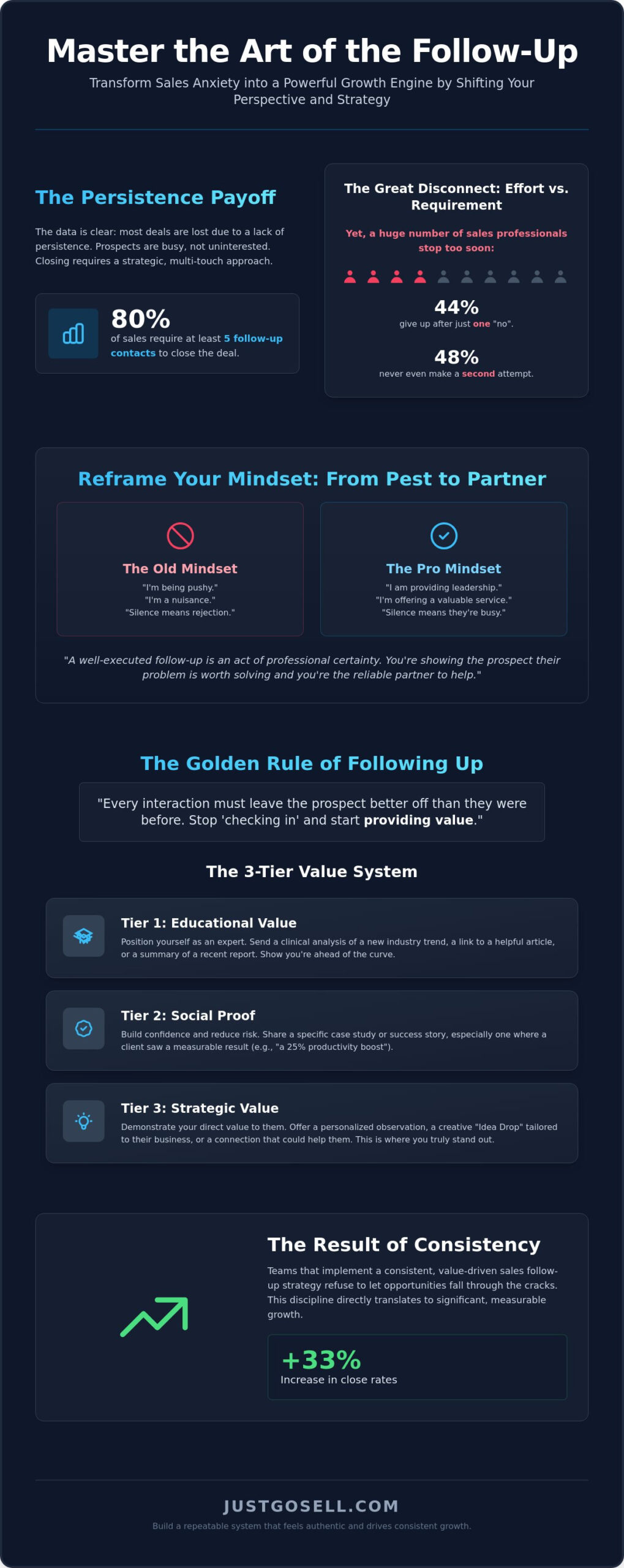
What if the reason those deals are stalling isn’t because you’re being too pushy, but because your prospects are actually waiting for you to lead the way? It’s a game-changing shift in perspective. Most home-based entrepreneurs hesitate because they fear rejection or feel like a nuisance. In fact, data from Invesp shows that 80% of sales require at least five follow-up contacts to close, yet 44% of sales professionals give up after just one "no." This lack of a structured sales follow-up strategy isn’t just a tactical error; it’s a major source of sales anxiety that keeps your business from reaching its full potential.
You deserve to feel empowered and professional every time you hit send. We’re going to transform your approach from a source of dread into a fantastic, value-driven engine for consistent growth. This article promises to show you how to build a repeatable system that feels authentic to your unique personality. We will dive into out of the box methods to stay top-of-mind, increase your conversion rates, and ensure you never feel like a boiler room stereotype again.
Key Takeaways
-
Reframe your mindset to see persistence as an act of leadership that provides clarity and professional certainty to your busy prospects.
-
Discover how to build a value-driven sales follow-up strategy by applying the "Golden Rule" of providing new insights in every interaction.
-
Learn to choose communication channels that align with your unique personality, ensuring your outreach feels authentic rather than forced.
-
Uncover "out of the box" techniques like the "Idea Drop" to grab attention and prove your value without ever feeling pushy.
-
Transform sales anxiety into a professional engine for growth by integrating these repeatable, high-impact habits into your daily routine.
Table of Contents
-
The Psychology of the Follow-Up: Why Persistence is a Professional Service
-
Scaling Your Strategy with the Ultimate Sales Professional Mindset
The Psychology of the Follow-Up: Why Persistence is a Professional Service
Many entrepreneurs experience a specific kind of internal resistance when they think about reaching out to a prospect for the third or fourth time. This sales anxiety often stems from the fear of being a "nuisance." It’s time to flip that script. A well-executed sales follow-up strategy is actually an act of professional certainty and leadership. When you stop following up, you aren’t being polite; you’re essentially telling the prospect that their problem isn’t worth solving or that your solution isn’t worth the effort. It’s about moving from a place of insecurity to a place of service.
Silence from a prospect rarely translates to a rejection. Data from various CRM studies indicates that it takes an average of five follow-up attempts to close a deal, yet 48% of sales professionals never even make a second attempt. In most cases, your contact is simply one of the millions of professionals dealing with an average of 121 emails per day. They’re busy, not disinterested. By staying present, you help them cut through the noise and stay focused on the goals you discussed during the sales process. This consistency proves your business is healthy and that you have the clinical discipline to see things through.
Overcoming the Fear of Being Pushy
The difference between being persistent and being aggressive lies in your intent. Aggression is about your need to hit a quota. Persistence is about your desire to help the prospect achieve a specific result. If your solution is truly game-changing, then walking away after one "maybe" is a disservice to the person you’re trying to help. Professional follow-up is a commitment to the client’s success that ensures their needs remain a priority even when life gets in the way.
The Value of Professional Certainty
Your follow-up frequency acts as a signal for the quality of service a client can expect after they sign the contract. If you’re proactive and organized during the "chase," they’ll trust you to be just as diligent during the delivery. A gentle nudge isn’t pestering; it’s a reminder that you’re a reliable partner ready to provide a fantastic experience. This tactical persistence builds a foundation of trust before a single dollar changes hands. It shows you’re an "Ultimate Sales Professional" who values the relationship enough to keep it moving forward. High-performing teams who use a consistent sales follow-up strategy see a 33% increase in their close rates because they refuse to let opportunities fall through the cracks.
-
Follow-up is leadership, not begging.
-
Silence usually means the prospect is overwhelmed, not annoyed.
-
Consistency signals a high-quality service level.
-
Overcoming sales anxiety is the first step toward financial success.
Building a Value-Driven Follow-Up Framework
Stop "checking in." It’s a phrase that triggers instant resistance and makes you sound like every other salesperson cluttering an inbox. Your sales follow-up strategy shouldn’t feel like a chore for you or a nuisance for your prospect. The Golden Rule is simple: every interaction must leave them better off than they were before they opened your message. If you aren’t providing new value, you’re just adding to the noise. By mapping your touches to their specific journey, you move from being a vendor to a trusted partner.
Successful entrepreneurs know that high-ticket sales aren’t won through persistence alone; they’re won through relevance. You need to bridge the gap between their current "sales anxiety" and the financial success they crave. This requires an out of the box approach that prioritizes their needs over your quota. When you lead with helpfulness, the pressure vanishes for both parties.
The 3-Tier Value System
I recommend using a structured 3-Tier Value System to ensure your outreach remains game-changing rather than annoying. This tactical framework keeps your communication fresh and professional:
-
Tier 1: Educational Value. Send a clinical analysis of a new industry trend or a link to a helpful article. This positions you as an expert who stays ahead of the curve.
-
Tier 2: Social Proof. Share a specific case study where you achieved a 25% or higher productivity boost for a client in a similar niche. Success stories build confidence.
-
Tier 3: Strategic Value. This is where you get creative. Offer a personalized observation or an out of the box idea tailored specifically to their business model.
Using these tiers helps you maintain a dynamic presence. You’re no longer asking for their time; you’re giving them insights that could transform their results.
Timing and Cadence: The Science of Staying Top-of-Mind
Timing is clinical. You must hit the 24-hour window for post-meeting follow-ups while the emotional momentum is still high. There is research-based evidence showing that the window of opportunity for lead engagement drops significantly after just a few hours. If you wait 48 hours, you’ve already lost the "warmth" of the initial connection.
For high-ticket service sales, the Rule of 7 is your benchmark. Data from sales process studies indicates that 80% of major deals require at least five to seven touchpoints after the initial meeting. Spacing these interactions is vital to avoid fatigue. Try a sequence like Day 1, Day 4, Day 8, and Day 15. This rhythm maintains momentum without being overbearing. If you’re struggling to find your rhythm, you can overcome sales anxiety by focusing on the foundation of your process rather than the fear of rejection. This personality-based approach ensures you remain an Ultimate Sales Professional (USP) throughout the entire journey.
Choosing Your Channels: Matching Strategy to Personality
Your sales follow-up strategy shouldn’t feel like a rigid script or a robotic sequence. It’s a bridge between your personality and your prospect’s preferences. If you’re naturally a conversationalist, the phone might be your strongest asset. If you prefer precision and data, email allows you to shine. The key is to stop trying to fit into a "one-size-fits-all" mold and start using the channels that feel authentic to you.
The "Omnipresent" approach is a game-changer for building trust. Research from the Bridge Group shows that high-growth companies use an average of 8 touches across multiple channels to secure a meeting. Relying on a single channel is risky. If you only send emails, you’re competing with the 121 business messages the average professional receives daily. By mixing email, phone calls, and social media, you increase your visibility without becoming a nuisance. It’s about being present, not persistent. Transitioning between these channels should feel like a natural conversation. If you leave a voicemail, follow up with a quick LinkedIn message saying you’ve left a detailed thought in their inbox. This creates a cohesive experience rather than a series of disjointed interruptions.
Mastering the Personalised Email
Email is the foundation of most outreach, but it’s easy to get lost in the noise. To stand out, keep your messages digestible. Data from Boomerang indicates that emails between 50 and 125 words receive a 50% higher response rate than longer ones. Your subject line is your gatekeeper. Avoid "Checking in" or "Following up." Instead, use specific hooks like "Idea for your [Project Name]" or "Question about [Specific Goal]." If you want to add a human touch, record a 30-second Loom video. Seeing your face and hearing your voice instantly reduces "sales anxiety" for both parties and builds a clinical level of rapport that text alone cannot achieve.
The Lost Art of the Follow-Up Phone Call
Many entrepreneurs feel a sense of dread when picking up the phone, but it remains the fastest way to get a definitive answer. The secret to a confident call is having a "reason for the call" that isn’t just asking for a sale. Focus on providing value or sharing a quick insight. If you hit a voicemail, keep it under 20 seconds. State your name, your number, and one specific reason you’re reaching out. Use LinkedIn as a "soft" channel to warm up these calls. Engaging with a prospect’s post or sending a brief connection request 24 hours before you call makes you a familiar name rather than a total stranger. This "out of the box" thinking turns a cold follow-up into a warm, professional interaction that leads to financial success.
5 "Out of the Box" Follow-Up Techniques That Close Deals
Traditional follow-ups often feel like a chore because they lack personality. If you want to transform your sales follow-up strategy, you need to move beyond the "just checking in" email. These five "out of the box" methods help you transition from a persistent salesperson to a trusted advisor.
-
The Relevant News Nudge: Share a specific update that impacts their world. For example, if your prospect is in a rapidly evolving industry, send a link to a recent report or analysis highlighting a key trend or challenge impacting their market. This demonstrates you’re paying attention to their industry’s specific landscape.
-
The Idea Drop: Send a creative suggestion for their business with no strings attached. You might suggest a specific headline for their landing page or a new lead magnet idea. This demonstrates your value before they’ve even paid you a penny.
-
Third-Party Validation: Don’t just send a generic testimonial. Send a case study that mirrors their exact pain point. If they worried about onboarding time, share how a similar client reduced setup from 30 days to 12.
-
The Handwritten Note: According to the Radicati Group, the average professional receives 121 emails per day. A physical card sent via post is rare. It creates a tactile connection that digital messages simply cannot match.
-
The Clean-Up Email: This is your professional "break-up" message. It’s designed to clear your pipeline and often triggers a "wait, don’t go" response from the prospect.
Implementing Creative Touchpoints
High-ticket sales coaching thrives on human connection, not robotic automation. You can’t automate trust. When you use "out of the box" thinking, you’re signaling that the prospect is worth your manual effort. For service-based entrepreneurs, a practical "Idea Drop" could be as simple as sending a 60-second Loom video explaining one way they could improve their current workflow. This tailored approach reduces sales anxiety because you’re leading with a gift rather than a request. It positions you as an Ultimate Sales Professional who cares about results.
If you want to stand out even more, you can explore Personalized Song Gift Sales to create a custom musical tribute for a key client, turning a standard professional interaction into a deeply personal connection.
The Art of the Professional Break-Up
There comes a point where continuing to chase a silent prospect hurts your productivity and your brand. In 2024, the most effective way to handle this is the "Permission to Close the File" template. You simply state that since you haven’t heard back, you assume their priorities have shifted and you’re closing their file to focus on other projects. This works because of loss aversion; people hate losing access to an opportunity. Even if they don’t buy now, this professional exit keeps the door open for future collaboration. You leave the relationship with your head high and your reputation intact.
Ready to stop guessing and start closing? Learn the exact steps to become an Ultimate Sales Professional and master your outreach today.
Scaling Your Strategy with the Ultimate Sales Professional Mindset
Mastering your sales follow-up strategy isn’t just about adding more tasks to your calendar. It’s about evolving your mindset to see every touchpoint as an opportunity to provide value. Data from the Brevet Group indicates that 80% of sales require at least five follow-up attempts, yet 44% of sales professionals stop after the first "no." Scaling your results requires you to integrate these follow-ups into a repeatable, clinical process that removes the emotional weight of rejection.
When you transition from a "seller" to a Trusted Partner, the dynamic changes. You’re no longer chasing a lead; you’re guiding a future client toward a solution. This supportive approach replaces sales anxiety with a sense of purpose. By focusing on a foundation of self-belief and tactical productivity, you create a system that works even when you’re not feeling 100% "on." It’s about building a professional rhythm that leads to long-term financial success.
For industrial and manufacturing entrepreneurs, this partnership approach is often facilitated by specialist firms like Co-Advisor, ensuring that sales efforts are backed by a robust, clinical growth strategy.
Developing Your Unique Sales Voice
Authenticity is your greatest asset in any follow-up sequence. Prospects can smell a canned script from a mile away, and it’s the fastest way to kill trust. We focus on "out of the box" communication that lets your personality shine through. This doesn’t mean winging it. It means tailoring your message so it feels like a real conversation between two humans. Learn more about our Sales Strategy Consulting to see how we help you ditch the rigid scripts for a voice that actually converts.
-
Move from high-pressure tactics to personality-driven dialogue.
-
Build rapport by being a human, not a corporate mouthpiece.
-
Use "if/then" logic to stay prepared for any prospect response.
-
Focus on "out of the box" creativity to stand out in a crowded inbox.
Your Journey to Sales Mastery
Continuous refinement is the difference between a one-hit wonder and a top-tier producer. You need a feedback loop to see where your sales follow-up strategy might be leaking leads. This is where 1-to-1 coaching becomes game-changing. It removes the guesswork and provides a clinical look at your specific pitch and productivity. Joining the Ultimate Sales Professional (USP) community gives you the tools to turn your "out of the box" ideas into a consistent revenue stream. Book a discovery session with me (Colin Knowles) to start refining your process and closing more deals with total confidence.
Transform Your Conversations Into Closures
Mastering your sales follow-up strategy isn’t about being a nuisance. It’s about becoming a resource. By shifting your mindset from pestering to providing value, you build the foundation for long-term financial success. Industry data from the National Sales Executive Association shows that 80% of sales require five follow-up contacts, yet 44% of professionals give up after just one attempt. You can bridge this gap by matching your communication channels to your unique personality and using creative, "out of the box" techniques that make you stand out from the noise.
If you’re tired of feeling sales anxiety every time you pick up the phone, it’s time for a tactical change. I founded Just Go Sell to empower entrepreneurs and non-sales people with clinical, effective methods that actually feel good to use. You don’t have to follow a rigid script to see amazing results. Instead, you can develop a process that feels authentic and supportive to your clients.
Master your follow-up and close more deals with the Ultimate Sales Professional course and start building the confidence you need to scale your business. You’ve got the talent; now let’s give you the framework to let it shine. We’re here to help you every step of the way.
Frequently Asked Questions
How many times should I follow up before giving up?
You should follow up at least 5 times before you consider moving on. Research from IRC Sales Solutions shows that 80% of sales require 5 follow-up contacts, yet 48% of sales reps never make a second attempt. Persistence is the foundation of an Ultimate Sales Professional. It’s not about being a nuisance; it’s about showing you’re a reliable partner who’s genuinely invested in their success.
What is the best time of day to send a follow-up email?
The best time to send a follow-up email is between 10:00 AM and 11:00 AM on Tuesdays or Thursdays. HubSpot analyzed 20 million emails and found these mid-week mornings produce the highest engagement rates. Sticking to this schedule helps reduce your sales anxiety because you’re using a clinical, data-backed approach. It ensures your message lands when your prospect is focused and productive rather than clearing out a Monday backlog.
How do I follow up after a prospect says "it is too expensive"?
When a prospect mentions price, shift the focus immediately to the long-term return on investment. Gartner reports that 53% of B2B buyers prioritize the specific value offered over the initial cost. Ask them what it’ll cost their company to leave the problem unsolved for the next 180 days. This out of the box strategy helps you act as a mentor, guiding them toward financial success rather than just defending a price.
Should I use automation for my sales follow-ups?
You should use automation for your initial outreach, but keep your deeper sales follow-up strategy personal and tailored. A successful approach uses a 70/30 split between automated reminders and manual, personality-based touchpoints. Automation ensures you don’t miss a beat with the 15 or 20 leads in your pipeline. Your personal voice is what bridges the gap between a cold lead and a loyal client, so don’t automate the human connection.
What should I do if a prospect goes completely silent (ghosts me)?
Send a short, value-heavy "re-engagement" message if a prospect hasn’t responded for 72 hours. Ghosting is often a sign of a prospect’s internal stress rather than a rejection of your offer. Provide a 2-minute video tip or a relevant case study from a 2023 project to restart the conversation. This low-pressure tactic provides immediate relief for their problems and keeps the momentum moving forward without you sounding desperate for a reply.
Is it okay to follow up on LinkedIn and via email at the same time?
It’s highly effective to use LinkedIn and email simultaneously to increase your visibility. Using a multi-channel approach can boost your response rates by 3.5 times compared to using email alone. You might send a tactical email with a proposal and then a quick LinkedIn note to mention it. This dynamic strategy shows you’re hardworking and adaptable, meeting the prospect in the digital space where they feel most comfortable.
How do I ask for a decision without sounding desperate?
Ask for a decision by tying the deadline to the prospect’s own goals and timeline. Instead of asking for a generic update, say that you need an answer by Friday to hit their target start date of November 1st. This clinical approach removes the emotional pressure from you and puts the focus on their results. It’s a game-changing way to lead the conversation as a trusted partner rather than a salesperson.
What is a "break-up" email and when should I use it?
A break-up email is a final message sent after your 7th attempt to let the prospect know you’re closing their file. This is a vital part of a professional sales follow-up strategy because it often triggers a 33% response rate from silent leads. It uses the psychological principle of loss aversion to get a final "yes" or "no." It’s a fantastic tool for maintaining your productivity and clearing your mind of stagnant opportunities.
With an extensive background in corporate sales training and team leadership, my role as Sales Trainer and Director at Just Go S.L. revolves around empowering sales professionals to excel. My approach has consistently fostered environments where sales teams surpass targets, thanks in part to my focus on effective sales processes and direct sales techniques.
At the core of my professional ethos lies the commitment to continual development and adaptation of sales strategies to stay ahead in a dynamic market. Through one-on-one coaching, group webinars, and the authorship of "JustGoSell," I have solidified my reputation as a catalyst for transformative sales results and an advocate for sustained sales skill advancement.

Article by
Colin Knowles
Sales Growth Consultant | Sales Director | Author | Founder: JustGoSell
With an extensive background in corporate sales training and team leadership, my role as Sales Trainer and Director at Just Go S.L. revolves around empowering sales professionals to excel. My approach has consistently fostered environments where sales teams surpass targets, thanks in part to my focus on effective sales processes and direct sales techniques.
At the core of my professional ethos lies the commitment to continual development and adaptation of sales strategies to stay ahead in a dynamic market. Through one-on-one coaching, group webinars, and the authorship of "JustGoSell," I have solidified my reputation as a catalyst for transformative sales results and an advocate for sustained sales skill advancement.